ゆっくり歩きたい中国の古鎮10選
Over the course of one year, this writer visited more than twenty ancient towns across China. Frankly, many have been over-commercialized — streets lined with wholesale tourist trinkets from Yiwu, every storefront fronted by the same stinky tofu fryer. Yet some places remain where, pushing open a wooden door of a riverside old house and finding an eighty-year-old grandmother washing vegetables in the courtyard, you suddenly feel time decelerating.
The following ten are my genuine recommendations after filtering — with a single criterion: once you walk in, you won’t want to pull out your phone to check the time.
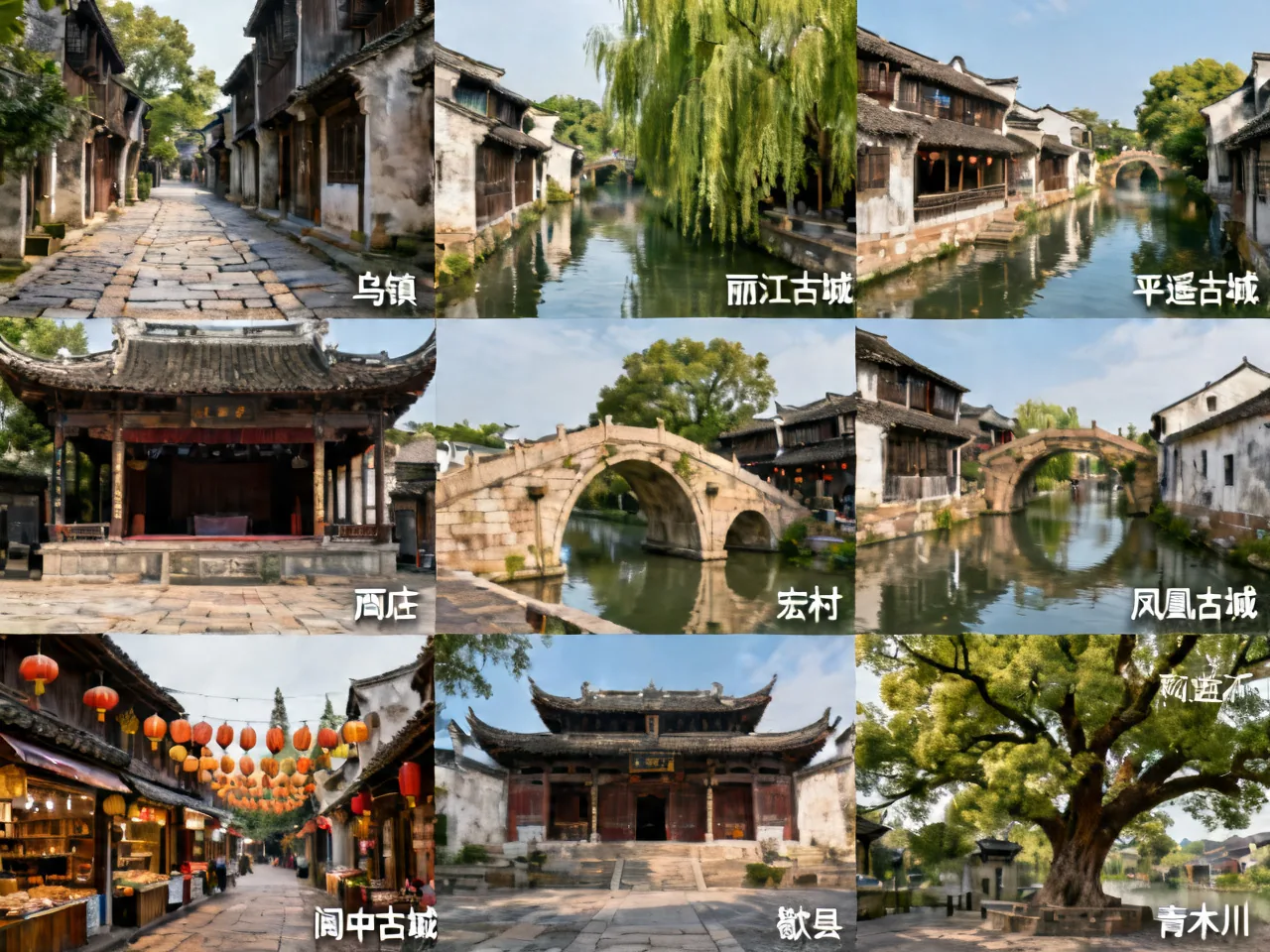
Wuzhen’s East Gate and West Gate are two different experiences. East Gate is free before 6 AM and walkable in an hour or two; West Gate is where you stay the night. Guesthouses line both sides of the canal, every window facing water. At night, lanterns glow along the river and the whole town transforms into a slightly unreal painting. I stayed at a place called “In the Mood for Love” — no AC, just a ceiling fan whirring, woken at midnight by frogs, opening the window to see moonlight pooled on the stone bridge.
How to get there: High-speed rail from Shanghai/Hangzhou to Tongxiang station (30–60 min), then bus K282 directly to the town.
Most people spend half a day at Hongcun taking photos and leave. This is a mistake. Hongcun’s real treasure isn’t the South Lake reflection that’s been photographed millions of times — it’s the deserted alleys deep inside the village. I found an old gentleman practicing calligraphy outside his door in a completely empty lane. He invited me to sit and drink tea, and we talked all afternoon about four hundred years of clan history. That kind of experience is something drive-by sightseeing will never deliver.
Accommodation tip: Stay in a converted Hui-style old house guesthouse inside the village, 200–400 yuan/night. Wake at 5–6 AM and the South Lake belongs to just you and a few elderly morning exercisers.
The stilted houses along the Tuojiang River are indeed filled with bars and shops during the day, but if you step out at 4 or 5 AM, the entire ancient city is silent. Thin mist floats over the river, and occasionally an early-rising fisherman paddles by on a bamboo raft. The Fenghuang that Shen Congwen wrote about only appears during this window.
Key tip: About 5.5 hours by bus from Changsha (or high-speed rail to Huaihua then transfer). The ancient city itself isn’t large — one day is enough to walk it, but an extra night is worth it to see both the dawn and the nightfall extremes.
Xizhou’s Bai-ethnic tie-dye is still alive in the hands of grandmothers in the alleys — not the performative kind in tourist zones, but an old woman actually dyeing a tablecloth for a neighbor. The screen walls and upturned eaves of Bai residences are among the most exquisite in Chinese vernacular architecture. I interviewed an elderly Xizhou architect who said: “Our Bai houses follow the ‘three wings and one screen wall’ pattern — every wall faces Cangshan Mountain. It’s not design; it’s a rule that’s been alive for centuries.”
How to get there: 18 km north of Dali Old Town, 40 minutes by electric scooter. Renting an e-bike is the single best transport decision in Dali.
The Wuyang River runs through the center, flanked by Ming-Qing Hui-style buildings — yes, the architecture here looks almost identical to Anhui’s, because large numbers of Anhui merchants settled here during the Ming Dynasty. At night, sit by the river eating sour soup fish (a Guizhou specialty), a whole fish for just 40–50 yuan, while the man at the next table drinks homemade rice wine. No bar street, no light show — just a small city living its normal life.
Transport: High-speed rail from Guiyang to Zhenyuan takes just 1.5 hours — very convenient.
Nestled between Wuzhen and Xitang, Nanxun has been squeezed into “invisible.” But those who’ve visited all three almost always say the same thing: Nanxun is the best. Because it’s quiet. Because original residents still live there. Because those grand silk merchant mansions aren’t museums — in the alleys next door, people are still cooking, playing cards, drying quilts. I sat outside Xiao Lianzhuan garden for an hour; only three groups of tourists passed. Same time slot in Wuzhen? Probably three hundred.
I include it here because: if you’re going to visit just one ancient city to understand Chinese commercial and financial history, Pingyao is your only choice. China’s first draft bank (equivalent to a modern bank), “Rishengchang,” is right here. Walking in and seeing the accounting room, vault, and coded cipher system will give you an entirely new appreciation for the Chinese business mind.
Best season: Winter. Snow on the city walls, fewest tourists, the ancient city looks most like an ancient city.
A thousand-year-old town hanging on a waterfall — this isn’t a metaphor. The main street is built right beside the cascade; walking along it, you feel the mist on your face. A bowl of rice tofu made this town famous (from the movie “Hibiscus Town” starring Liu Xiaoqing), but what truly stays with you is the sensation of being enveloped by the sound of water. Sleep in a guesthouse overlooking the falls with the window open — the white noise is all water. I’ve never slept that well anywhere else.
900-year-old flagstone streets are still in use. Not the “restored to look old” kind — the kind where tractors actually drive over them. Massive ancient banyan trees grow out of cracks in stone walls, roots and masonry indistinguishable. At night there are no streetlights, just the glow from guesthouses and a sky full of stars.
Best for: People who genuinely want to disconnect and zone out. Cell signal comes and goes (this is a feature, not a bug).
Lùzhí is only 25 km from Suzhou city center, but tourist volume is roughly one-tenth of Zhouzhuang. It’s especially bridge-rich — reportedly once home to 72 and a half bridges, with over 40 still standing. I sat for a long time on a small unnamed stone bridge, someone washing clothes in the water below, pingtan (Suzhou-dialect storytelling) drifting from an old house window across the canal. In that moment, all check-in anxiety evaporated.
One last word: The biggest mistake at ancient towns is rushing the itinerary. If you cram three towns into two days, all you’ll see is ticket booths and souvenir shops. Pick one, stay two nights, forget all travel guides, just wander. That’s the right way to open them.
Related Reads
- 10-Day East China Five-City Loop
- Lijiang Old Town: Naxi Culture & Snow Mountain Views
- Zhangjiajie Glass Bridge & Tianmen Mountain Guide
- Guilin Li River Scenic Tour Complete Guide
- Spring Bloom Map: China’s Most Beautiful Flower Fields