Lijiang Old Town: Naxi Culture & Snow Mountain Views
Lijiang is the kind of place that makes you want to cancel your return ticket. Ancient Naxi culture, the dramatic sweep of Jade Dragon Snow Mountain, and the living pulse of Sifang Square — this guide takes you deep into every corner of Lijiang, from cobblestone alleys to glacier peaks.
First Impressions of the Old Town
Arriving in Lijiang at dusk is one of the best travel decisions I’ve ever made. The moment the taxi crosses from the new city into the old town entrance, the cobblestone rumble beneath the wheels signals a shift in time. No cars here — just foot traffic, the occasional mule train, and the distant sound of “The Moon Represents My Heart” drifting from a bar down the lane. The air carries a mix of Naxi spices, burning wood, and something harder to name — maybe just the smell of centuries.
Lijiang Old Town (Dayan Ancient Town) was built in the late Song and early Yuan dynasties, over 800 years ago, and was designated a UNESCO World Heritage Site in 1997. Three rivers — the Yu, Zhong, and Xi — thread through the town, earning it the nickname “Highland Water City.” Around 6,000 households still live here, mostly Naxi people, which keeps the place feeling genuinely inhabited rather than merely preserved for tourists.
Sifang Square: The Heart of the Old Town
Sifang Square is the beating heart of Lijiang Old Town. Every morning around 6 AM, while most tourists are still asleep, elderly Naxi women gather here to dance the traditional Guozhuang circle dance. Dressed in dark blue-and-black Naxi costumes, they hold hands and move to rhythms that predate the town itself. Their faces carry the kind of easy joy that no amount of tourist infrastructure can manufacture. This scene moved me more than any ticketed attraction.
The square is ringed by shops and teahouses selling everything from Naxi silverwork and Dongba script paintings to Pu’er tea and yak jerky. My honest advice: don’t shop on the main streets around Sifang Square — prices are inflated for foot traffic. Walk two or three alleys deeper into the old town and find the low-key shops where the owner is sitting in the sun out front. A pair of handmade silver earrings costs 280 yuan on the main drag; the old silversmith two alleys back charges 120 yuan and does finer work.
Naxi Culture: Dongba Script & Mu Fu Palace
The Naxi people’s Dongba script is the world’s only pictographic writing system still in active use — often called “a living fossil of writing.” In the old town, the Dongba Culture Research Institute (free entry, north side of the old town) has a comprehensive exhibition of Dongba classics. For 50–80 yuan, you can commission a Dongba practitioner to write your name or a blessing in this ancient script — a far more meaningful souvenir than anything sold in the tourist shops.
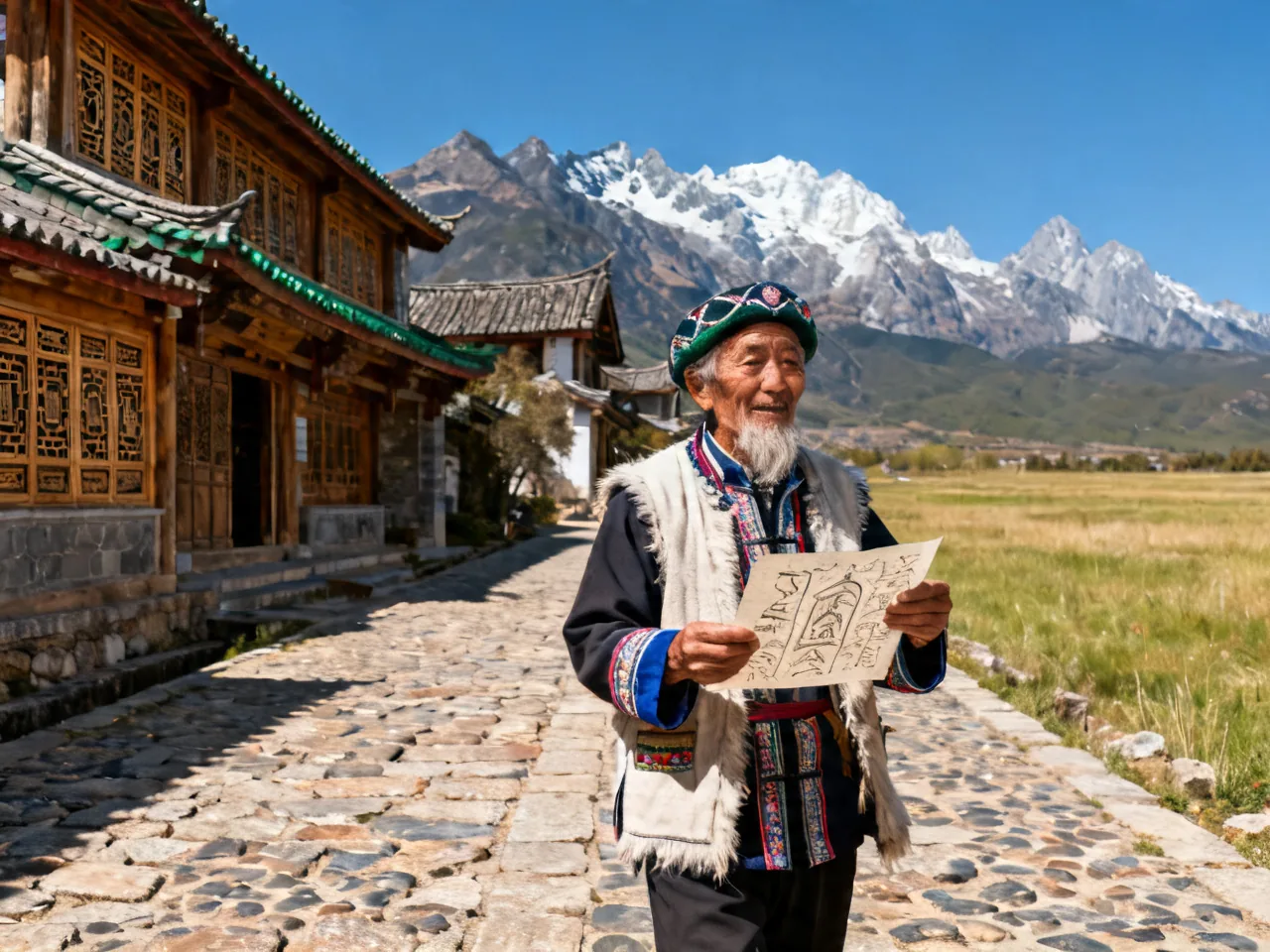
Mu Fu Palace was the official residence of the Mu clan, the Naxi tusi (hereditary chieftains) who ruled Lijiang for generations. Built in 1382 and expanded through the Ming and Qing dynasties, it covers 46 mu of land and is often described as “the Forbidden City of the South.” Admission is 60 yuan; open 8:30 AM–5:30 PM. The architecture blends Han, Tibetan, and Naxi styles, with particularly fine carved beams and well-preserved painted murals in the Council Hall and Wanjuan Tower. The viewing platform behind the palace offers one of the best free panoramas in the old town — rooftops stretching to the horizon, with the outline of Jade Dragon Snow Mountain beyond.
Jade Dragon Snow Mountain: Awe Above the Clouds
Jade Dragon Snow Mountain rises to 5,596 meters — the southernmost major snow mountain in the Northern Hemisphere and the sacred mountain of the Naxi people. From Lijiang Old Town, tourist buses take about 45 minutes (around 20 yuan), or a taxi runs 80–100 yuan. Entry requires a park ticket (105 yuan) plus an eco-bus ticket (around 80 yuan). The large cable car to the glacier costs 230 yuan; the mid-mountain cable car to Spruce Meadow is 90 yuan; the small cable car to Baishui River is 55 yuan.
I strongly recommend booking the large cable car tickets online in advance — during peak season (March–October) on-site tickets regularly sell out. The cable car terminus sits at 4,506 meters, and the altitude hits you the moment you step off: a slight heaviness in the head, a reminder to breathe more deliberately. But when you reach the viewing platform, the world opens into blue and white — deep azure crevasses in the glacier like veins in the earth, distant peaks catching metallic light, clouds wrapping the mountainside and parting to reveal that permanent white. No photograph captures even a tenth of it.
Shuhe Ancient Town: Lijiang’s Quieter Side
If Dayan Old Town is Lijiang’s main stage, Shuhe Ancient Town is its back garden. Shuhe sits about 4 km from Dayan — a 15-yuan taxi ride or a 30-minute bike ride on a shared bicycle. It’s part of the same UNESCO World Heritage listing but sees far fewer visitors and far less commercial pressure.
The highlight of Shuhe is Qingquan Park — a pool of startlingly clear spring water surrounded by century-old willows and Naxi courtyard houses. Sit on a stone bench by the water, order a cup of Naxi roasted tea (about 15 yuan), watch the ducks, watch the old men playing chess in the shade. Time genuinely slows here. Shuhe is also the historical birthplace of Lijiang’s leather craft industry; a few old workshops still make handmade leather goods with solid craftsmanship and prices about 30% lower than in Dayan.
Practical Information
Best Time to Visit
Lijiang is worth visiting year-round, but the sweet spots are March–May (spring flowers, clear mountain views) and September–November (golden autumn, thinner crowds). July–August is rainy season and peak tourist season simultaneously — crowded but lush. December–February is cold, but snow mountain views are at their most dramatic and crowds are at their thinnest.
Where to Stay
Staying inside the old town is the obvious choice, with guesthouses ranging from 150 yuan (standard room) to 800+ yuan (boutique courtyard with snow mountain views). I’d recommend the northern part of the old town near Black Dragon Pool Park — about a 10-minute walk from Sifang Square but well away from the bar street noise. Book online in advance; peak season prices jump 50–100%.
Getting There
Lijiang Sanyi International Airport is about 25 km from the old town — taxi 60–80 yuan, airport bus 20 yuan. The train station is about 5 km away (taxi ~20 yuan). High-speed rail from Kunming takes about 3 hours, with second-class tickets running 150–200 yuan.
Altitude Note
Lijiang Old Town sits at about 2,400 meters — most visitors feel fine here. The Jade Dragon Snow Mountain scenic area reaches 4,506 meters, where altitude effects are real: avoid strenuous activity, consider bringing Rhodiola or altitude sickness medication, and consult a doctor in advance if you have heart or lung conditions.
Related Reads
- 10-Day East China Five-City Loop
- Zhangjiajie Glass Bridge & Tianmen Mountain Guide
- Guilin Li River Scenic Tour Complete Guide
- 15-Day Yunnan-Guizhou-Sichuan Road Trip
- Spring Bloom Map: China’s Most Beautiful Flower Fields