瀋陽の雨がやんだとたん、街角のバーベキューの香りが夕方を再び灯した
After the rain stops, Shenyang seems to have gently washed away a layer of dust. Evening has not fully fallen, yet the streets are already lit in advance by reflections of water. Asphalt mirrors car lights, roadside tree leaves look greener under the weight of rain, and small puddles remain in the gaps between bricks. The air carries the smells of soil, bark, damp walls, and a barbecue stall in the distance just beginning to light its fire. Such a moment is best suited to slow walking. Not to hurry toward a landmark, and not to complete a step count, but simply to slow the feet and let the details of the post-rain city rise gradually. Shenyang often gives an impression of being straightforward, spacious, and northern in its directness, yet during a slow walk after rain, it also reveals a softer side.
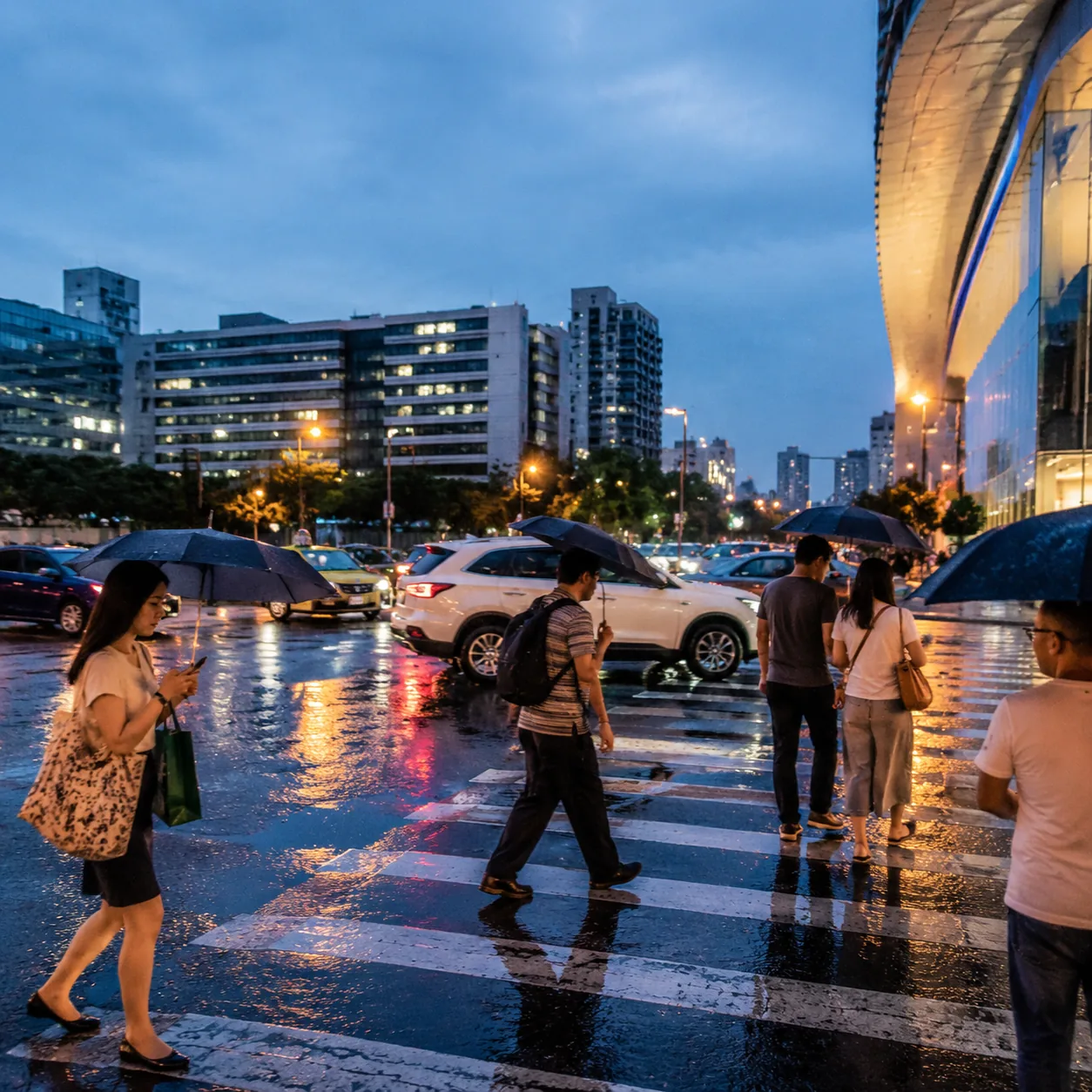
When I came out of the metro station, water was still dripping from the edge of the awning. The people who had sheltered from the rain had already scattered, leaving only a few folded umbrellas dripping small beads in pedestrians’ hands. Traffic lights at the intersection shone on the wet ground, their colors deeper than usual, as if freshly painted. Shenyang streets are wide and have many lanes, and after rain they seem even more open. When crossing in a hurry, one usually notices only the green-light countdown and the direction of traffic. After slowing down, one sees water on the zebra crossing being pushed aside by soles and hears the soft sound of tires passing through shallow puddles. Rain filters the city’s sounds, making many small noises that are usually ignored become clear.
I walk along the sidewalk, trying to avoid the deepest water but not deliberately avoiding every small puddle. When the soles of my shoes get slightly wet now and then, it actually makes me more certain that I am walking through a real city. The wind after rain in Shenyang carries coolness, moving between buildings and dispersing the stuffiness left by daytime. Poplars and locust trees along the road shake down a few drops of water that land suddenly on my shoulder. At a residential gate, a security guard drags a floor mat outside to dry; a convenience store clerk uses a squeegee to push away water in front of the door. None of the movements are hurried. After rain stops, people do not immediately return to their original speed; they first slowly restore the order that rain disrupted.
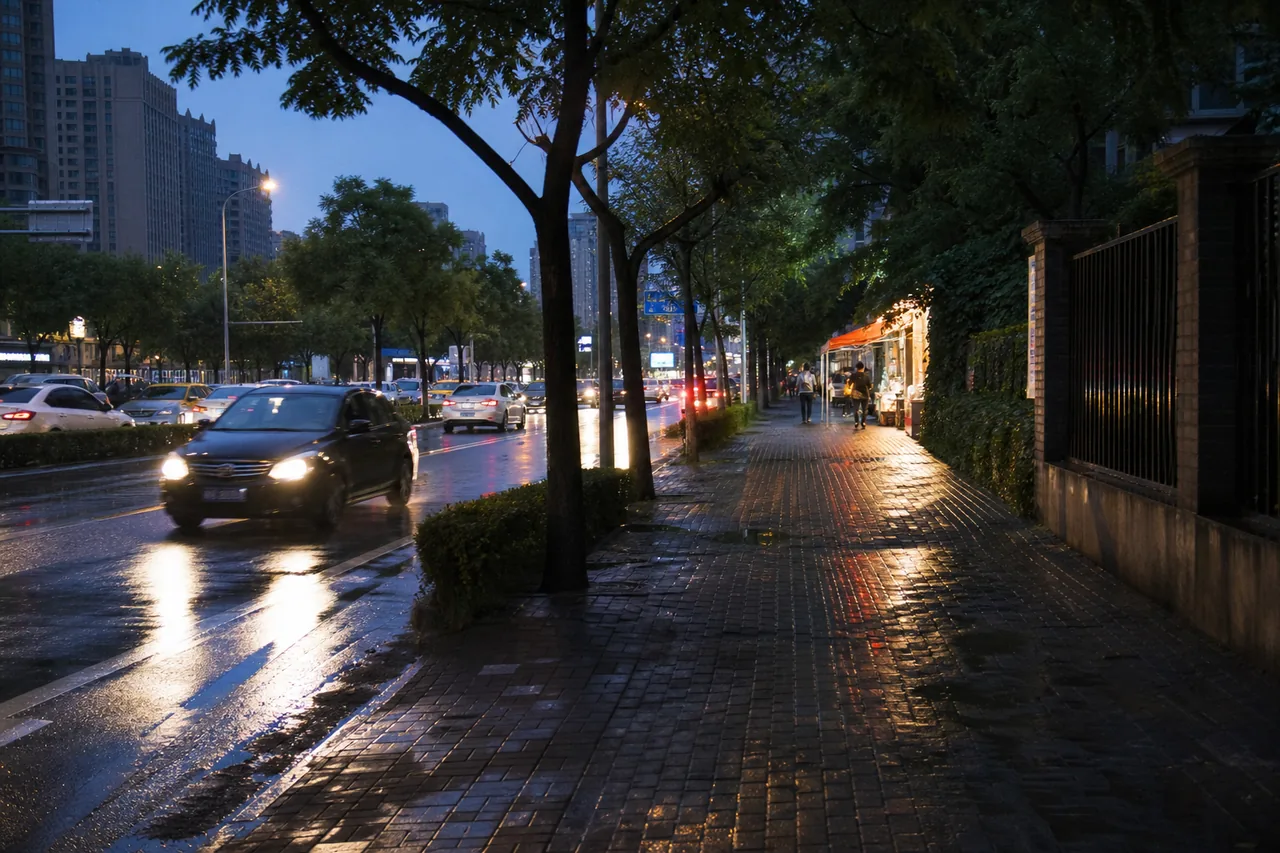
Slow walking after rain makes it easiest to see the expressions of shops. When a restaurant light comes on, wet glass layers indoor warmth with the cold light outside. In a dumpling restaurant, someone sits by the window with a plate of dumplings still giving off steam. The small supermarket next door places cardboard boxes at the entrance, warning customers that the floor is slippery. A barbershop’s neon sign flashes upside down in a puddle, its red and blue colors broken by footsteps and then joining again. Street shops in Shenyang are often practical, with large signs and direct words: home-style dishes, old-flavor barbecue, smoked pork flatbread, chicken racks. After rain, these words lose some of their daytime toughness and gain a little warm everyday feeling.
I turn onto a quieter street, where traffic noise is blocked by buildings and only the sound of water dripping from air-conditioning units remains. Several bicycles stand by the road, water gathered on their seats, plastic bags hanging from their handlebars. An elderly person folds an umbrella, shakes it slowly twice, and then enters the unit door. A child squats beside the road, using a twig to move the water and watching it flow along brick gaps. Such scenes are small, yet they suit the rhythm of Shenyang after rain. There is no deliberate poetry of a southern rain lane here, nor the salty dampness after rain in a seaside city. It is more like a rain that has just ended in a northern courtyard: clean and direct, yet holding quietness in certain corners.
The sky after rain changes quickly. Clouds that had just been pressing low suddenly reveal a little brightness in the west, and roof edges are outlined with pale gold. Shenyang’s building lines are distinct, and after being washed by rain, wall colors also become clearer. Half-damp clothes hang from balconies of older buildings, glass railings in new compounds reflect light, and taller office towers in the distance seem to slowly stand up from the moisture. Slow walking gives a person time to see these layers. A city is not worth pausing in only because of famous buildings. Ordinary facades, drying rods, post-rain windowsills, and small flower beds downstairs can also reveal the true shape of life at certain moments.
I pass a small square where several puddles remain on the ground. Usually there might be people dancing, walking dogs, or pushing strollers here, but just after rain, the square feels slightly empty. Several elderly people sit on a bench with plastic bags under them, chatting while watching the clouds break apart. A young person leads a dog around the water, but the dog insists on stepping into a puddle, splashing a small ring. The exercise equipment nearby has been washed bright by rain, as if just moved out of storage. Shenyang’s public spaces have a sense of pause after rain. It is not desolation; everyone is waiting for the ground to dry a little, waiting for the city to become suitable again for sitting and staying.
The advantage of walking slowly is that one can give direction to the street instead of constantly giving it to the map. I do not immediately open phone navigation, but follow the cleaner-looking side of the road. Shenyang street names often carry a clear order, intersections are wide, and it is not difficult to regain a sense of direction. After rain, the air becomes a little more transparent, and distant streetlights, bus stop signs, and mall entrances are easy to see. When I occasionally do not know which way to go, I stop under a tree, look around, and then decide. Such pauses rarely appear when one is hurrying. Slow walking is not purposeless; it simply lets the goal step back for a while and lets the city lead you forward with its own details.
A bus pulls into a roadside stop, its wheels pushing water into two arcs. The doors open, and warm air emerges with human voices. Some people board while folding umbrellas; others step down and first stand beside the stop sign to adjust their trouser hems. The light inside the bus reflects on the wet road like a moving piece of indoor life. After rain, Shenyang bus stops feel especially humane because they temporarily gather people from the road. Everyone has a different direction, yet they have waited under the same shelter, heard the same braking sound, and watched the same cloud move from behind a building. Urban connection is sometimes this brief, brief enough to scatter when one bus leaves.
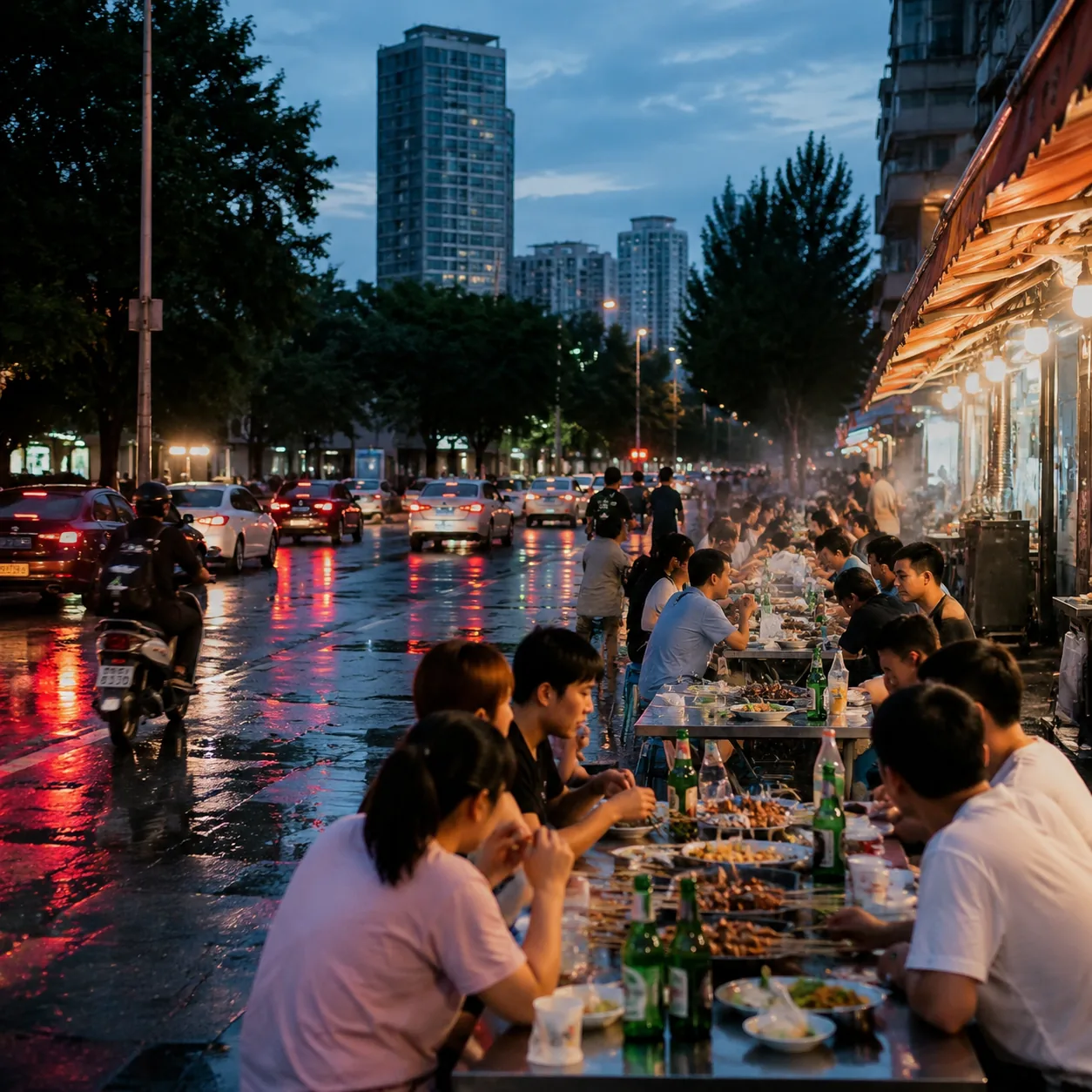
Farther ahead, smoke begins to rise from barbecue stalls. The post-rain air was originally cool, and once the smell of charcoal joins it, evening gains weight. Vendors move tables and chairs out from inside, wipe away water with cloths, and turn plastic stools over to pour out a few drops of rain. Iron skewers lie on plates; chicken racks, meat skewers, green peppers, and slices of steamed bread have not yet fully begun to roast, but already make one imagine how lively the night will become. A slow walk after rain in Shenyang often leads into such street warmth. Daytime rain washes the street clean, and evening fire gathers people again. Wetness and heat, coolness and spice, connect naturally at one intersection.
I do not sit down for barbecue immediately, but stop beside the stall for a while. Someone asks when the chicken racks will be ready, and the vendor says to wait a few more minutes. Someone leans a wet umbrella against the wall and orders a soda first. Two young people discuss which place to watch a football match. Nightlife after rain does not begin suddenly; it grows gradually like charcoal fire. A slow walker can see this process: tables come out from indoors, bulbs are screwed on, menus are pasted to the wall, the first customers sit down, and the first wave of fragrance drifts from the grill. The city’s night is not turned on by a switch; it is slowly lit by many small actions.
The colors of Shenyang after rain are also worth seeing slowly. Wet tree trunks are dark brown, streetlights are warm yellow, taxi roof signs are bright green, shopping mall screens are cold white, and light from old apartment windows is somewhat orange. Water connects these colors, making the ground like a dark mirror wiped again and again. When walking fast, these colors are only a mixed brightness. When walking slowly, one discovers that each light has its own source and temperature. A city’s evening does not simply become dark; it hands over, one by one, the lights hidden during daytime. Rainwater gives these lights places to rest and gives passersby reasons to look once more.
As I walk, I think of Shenyang’s sense of history. It has the Imperial Palace, old industrial memory, many factory areas that once roared, and also new malls and metro lines. During a slow walk after rain, these layers do not appear grandly, but hide in roadside walls, old doorplates, wide roads, and the accents with which people speak. A city’s history does not always stand at the entrance of a scenic area waiting for you; it may also show a small edge on an ordinary street. For example, a red brick wall washed bright by rain, a snack shop that has operated for many years, or the familiarity that naturally appears when an older person mentions a place name. Slow walking keeps these edges from being missed.
When darkness finally settles, the ground is no longer as wet as before. Large puddles shrink, leaving only a few thin bright lines under the curb. Pedestrian speed begins to recover, delivery riders’ lights pass through the street, and the mall entrance becomes lively again. I also open my phone to check the time and find that I have not walked very far, yet it feels as if I have passed through a long section of city. Slow walking changes the meaning of distance. It does not hand nearness and farness only to kilometers, but to how much you have seen, how much you have heard, and how many times you have stopped. Shenyang after rain suits this kind of measurement because it washes the city’s usually rough surface a little finer, allowing people to touch it again.
I find a small shop and sit down, ordering a bowl of hot soup and a simple staple. Outside the window, people still enter while folding umbrellas, and the floor mat quickly gains footprints of different shades. A staff member leans a mop in the corner and turns to refill water for the next table. When the hot soup arrives, steam blocks the lights beyond the glass, and I suddenly feel that the slow walk has found a complete ending. Walking after rain gradually cools the body, while the warmth of street life awakens the appetite. Sitting down to eat something hot is not a reward, but a natural continuation. The city has just been cared for by rain, and a person also needs to be cared for by a bowl of soup.
While eating, I recall the scenes from the walk: water dripping at the metro exit, arcs made by bus wheels, the twig with which a child moved water, plastic stools turned over at the barbecue stall, and orange lights in old apartment windows. None of them is grand enough to become the main image of a travel brochure, yet together they form the true temperament of Shenyang after rain. Slow walking gives these images time to enter memory instead of flashing before the eyes and disappearing. Many cities are suitable for photographs, but not every city is suitable for being understood slowly on foot. Shenyang’s virtue is that it does not hurry to please you, yet it is willing to spread out its everyday life for you to see.
When I leave the small shop, the rain has completely stopped. There are no stars in the night sky, but the clouds have opened somewhat, and the wind is fresher. More people appear on the street. The earlier quietness has not vanished; it has only retreated deeper. Shenyang returns to its familiar speed: traffic grows denser, shop calls become louder, and waiting crowds gather again at intersections. Yet I know that the slow walk after rain has changed the way I see it. It is no longer only a northeastern metropolis on the map, nor only a historical term and transport node. It has lights in puddles, the smell of wet leaves, and hands slowly warming before a bowl of hot soup.
If someone later asks me how Shenyang is best walked, I will say: choose an evening just after rain, do not hurry to call a car, and do not stare only at navigation. Walk slowly for a while along a wide road. Watch how water falls from leaves, how shops open again, and how people return from sheltering into ordinary life. You will find that a city’s character appears not only in sunshine and noon, but also in transitional times after rain. A slow walk after rain in Shenyang has no dramatic climax, yet it has a steady aftertaste. It makes one believe that the tenderness of a northern city is often not spoken aloud, but walked out step by step on a wet and shining road.