華東五都市10日間の定番周遊ルート
Shanghai, Hangzhou, Suzhou, Nanjing, Huangshan — five cities, one loop. This guide covers transport links, pacing, and the highlights of each stop so you never backtrack.
Why This Route Works
East China packs more variety per square kilometer than almost anywhere else in the country. The longest high-speed rail leg on this loop is about three hours; the shortest — Shanghai to Suzhou — takes just 25 minutes. No flights needed. One China Railway 12306 app handles every booking.
The biggest trap on this route is trying to see everything. Each city could easily fill three days. Ten days is actually tight. My recommendation: two to three days each for Shanghai and Hangzhou, one and a half for Suzhou, two for Nanjing, two for Huangshan (including the mountain ascent and descent), and half a day as buffer.
Stop 1: Shanghai (Day 1–3)
Getting into the city from either airport is straightforward. Pudong has the Maglev — 8 minutes to Longyang Road metro, ¥50 — and Hongqiao connects directly to Metro Lines 2 and 10. Stay near People’s Square or West Nanjing Road for the best access to everything.
Day 1 — Arrive, adjust, and walk the Bund. In the evening, stroll from East Nanjing Road Pedestrian Street south toward Shiliupu Wharf. The skyline across the Huangpu is best after sunset. Skip the river cruise — the view from the promenade is steadier and wider.
Day 2 — Morning at Yu Garden and City God Temple. Get there before 9:30 to beat the tour groups. Lunch in the Old Town — Nanxiang Steamed Bun Restaurant always has a line, but the smaller shops in the alleyways nearby are often more authentic. Afternoon in the Former French Concession: wander between Wukang Road and Anfu Road, where plane trees and independent cafés define the neighborhood.
Day 3 — Morning in Lujiazui, Pudong. The Shanghai Tower’s 118th-floor observation deck costs ¥180 (book online to save ¥20). Afternoon at Tianzifang or M50 Art District for Shanghai’s creative side. Evening bullet train to Hangzhou — about one hour.
Stop 2: Hangzhou (Day 3 evening–Day 5)
Hangzhou revolves around West Lake, but don’t just circle it and move on.
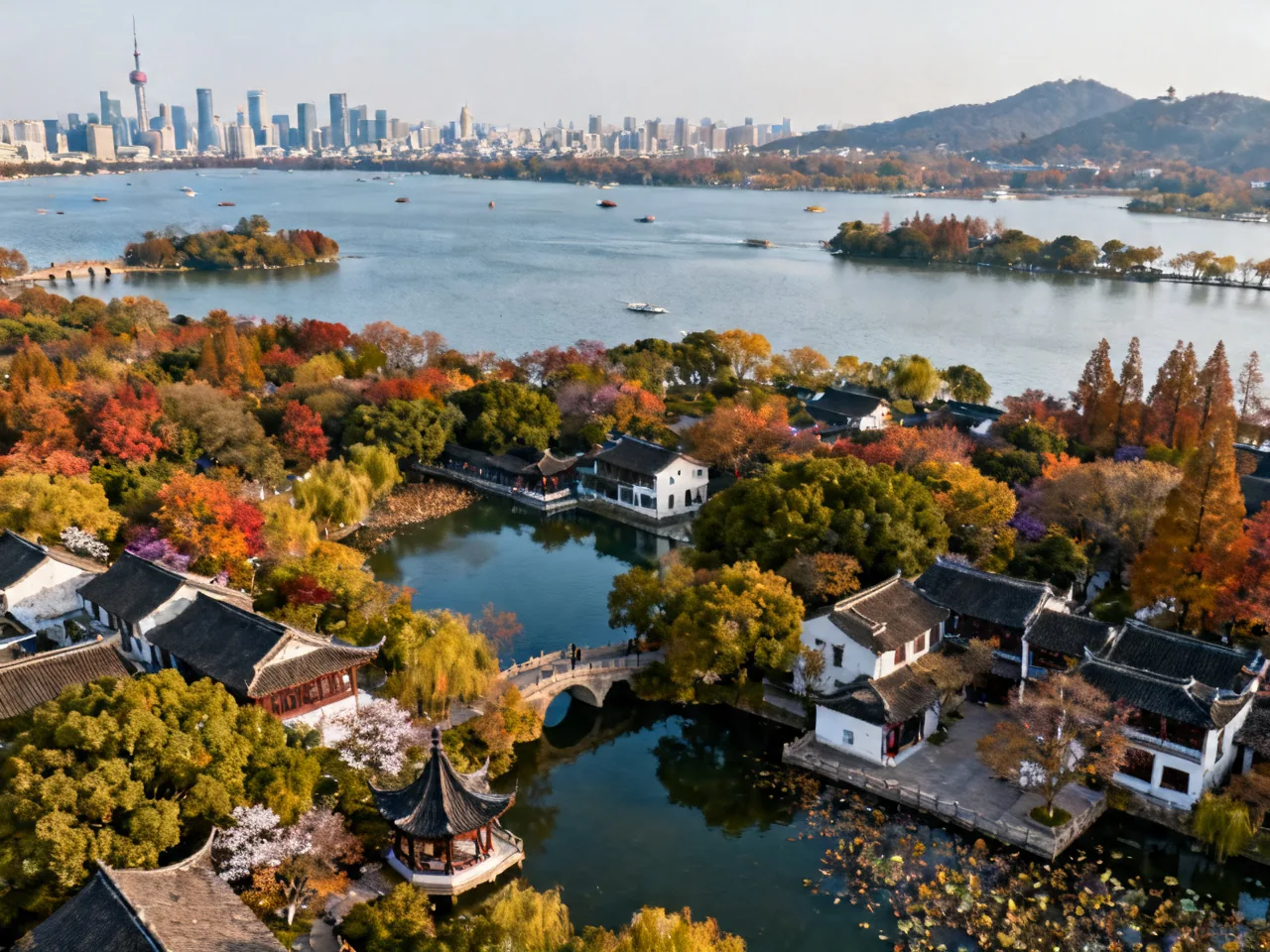
Day 4 — Get up early, grab a shared bike (scan with Alipay, free for the first hour), and ride along Su Causeway to Flower Harbour Park. Morning at Lingyin Temple — taxi or bus Y2 to Feilai Peak entrance, ¥75 including the peak. Lingyin Temple itself costs an additional ¥30 incense ticket. Lunch at a farmhouse restaurant in Longjing Village. Try pre-Qingming Longjing tea — prices range from dozens to thousands per 50g, but a ¥50 cup is perfectly good.
Day 5 — Morning at Hefang Street and Southern Song Imperial Street — Hangzhou’s liveliest heritage strip. Afternoon at Xixi Wetland Park (¥80 entry), where a slow punt through the reed marshes offers a rawer landscape than West Lake’s manicured beauty. Evening train to Suzhou, about 1.5 hours.
Stop 3: Suzhou (Day 5 evening–Day 7 morning)
Suzhou’s gardens are the quietest stretch of this loop. Most visitors hit the Humble Administrator’s Garden and Lion Grove, but I’d recommend Lingering Garden and Master of the Nets Garden instead — fewer crowds, more refined spatial design.
Day 6 — Morning at Lingering Garden (¥55 peak season), the most spatially layered of Suzhou’s gardens. Lunch on Pingjiang Road — a canal-side heritage street with a balanced mix of old and new. Try Jitou Mi (Gorgon fruit porridge) and Wadi Su (crispy flatbread). Afternoon at Master of the Nets Garden. If the evening garden tour is running (March–November, ¥100), don’t miss it. Kunqu opera and Pingtan performed right inside the garden, lantern light reflected on the pond — one of the most poetic moments of the whole trip.
Day 7 morning — Quick stop at Tiger Hill and its leaning pagoda (¥80), then bullet train to Nanjing, about one hour.
Stop 4: Nanjing (Day 7–Day 8)
Nanjing feels heavier than the previous three cities. This is the capital of six ancient dynasties and one of the most significant cities in modern Chinese history.
Day 7 afternoon — Head to Sun Yat-sen Mausoleum (free, reservation required). After climbing all 392 steps, turn around — the view across Purple Mountain is worth every breath. Evening at Confucius Temple and the Qinhuai River. Try duck blood vermicelli soup and salted duck — Nanjing people really do eat duck every day; it’s not a joke.
Day 8 — Morning at the Nanjing Massacre Memorial Hall. It’s not an easy visit, but if you want to understand China, this history can’t be skipped. Free entry; closed Mondays. Afternoon at the Ming City Wall (Zhonghua Gate section is the most impressive, ¥50) or decompress at Librairie Avant-Garde’s flagship store — built inside a former air-raid shelter and named one of the world’s most beautiful bookshops.
Stop 5: Huangshan (Day 9–Day 10)
Nanjing to Huangshan North Station is about two hours by bullet train. From there, a shuttle bus or shared car to Tangkou Town at the mountain base takes another hour (around ¥30).
Day 9 — Stay one night in Tangkou. Take the Yungu (Cloud Valley) cable car up the back mountain (¥90 one way, recommended for ascent) and the Yuping cable car down the front (¥90, recommended for descent). On-mountain accommodation is expensive and basic — if budget allows, the Baiyu Hotel near Bright Summit charges around ¥1,200/night for a double, but stepping outside at 4:30 a.m. for sunrise is priceless.
Day 10 — After sunrise, hike the West Sea Grand Canyon loop (3–4 hours) — the most spectacular section of Huangshan. A funicular at the canyon floor (¥100) saves your knees. Afternoon descent, bus back to the station, then bullet train to Shanghai (about 4.5 hours) or fly out of Hefei if closer.
Practical Info at a Glance
Transport — High-speed rail throughout. Book on 12306 or Trip.com, ideally 3–5 days ahead, two weeks ahead for holidays.
Payment — WeChat Pay and Alipay work almost everywhere, but signal on Huangshan’s summit can be weak — carry some cash. Foreign passport holders can activate Alipay’s Tour Pass to link an international credit card.
Accommodation budget (double room/night) — Shanghai ¥500–800, Hangzhou ¥400–600, Suzhou ¥300–500, Nanjing ¥350–550, Huangshan base ¥200–400 / summit ¥800–1,500.
Best seasons — Late March to May (spring blooms, comfortable temps), mid-September to mid-November (fall colors, cool weather). July–August are hot and humid, though Huangshan’s summit stays cool.
The Hidden Payoff
After finishing this loop, you’ll realize East China isn’t just the “Jiangnan water towns” cliché. Shanghai is modern China at full throttle. Hangzhou is the literati ideal of a city between mountains and lake. Suzhou is the art of compressing nature within garden walls. Nanjing is where memory and rebirth coexist. And Huangshan is Chinese landscape painting stepping out of the scroll.
Ten days isn’t long, but it’s enough to carry home five entirely different impressions of China.