 Travel Notes
 Jiefangbei: The Monument That Beats at the Heart of Chongqing
There is a spot in Chongqing where time folds in on itself. A 27.5-metre stone spire stands at the centre of a swirling intersection, ringed by glass skyscrapers and flashing neon. This is Jiefangbei — the Liberation Monument — and it is far more than a landmark. It is the only monument in China dedicated to the victory of the War of Resistance Against Japanese Aggression, a silent witness to a city that refused to break, and today the pulsing heart of southwest China’s most dazzling commercial district. To understand Chongqing, you must start here.
A Monument Built on Layered History
The story of Jiefangbei begins not with peace, but with war. In December 1941, the Nationalist government laid the foundation for a “Spirit Fortress” (精神堡垒) at Duyou Street Square — a wooden structure, 25.7 metres tall, built to rally public morale during the darkest days of the resistance. Its height was deliberate: 7.7 zhang, a reference to the July 7th Incident that ignited full-scale war.
When victory came in 1945, the city decided to replace the wooden fortress with something permanent. The “Monument to the Victory of the War of Resistance” (抗战胜利纪功碑) was designed by architect Li Lunjie, completed in August 1947, and built from reinforced concrete clad in granite. Then, after Chongqing’s liberation in 1949, the Southwest Military and Political Committee renamed it the “People’s Liberation Monument” in October 1950, with Marshal Liu Bocheng personally inscribing the new name.
Today, the monument carries dual meaning — it commemorates both the resistance victory and the people’s liberation. The original inscription “抗战胜利纪功碑” still survives on the reverse face, while Liu Bocheng’s gilded calligraphy “人民解放纪念碑” adorns the front.
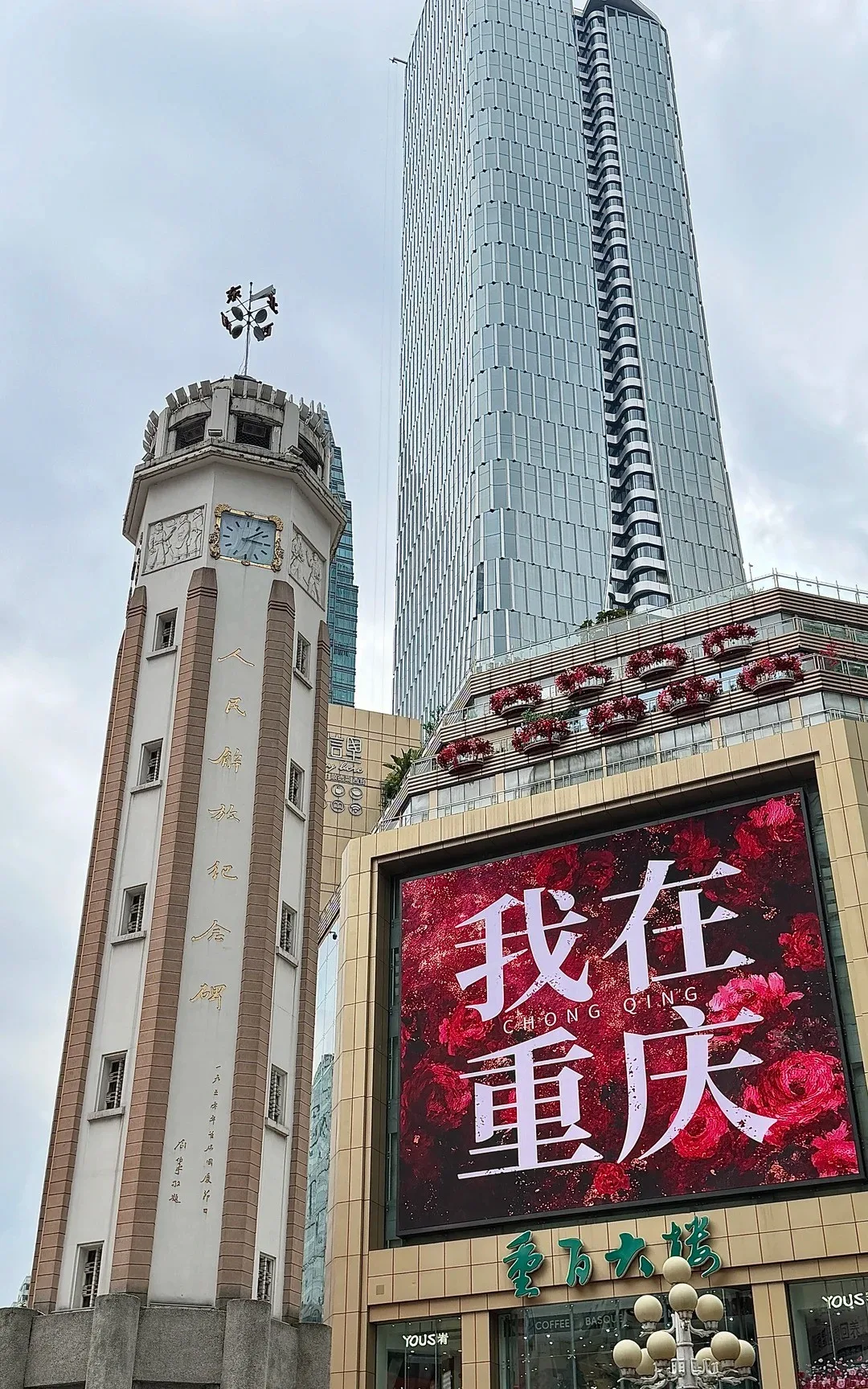
Three Eras, One Site
-
Spirit Fortress (1941–1945): A wooden structure with a clock tower at the top, used for rallies and propaganda.
-
Victory Monument (1947–1949): An eight-sided reinforced concrete tower bearing the commemorative inscription and relief carvings.
-
People’s Liberation Monument (1950–present): Renamed by Liu Bocheng, with a four-faced clock at the top — now Chongqing’s most recognisable symbol.
What to See: The Tower and Its Surroundings
The monument itself is a study in restrained dignity. Its eight-sided column symbolises unity from all directions. The circular base measures 20 metres across; each face of the tower is about 2.5 metres wide. At the top, a four-faced mechanical clock — 1.5 metres in diameter, manufactured by the Shanghai Clock Factory — still chimes every hour.
A spiral staircase inside leads to the top, but it is not open to the public. Around the base, relief carvings depict themes of resistance and liberation. The base itself is ringed with steps and railings, and a ramp ensures wheelchair access.
The Inscriptions
The front face bears Marshal Liu Bocheng’s inscription “人民解放纪念碑” in gilded characters. The reverse preserves the original “抗战胜利纪功碑”. An 800-character commemorative text, written by Wu Dingchang, Secretary-General of the Nationalist Government, is carved into the base, recounting the history of the war and the purpose of the monument.

Architecture: Where Modernism Meets Chinese Tradition
Jiefangbei’s design fuses Western modernism with the solemnity of traditional Chinese stelae. The geometric lines and symmetry speak to early 20th-century architectural thinking, while cloud-pattern ornaments at the top of each face and lotus-pedestal reliefs at the base anchor it in Chinese decorative tradition. The circular base symbolises completeness; the unadorned shaft keeps the focus on commemoration rather than ornament.
-
Architect: Li Lunjie, a graduate of the Department of Architecture at National Central University.
-
Structure: Eight-sided column, reinforced concrete frame, granite cladding.
-
Decorative elements: Cloud patterns, lotus pedestal, resistance-themed reliefs.
Cultural Significance: More Than Stone
Jiefangbei is the spiritual anchor of Chongqing. Every October 1st, citizens gather spontaneously for the national flag-raising ceremony. It is also the birthplace of Chongqing’s commercial culture — the surrounding district generates over 50 billion yuan in annual retail sales, making it one of southwest China’s most prosperous commercial centres.
The monument has appeared in novels like Red Crag (红岩) and films such as Chongqing Negotiations (重庆谈判), embedding itself in China’s cultural imagination. In 2000 it was designated a Major Historical and Cultural Site Protected at the National Level, and in 2016 the pedestrian street was named among the first batch of “Chinese Historical and Cultural Districts.”
Practical Information
Visitor Details
-
Opening hours: Open 24 hours (interior not accessible to the public).
-
Admission: Free.
-
Address: No. 177 Minzu Road, Yuzhong District, Chongqing.
-
Phone: 023-63835267 (Yuzhong District Tourism Bureau).
Visiting Tips
-
Best time for photos: Dusk to night, when the monument is lit and the surrounding skyscrapers glow.
-
Crowds: Holidays are extremely busy — keep valuables secure. Climbing the monument is prohibited.
-
Suggested duration: 30 minutes to 1 hour (excluding shopping).
-
Accessibility: Ramps at the base; wheelchair accessible.
Nearby Attractions
Jiefangbei sits at the centre of a dense cluster of Chongqing’s best-known sights:
-
Hongyadong (5-min walk): The legendary stilt-house complex and night-view destination.
-
Luohan Temple (10-min walk): Founded in the Northern Song dynasty, one of Chongqing’s oldest Buddhist temples.
-
Three Gorges Museum (15-min walk): Explore Three Gorges culture and Bayu history.
-
Shibati Traditional District (10-min walk): Wander the old streets and alleys of historic Chongqing.
-
Yangtze River Cableway (20-min walk): Cross the Yangtze for a bird’s-eye view of the mountain city.
Best Time to Visit
Chongqing has a subtropical monsoon climate — hot and foggy in summer, damp and cold in winter. The best seasons are spring (March–May) and autumn (September–November), when temperatures are mild and rainfall is low. Summer highs can reach 40°C, but the shopping malls are fully air-conditioned. Winter brings fog and reduced visibility, but also the atmospheric “Fog City” charm. New Year’s Eve and National Day feature countdown events with a festive atmosphere.
Getting There & Where to Stay
-
Metro: Lines 1 & 2 to Jiaochangkou Station (5-min walk); or Line 6 to Xiaoshizi Station (10-min walk).
-
Bus: Routes 105, 111, 112, 114, 132, 151, 181, 261, 262, 401, 461, 462, 465, 466, 601, 612, 862 to “Jiefangbei” stop.
-
Taxi: Jiangbei International Airport → Jiefangbei ~40 min, ~60 yuan; Chongqing North Station → Jiefangbei ~30 min, ~30 yuan.
-
Hotels: The Westin Chongqing Jiefangbei (5★), JW Marriott Hotel Chongqing (5★), Atour Hotel Jiefangbei (4★) — prices range from 300 to 2,000 yuan per night.
Historical Milestones
Jiefangbei has stood witness to some of Chongqing’s most consequential moments. On November 30, 1949, citizens gathered before the monument to celebrate the city’s liberation. The first national flag-raising ceremony was held here on October 1, 1950, and the site has remained a spontaneous gathering point for National Day and New Year celebrations ever since. In 1997, when Chongqing became a direct-controlled municipality, the Jiefangbei commercial district underwent a major upgrade. The monument was designated a Major Historical and Cultural Site Protected at the National Level in 2000. In 2016, the pedestrian street was named among the first batch of “Chinese Historical and Cultural Districts.” Most recently, in 2020, the Jiefangbei–Chaotianmen pedestrian promenade was completed, forming a 2.3-kilometre urban landscape axis.
Food & Shopping
The Jiefangbei district is Chongqing’s commercial core, home to Times Square, WFC (World Financial Centre), Metropolitan Oriental Plaza, and Bayi Square, along with flagship stores of international brands. For food, seek out time-honoured snack shops like Qiu’er Guan (丘二馆) and Wu Chaoshu (吴抄手), or famous hotpot restaurants such as Peijie Old Hotpot (珮姐老火锅) and Zhou Shixiong Hotpot (周师兄大刀腰片火锅). The night economy thrives here — the pedestrian street is a designated “night economy” demonstration zone, with businesses typically open until the early hours.
Protection & Future Plans
As a Major Historical and Cultural Site Protected at the National Level, Jiefangbei’s protection zone encompasses the monument itself and a 50-metre radius around it. The Yuzhong District government has issued a “Jiefangbei Historical and Cultural District Conservation Plan” that strictly controls the height and style of surrounding buildings to preserve sightlines to the tower. In 2021, the Jiefangbei–Chaotianmen Green Finance Avenue renovation was completed, improving the pedestrian experience. Looking ahead, the district is positioned to become a “world-renowned commercial hub,” with plans to introduce more cultural and experiential attractions.
Frequently Asked Questions
-
Can I climb to the top? No — the interior is not open to the public.
-
Is there parking nearby? Yes, including Jiefangbei Underground Parking and Times Square Parking, at about 5 yuan/hour.
-
Is it suitable for children? Yes, but take care during crowded holidays.