 Travel Notes
 Hongyadong: The Cliffside Stilt-House City That Glows After Dark
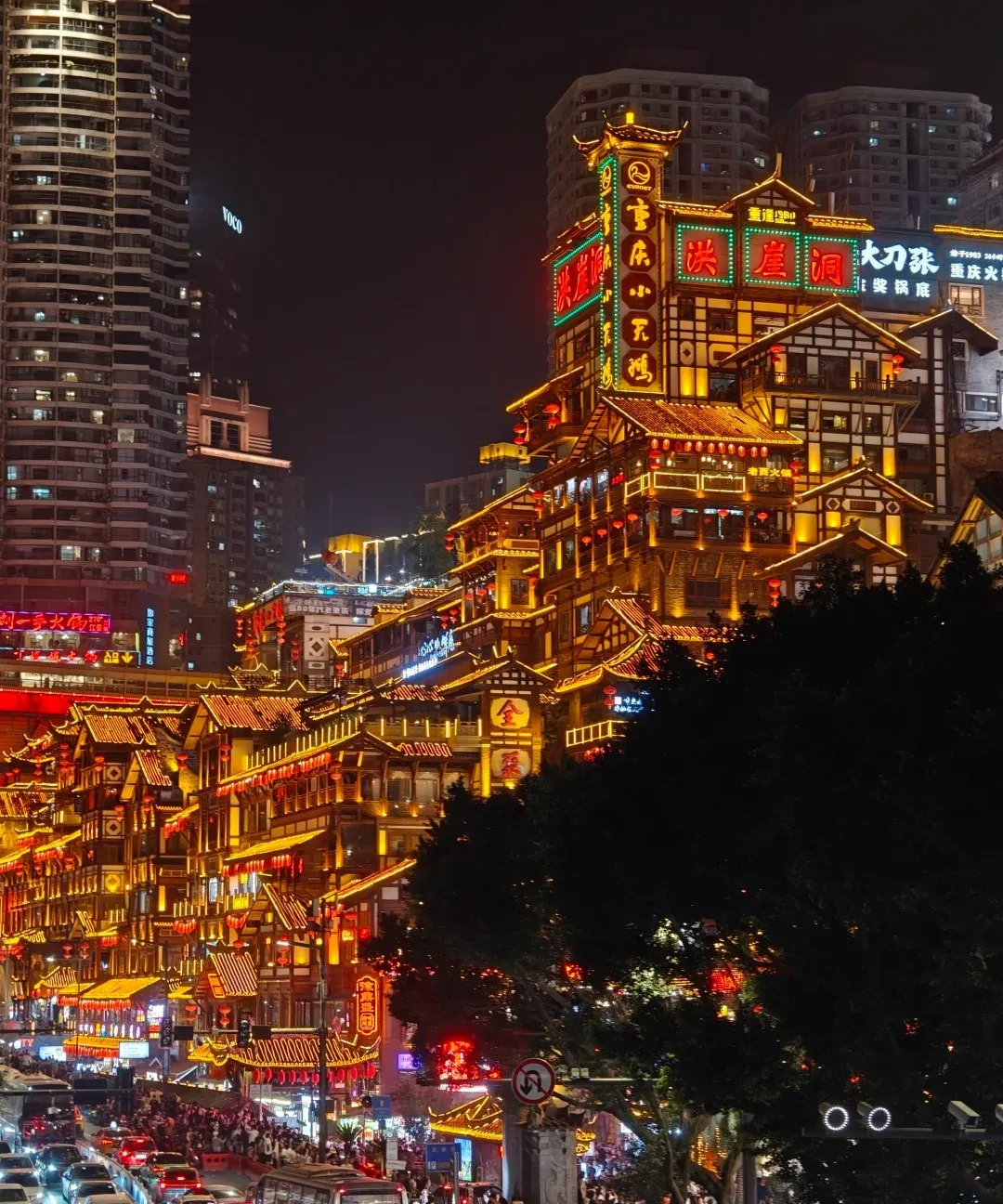
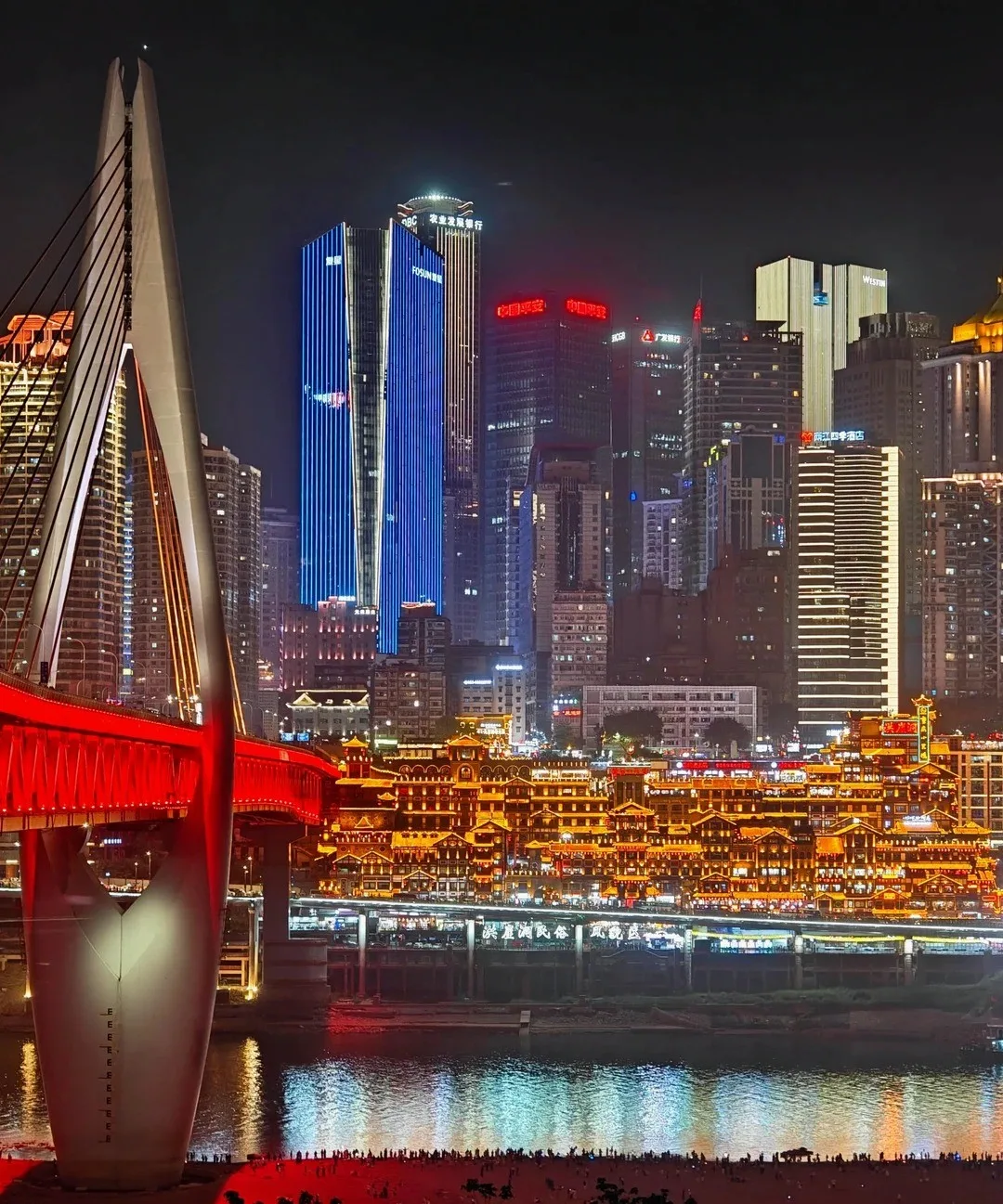
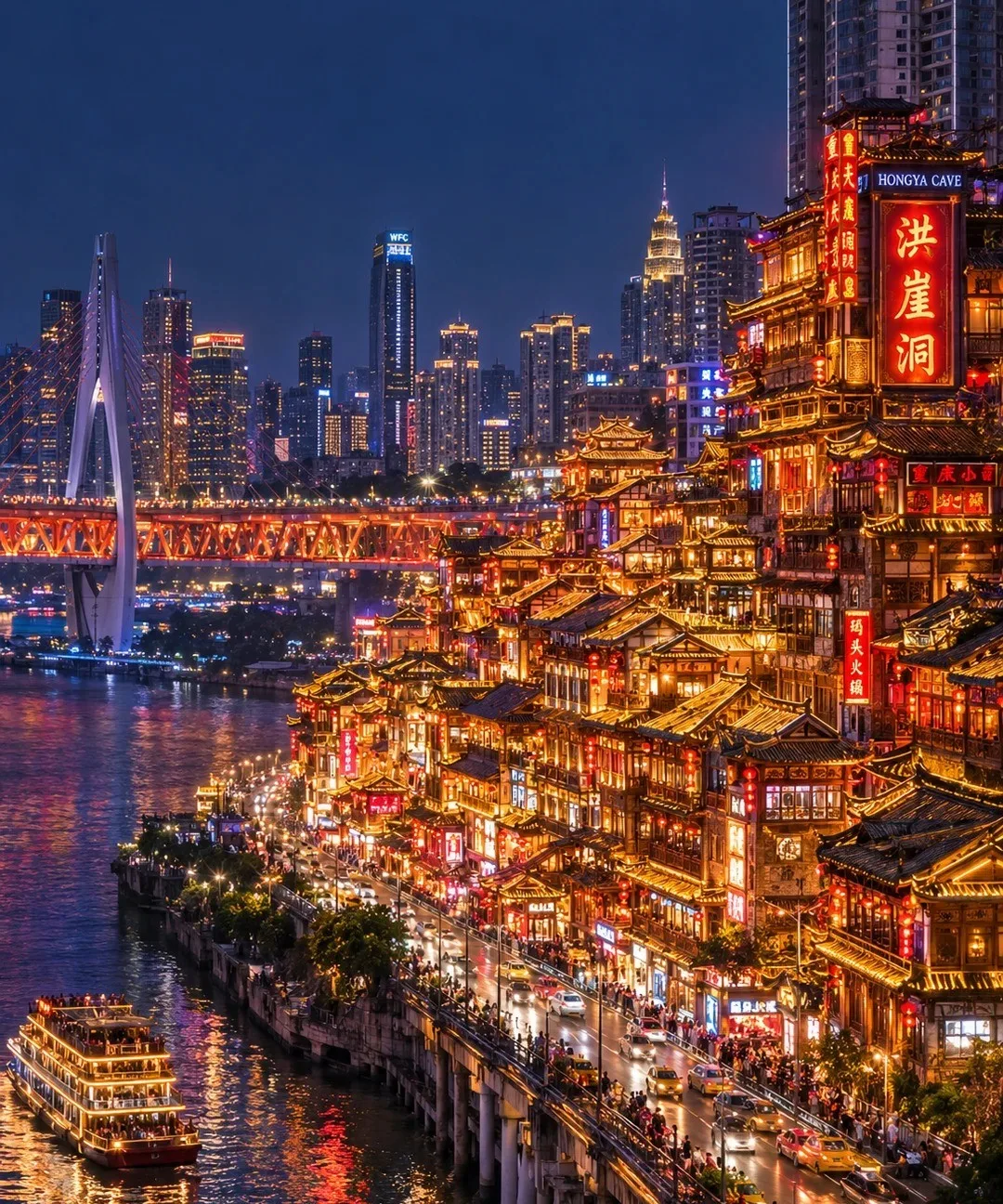
There is a corner of Chongqing where a whole city seems to hang from a cliff. Thirteen storeys of grey-tiled, white-walled wooden houses climb up the rock face above the Jialing River, and when night falls they light up gold — glowing, layered, impossibly stacked. This is Hongyadong (洪崖洞), the “Rongdong” folk-custom scenic zone, a modern reconstruction of the stilt-house (吊脚楼) settlements that once lined the steep banks of the mountain city. To some it looks like a page lifted from Spirited Away (千与千寻). To Chongqing it is simply the city’s most photographed calling card — a vertical world where the street on level one and the street on level thirteen are both ground level, depending on where you stand.
A Gateway That Climbs Through Two Thousand Years
The name Hongyadong comes from Hongya Gate (洪崖门), one of the ancient city gates of Chongqing. According to the Chronicles of Huayang: Treatise on Ba (《华阳国志·巴志》), the Ba kingdom built its capital, Jiangzhou (today’s Chongqing), against the hills and ringed it with gates. In 1371, the fourth year of the Hongwu reign of the Ming dynasty, Dai Ding (戴鼎), military commissioner of Chongqing Garrison, enlarged the old city into a stone wall with seventeen gates; Hongya Gate stood on the western side, facing the river beneath a sheer cliff. Below the gate, waterfalls once tumbled down the rock, giving rise to “Hongya Dripping Green” (洪崖滴翠), one of the Twelve Sights of Bayu.
During the Qianlong era of the Qing dynasty, Wang Erjian (王尔鉴), magistrate of Ba County, listed “Hongya Dripping Green” among the Twelve Sights of Bayu and wrote of it: “I may clap the Hongya shoulder bare / An ancient cave where forms are rare / I bring a cup of wine to share / And watch the five-fold colours flare.” The cave itself was once a natural grotto holding a temple that drew crowds of worshippers, until war and the scouring of the river gradually left it abandoned.
From Riverside Dwellings to a Modern Landmark
In the early 20th century, after Chongqing opened as a treaty port, the Hongya Gate area became a wharf and commercial district. Row upon row of stilt-houses were thrown up along the bank, braced with slanted wooden posts, home to boatmen and vendors — a distinctive mountain-city streetscape. As urban redevelopment swept through in the 1990s, these ramshackle dwellings faced the wrecking ball. Then, in 2002, the city decided to build a folk-custom scenic zone centred on Hongyadong. The Chongqing Little Swan Group invested 385 million yuan; over four years the design team — led by Wu Zhiqiang (吴志强), who drew on Chongqing’s traditional stilt-houses and old-town character — rebuilt the site under the slogan “recreate old Chongqing.” The scenic street officially opened to the public on 1 October 2006.
Its ascent was meteoric. In 2015 Hongyadong was rated a National AAAA Tourist Attraction. In 2018, spread by short-video platforms, its night view was dubbed by netizens “the real-life Spirited Away,” and visitor numbers surged past ten million a year. In 2020 the site launched an upgrade that improved circulation and landscaping and introduced a “Hongyadong × Spirited Away” themed light show, cementing its status as Chongqing’s signature image.
What to See: Four Highlights
The complex is laid out as “one character, three rarities, four streets and eight sights” (一态、三绝、四街、八景) — a vertical tapestry rather than a flat layout. Its total floor area is about 46,000 square metres, and the highest tier reaches thirteen storeys.
The Stilt-House Complex
The main buildings are a modern take on the traditional stilt-house (干栏式建筑), built against the slope in receding terraces. They use a mortise-and-tenon timber frame, grey-tiled roofs, white walls and grey columns, with carved doors and windows and hanging lanterns that evoke the riverfront dwellings of late Qing and early Republican Chongqing. The complex divides into four streets, from bottom to top: Paper-Salt River Street (纸盐河街, levels 1–3, shopping); Tiancheng Alley (天成巷街, 4–6, dining); Hongyadong Street (洪崖洞街, 7–9, dining and hotels); and the City Balcony (城市阳台, 10–13, viewing platforms and upscale hotels), overlooking the Jialing River and Jiangbeizui.
Hongya Dripping Green
One of the Twelve Sights of Bayu, this is set in the cliff face at the heart of the scenic zone. In ancient times a waterfall poured from the cliff top, its spray scattering like jade in the sunlight. Today the site recreates the effect with an artificial cascade and a fog-forest system, especially cooling in summer; a viewing platform below lets visitors feel the mist at close range.
The Night Lights
The night view is Hongyadong’s single greatest attraction. From 19:00 to 22:00 every evening, outline lights, lanterns and spotlights switch on together. Warm golden light bathes the stilt-houses, and their reflection in the Jialing River conjures the illusion of a “heavenly market.” The classic vantage point is the riverbank beside the Chongqing Grand Theatre at Jiangbeizui, or the Qiansimen Bridge itself. Inside the site, a designated “Hongyadong night-photography spot” offers professional lighting control.
Folk Performances
The zone stages regular Bayu folk shows, including Sichuan opera face-changing (变脸), fire-breathing, puppet theatre and mountain-song duets. Performances take place three times a day (11:00, 15:00, 19:30) in the “Bayu Theatre” on level 4, free to watch. On holidays, grand processions such as the “Hongyadong Temple Fair” and the “Lantern Festival” pageant add to the atmosphere.
Architecture & Art: A Vertical City on a Cliff
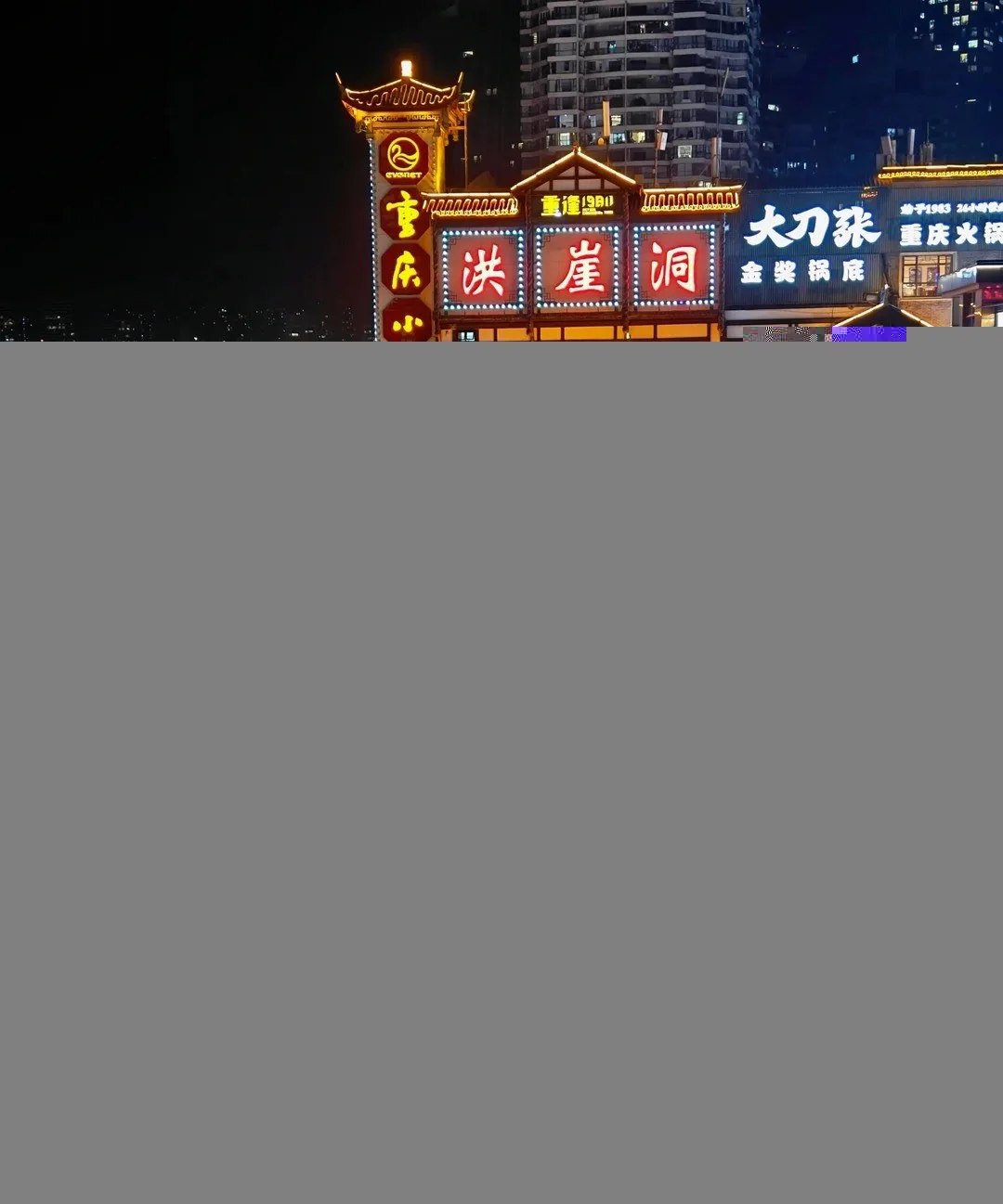
Hongyadong belongs to the “new Chinese” style of revival architecture, modelled on the Bayu stilt-house but built with modern techniques. The stilt-house is a干栏式 dwelling native to southwest China — set against hill and water, with the ground floor raised on wooden posts so it can cope with steep slopes. At Hongyadong the structure is a reinforced-concrete frame dressed in timber elements: it keeps the traditional look while meeting modern fire-loading and safety codes. The palette of grey, white and red — grey tile roofs, white walls, red lanterns and wooden columns — creates a strong visual contrast.
A “Three-Dimensional City”
The layout embodies the idea of a vertical city. Taking advantage of the elevation difference, the entrance sits on level 11 (Cangbai Road) and the exit on level 1 (Jiabin Road); visitors take the lift or walk down tier by tier. Every level has terraces and connecting corridors, forming the “four streets and eight sights”: the four streets are Paper-Salt River Street (levels 1–3), Tiancheng Alley (4–6), Hongyadong Street (7–9) and the City Balcony (10–13); the eight sights include Hongya Dripping Green, the confluence of the two rivers, the Jialing sunset and the Qiansimen moonlit night. The design keeps changing a visitor’s vantage point, delivering the quintessential mountain-city sensation of “climbing slopes and steps.”
Decorative Arts
The site is rich in Bayu ornament: doors and windows are carved with auspicious motifs — bats, deer and magpies; bronze bells hang from the eaves; blue-and-white porcelain shards are set into the walls; flagstones pave the ground. On level 4, “Bayu Style Street” recreates old Chongqing teahouses, taverns, apothecaries and pawnshops, furnished with stone mills, winnowing machines and sedan chairs for an immersive feel. There is also a “Hongyadong Art Gallery” showcasing intangible-heritage works such as Bayu wood carving, bamboo weaving and Shu embroidery.
Cultural Significance: A Window onto Bayu
Hongyadong is a stage for Bayu culture, which grew from the ancient Ba kingdom and is marked by fierceness, boldness and a love of life — expressed in its food (hotpot, xiaomian noodles), its arts (Sichuan opera, river work songs) and its folkways (temple fairs, dragon boats). Through architecture, performance and cuisine, the site concentrates the essence of that culture. Its “Bayu Folk Museum” holds more than 200 everyday objects from the region — old hotpot pots, bamboo backpack baskets, wooden water wheels and the like.
Its vertical structure is also a microcosm of Chongqing’s “mountain city” terrain. The main city sits on the hilly ground where the Yangtze and Jialing meet, where buildings climb the slopes so that “the first floor faces a road, and the tenth floor also faces a road.” Hongyadong’s thirteen storeys, each opening onto a different street, embody this magical geography and have become a textbook case for mountain-city architecture. Finally, the area was once part of old Chongqing: the preserved Hongya Gate relic at the level-11 entrance and the recreated Paper-Salt River Street — historically a distribution hub for salt, paper and other goods — stir civic memory, and an annual “Old Chongqing Photography Exhibition” records the city’s transformation.
Practical Information
Visitor Details
-
Opening hours: Open year-round 09:00–23:00 (last entry 22:30); holidays may extend to 24:00.
-
Admission: Free, no reservation needed. Some inner sites, such as the Bayu Folk Museum, require a 30-yuan ticket.
-
Best visit time: Night view is the highlight — enter after 18:00, browse the streets in daylight, then enjoy the lights after 19:00.
-
Phone: Enquiries 023-63039999; complaints 023-63038888.
-
Website: www.hongyadong.com (real-time visitor counts).
Visiting Tips
-
Avoid the crowds: Weekends and holidays are packed — a weekday visit is better. At peak times, see nearby sights first (Jiefangbei, Luohan Temple) and return after 20:00, when numbers thin out.
-
Best photo spots: Panorama — on Qiansimen Bridge (walk from the abutment to mid-span); reflections — the Jiabin Road riverbank (mind the tide); portraits — the level-4 terrace or the level-11 City Balcony.
-
Getting around locally: Metro Lines 1 or 6 to Xiaoshizi Station, exit 9, then about 500 m on foot; buses 111, 151, 181 to the “Hongyadong” stop; the on-site car park costs 10 yuan/hour but is tight — easier to park at Jiefangbei and walk.
-
Notes: Many steps — wear comfortable flat shoes; summer is hot (watch for heatstroke); the riverside is windy at night (wrap up); do not crowd the cliff edge.
Nearby Attractions
Hongyadong sits within walking distance of Chongqing’s most famous sights:
-
Jiefangbei (about 10 min walk): Chongqing’s busiest commercial centre, with the Victory Monument and Bayi Food Street.
-
Luohan Temple (about 15 min walk): Founded in the Northern Song, one of the city’s oldest temples, famous as a filming location for Crazy Stone.
-
Yangtze River Cableway (about 20 min walk to Xinhua Road station): Ride across the Yangtze for a bird’s-eye view of the mountain city and the river confluence.
-
Chaotianmen (about 25 min walk, or bus to the “Chaotianmen” stop): Witness the dramatic meeting of the Yangtze and Jialing rivers.
-
Qiansimen Bridge: Walk onto it for the classic Hongyadong panorama; the riverbank beneath is a viral photo spot.
Best Time to Visit
Chongqing has a subtropical monsoon climate — hot and foggy in summer, damp and cold in winter. The best seasons for Hongyadong are spring (March–May) and autumn (September–November), when temperatures are pleasant, humidity moderate and the night views clearest. Summer (June–August) is hot, but the riverside breeze cools the evenings and the site is air-conditioned; winter (December–February) brings fog that can soften the night view, though a mist-wreathed Hongyadong has its own hazy beauty. The Mid-Autumn Festival and National Day are especially recommended, when lantern shows and folk events fill the air with atmosphere.
Getting There & Where to Stay
Arriving from Outside
-
Jiangbei International Airport: About 25 km away. Metro Line 3 transfer to Line 1 to Xiaoshizi Station (~1 hour); taxi ~50 min, about 60 yuan.
-
Chongqing North Station: About 10 km. Metro Line 3 to Line 1 (~40 min); taxi ~30 min, about 30 yuan.
-
Chongqing West Station: About 15 km. Metro Line 5 transfer to Line 1 (~50 min); taxi ~40 min, about 40 yuan.
Where to Stay
-
Upscale: The Westin Chongqing Jiefangbei (10 min walk), about 1,200 yuan/night; InterContinental Chongqing Raffles City (15 min walk), about 1,500 yuan/night.
-
Mid-range: Hongyadong Grand Hotel (inside the scenic zone), about 500 yuan/night; Atour Hotel Jiefangbei (5 min walk), about 400 yuan/night.
-
Budget: Chongqing Youth Hostel (Jiefangbei branch), about 100 yuan/bed; Home Inn Express (Hongyadong branch), about 200 yuan/night.
Booking 1–2 weeks ahead is wise; holiday prices rise 50%–100%.