 Travel Notes
 Raffles City Chongqing: The Eight Ships That Sail Above the Two Rivers
At the very tip of the Yuzhong Peninsula, where the muddy Yangtze collides with the green Jialing, eight glass sails rise 350 metres into the mist and lock themselves together with a single 300-metre sky bridge. This is Raffles City (来福士) — Moshe Safdie’s love letter to a port city, a vertical shipyard suspended above one of the busiest confluences in China. It is controversial, enormous, and impossible to ignore: once you see it, you will never look at Chongqing the same way again.
A Landmark Born at the Gate of Three Thousand Years
Chaotianmen (朝天门) is not a random plot of reclaimed riverfront — it is the reason Chongqing exists. As far back as 316 BC, when the Qin state conquered the Ba kingdom and established Ba Commandery, this point was already the city’s water gate. Through the Ming and Qing dynasties it ranked among the nine gates of Chongqing’s old city wall, taking its name from the practice of local officials “facing heaven” (chao tian) to receive imperial edicts. After Chongqing opened as a treaty port in 1891, Chaotianmen grew into a commercial hub; when the city became a direct-controlled municipality in 1997, Chaotianmen Square was laid out on the waterfront.
The modern chapter began in 2012, when Singapore’s CapitaLand (凯德集团) won the Chaotianmen plot for 6.5 billion yuan and launched the Raffles City project — an investment of more than 24 billion yuan in total. Construction broke ground the same year; the shopping mall and the “Exploration Deck · Cloud Paradise” (探索舱·云端乐园) opened in September 2019, and the InterContinental Hotel followed in 2020. Its vast scale and avant-garde silhouette divided public opinion, but today it stands as one of the most cited cases of urban renewal in inland China.
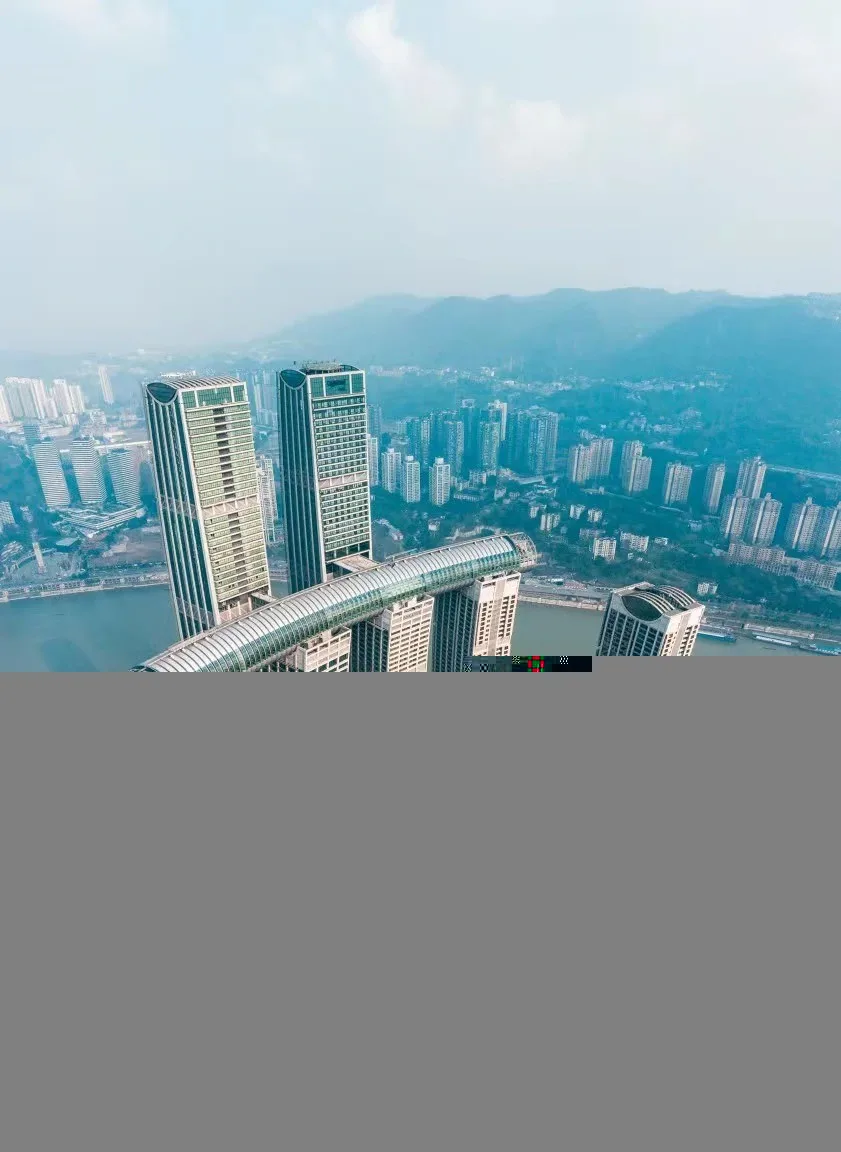
What to See: The Sky Bridge and the Cloud Deck
-
Crystal Sky Bridge (水晶连廊): Spanning four of the eight towers, this is the longest sky bridge in the world at this scale — 300 metres long, 32.5 metres wide, 26.5 metres tall, and weighing some 12,000 tonnes. Inside it hold an observation deck, an infinity pool, restaurants, and a sky garden.
-
Exploration Deck · Cloud Paradise (探索舱·云端乐园): Perched 250 metres above the ground, it features the fully transparent glass walkway “Cloud Walk” (云中漫步) and a cliff-edge swing, both hanging over the two-river confluence below.
-
The two-river confluence: From Chaotianmen Square and the sky-bridge deck, you can clearly see the Yangtze’s silty yellow water meeting the Jialing’s clearer green — the famous “mandarin-duck hotpot” (鸳鸯锅) phenomenon, most vivid during the summer flood season.
-
The shopping mall: Around 235,000 square metres of retail with more than 400 brands, including Chongqing’s first Apple Store and a Heytea “black-gold” flagship.
Architecture: Moshe Safdie’s Sailing Ships
The design is by Israeli-Canadian architect Moshe Safdie (摩西·萨夫迪), best known for Singapore’s Marina Bay Sands. Raffles City adopts a “sail” motif: each tower twists gently as it rises, mimicking a sail catching the wind. The facades combine glass curtain walls with aluminium panels, and the night lighting — designed by BPI — animates the sails with a moving play of light after dark.
The Crystal Sky Bridge itself is a steel-truss structure built using the pioneering “high-altitude assembly + integrated lifting” method, setting several engineering records. On the public art side, sculptures such as River and City and Chaotianmen weave in motifs from Bayu culture — the ancient civilisation of the Sichuan-Chongqing region.
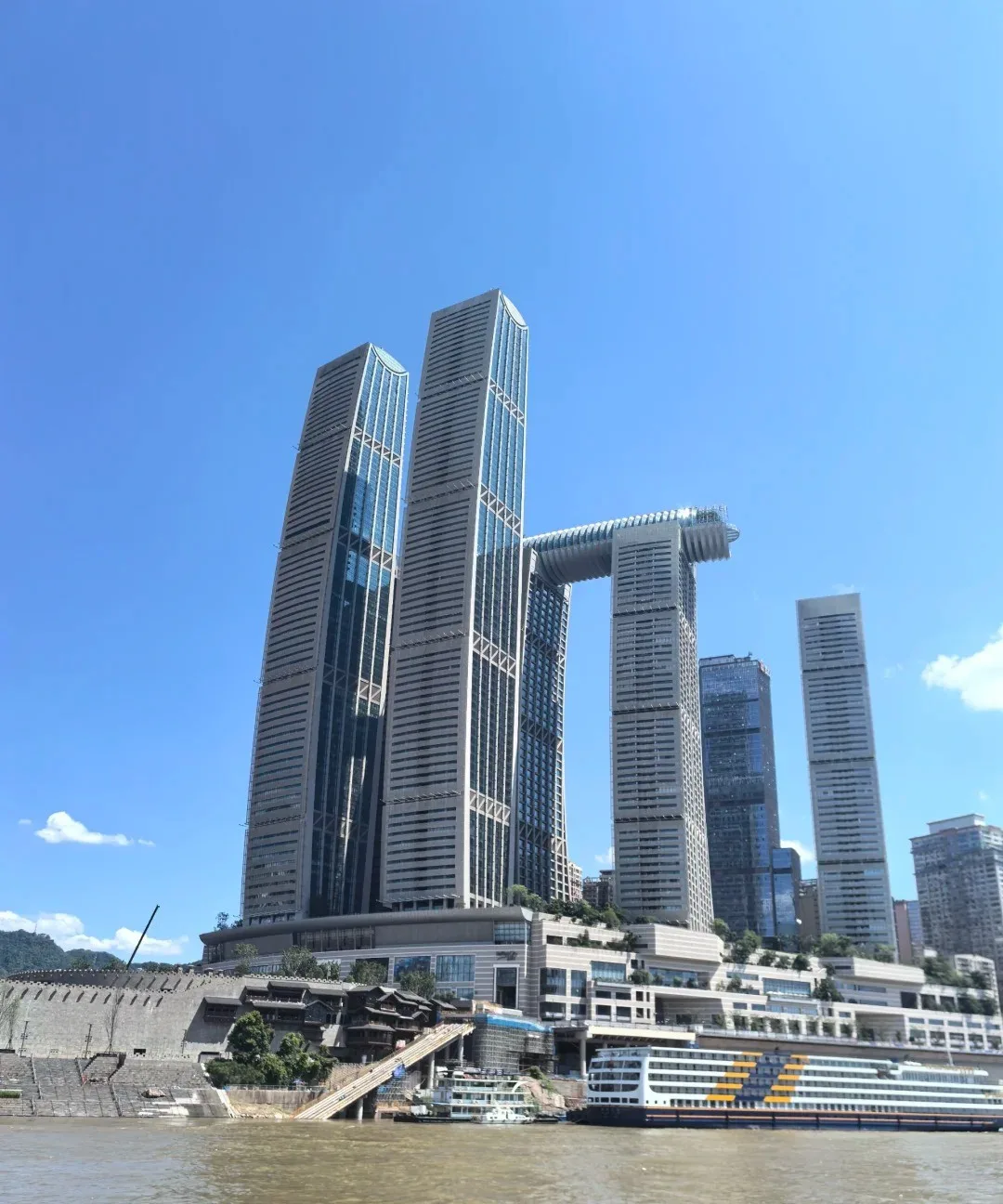
Cultural Significance: A Modern Ship for an Ancient Port
Although it is a contemporary glass megastructure, Raffles City is built on a site carrying three thousand years of urban memory. By preserving Chaotianmen Square and restoring fragments of the old city wall — such as the Dongshuimen (东水门) ruins — the project deliberately threads itself into the city’s historical lineage rather than replacing it. It has become the contemporary face of Chongqing’s “mountain-city, river-city” identity, appearing in films such as Better Days (少年的你) and A Writer’s Odyssey (刺杀小说家), and in international media, raising Chongqing’s global profile. Its “mega-complex + transport hub” model — with direct underground access to Metro Line 1 and a bus terminal — has also become a reference for transit-oriented development (TOD) across China.
Practical Information
Visitor Details
-
Opening hours: Shopping mall 10:00–22:00; Exploration Deck · Cloud Paradise 10:00–21:00 (last entry 20:00).
-
Admission: Exploration Deck adult ticket 180 yuan; Cloud Walk add-on 80 yuan. The sky-bridge observation deck is free (enter via the shopping mall).
-
Address: No. 8 Jiesheng Street, Yuzhong District, Chongqing (beside Chaotianmen Square).
-
Phone: 023-63708888 (customer service).
Visiting Tips
-
Best window: Arrive between 17:00 and 19:00 to catch the sunset and the night view in one visit; the two-river light show switches on at 19:30.
-
Photo spots: The Clock Tower Square on Nanbin Road, the Grand Theatre at Jiangbeizui, and aerial shots from the Yangtze River Cableway give the most iconic angles.
-
A practical note: The sky-bridge observation deck does not require a ticket, but you must take the elevator from the mall’s L1 level up to L47. It gets crowded on holidays — come off-peak if you can.
-
Food: The “Chaotianmen Food Street” on B1 serves local snacks such as Chongqing xiaomian noodles and hot-and-sour glass noodles.
Nearby Attractions
Raffles City anchors the eastern tip of the Yuzhong old city, with Chongqing’s signature sights within easy walking distance:
-
Hongyadong (15-min walk): The cliffside stilt-house complex famous for its fairy-tale night views and Bayu folk culture.
-
Jiefangbei (10-min walk): Chongqing’s commercial heart, home to the War of Resistance victory monument.
-
Yangtze River Cableway (10-min walk to Xinhua Road station): A cross-river cable car, 20 yuan one way.
-
Huguang Guild Hall (20-min walk): A Qing-dynasty complex of migrant merchants’ halls, a Major Historical and Cultural Site Protected at the National Level.
Best Time to Visit
Chongqing has a subtropical monsoon climate — hot and foggy in summer, damp and cold in winter. The most comfortable seasons are spring (March–May) and autumn (September–November), when temperatures sit around 15–25°C and the air is clear enough to enjoy the views. Summer (June–August) can climb to 40°C, though every mall here is fully air-conditioned; winter (December–February) brings thick fog that can block the panoramas. From May to October, during the flood season, the “mandarin-duck hotpot” contrast of the two rivers is especially striking.
Getting There & Where to Stay
-
Metro: Line 1 to Chaotianmen Station (Exit 2) — right at the complex; or Line 6 to Xiaoshizi Station for a short transfer.
-
Bus: Routes 181, 382, 503 and others stop at the Chaotianmen hub.
-
By car: Navigate to “Chongqing Raffles City Parking”; around 3,000 spaces at 5 yuan/hour.
-
Hotels: InterContinental Chongqing Raffles City (inside the sky bridge, ~1,500 yuan/night); Ascott Raffles City (serviced apartments, ~800 yuan/night); budget options nearby such as Hanting and 7 Days Inn (~300 yuan/night).