Культура напитков в Китае: от гунфу-чая до хайпового чая с молоком
I’ve lived in China on and off for four years. From buying bottled water at convenience stores in the beginning to now casually discussing “rock rhyme” (yan yun) and “returning sweetness” (hui gan) with tea shop owners, there’s been a long sensory awakening in between. Let me organize what I’ve drunk and studied over these years into a comparison — traditional tea versus new-style drinks, two threads, one China.
Traditional Tea: The Slow Side
China is the birthplace of tea — stating this feels redundant, but you don’t truly grasp its weight until you sit down for a proper gong fu tea session.
Gong Fu Tea Is Not a Type of Tea — It’s a Brewing Method
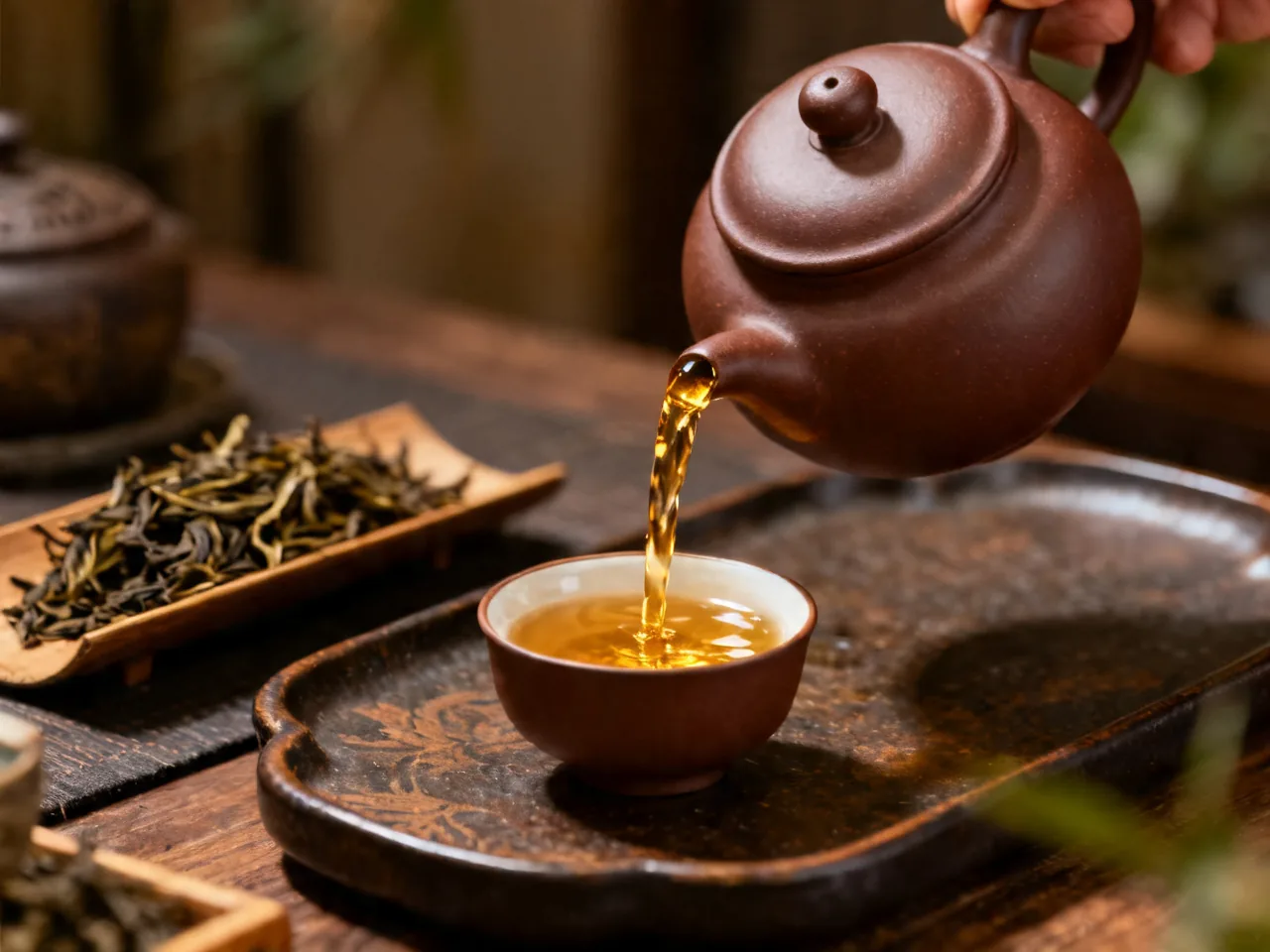
Many foreign friends assume “Kung Fu Tea” is a variety of tea. It isn’t. It’s a brewing method. The core idea: small pot, multiple infusions, each yielding just a few dozen milliliters — you taste the tea leaf’s evolution across different water temperatures and steeping times.
A single oolong can be infused seven or eight times, each round tasting different. The first infusion is a rinse — you don’t drink it. The second hits hardest with aroma. The third and fourth are the richest in body. By the seventh, the flavor fades, but the hui gan (returning sweetness at the back of the throat) actually becomes more pronounced. My first complete gong fu tea experience was in Wuyishan, Fujian, where a tea farmer invited me to sit and drink Da Hong Pao for two hours. I did absolutely nothing that afternoon but sit in a bamboo chair and drink. When I left, I asked him how much this tea cost per jin (500g). He said, “This one isn’t for sale — I keep it for myself.”
The Six Tea Categories at a Glance
| Category | Examples | Fermentation | My One-Liner |
|---|---|---|---|
| Green | Longjing, Biluochun | Unfermented | Like a spring meadow — refreshing but fades fast |
| White | Silver Needle, Shou Mei | Lightly fermented | So subtle you think there’s no flavor, then the aftertaste arrives |
| Yellow | Junshan Silver Needle | Slightly fermented | Green tea’s upgrade — softer, but too niche to find easily |
| Oolong | Tieguanyin, Da Hong Pao | Semi-fermented | Most versatile — same tea, ten infusions, ten different flavors |
| Black (Red) | Keemun, Lapsang Souchong | Fully fermented | Closest to what Westerners recognize as “tea” |
| Dark | Pu’er | Post-fermented | Like drinking liquid vintage — the older, the more valuable |
Note: What Chinese call “red tea” (hong cha) is “Black Tea” in English. And Chinese “black tea” (hei cha, like pu’er) is “Dark Tea” in English. This translation mismatch has confused countless people.
Where to Experience It?
I’d recommend three tiers:
Entry level: Any city’s “tea city” or “tea market.” Walk into any shop, sit down, say “I’d like to try some” — the owner will brew a few types for you to taste. You won’t be pressured to buy (most of the time). Beijing’s Maliandao Tea City and Guangzhou’s Fangcun Tea Market are the two biggest.
Intermediate: Visit the growing regions. Wuyishan for rock oolong, Hangzhou for Longjing, Yunnan for pu’er — drinking tea where it grows feels completely different. Wuyishan in particular: many farmers there welcome visitors and walk you through the entire process, from picking to roasting.
Deep dive: Take a tea ceremony class. Shanghai and Chengdu have quite a few English-language tea art classes aimed at foreigners, usually two to three hours. After completing one, you’ll be able to brew a proper gong fu tea session on your own.
New-Style Drinks: The Fast Side
If traditional tea is spending two hours sipping toward life enlightenment, new-style tea drinks are — queuing for thirty minutes, getting a photogenic beverage, posting it to social media, and finishing it in ten minutes.

These two forms coexist perfectly in China, with zero mutual disdain. The same young person might grab a HEYTEA “Grape Boom” downstairs from the office in the morning and head to a traditional teahouse to brew Tieguanyin in the afternoon.
The Big Three Compared
China’s new-style tea drink market has reached a suffocating level of competition. But for tourists, knowing three brands is enough:
HEYTEA: Positioned as premium, 20–40 yuan per cup. Famous for real-fruit and cheese-cap tea drinks. Store design is meticulous — every location has different decor, some becoming Instagram landmarks themselves. My top recommendation: “Grape Boom” — whole hand-peeled Kyoho grapes in green tea with a salted cheese cap on top. Sounds strange. Tastes addictive.
CHAGEE (Bawang Chaji): The fiercest dark horse of the past two years, focused on “original leaf fresh milk tea” — real tea leaves brewed fresh, mixed with real milk, no creamer, no tea powder. Priced at 15–25 yuan, cheaper than HEYTEA. Their signature “Boya Juexian” is jasmine tea + fresh milk — strong tea flavor without bitterness, milk aroma without heaviness. They’ve already expanded to Southeast Asia and Europe.
MIXUE Bingcheng):
MIXUE (Mixue Bingcheng): China’s national-level budget brand. A lemonade for 4 yuan, an ice cream for 3 yuan. Maximum value for money. Over 36,000 stores — more than four times Starbucks’ 7,000+ locations in China. Its theme song, “You love me, I love you, Mixue Ice City so sweet,” has reached “Baby Shark” levels of brain-worm status in China. Walk in, and it’s probably playing on loop.
Beyond Milk Tea
The new-style drink category goes beyond milk tea:
Fresh-brewed coffee: Luckin Coffee has driven the price down to 9.9 yuan per cup (regular promotional price). In China, your coffee habit might cost less than back home. Luckin’s “Coconut Latte” is the mega-hit of mega-hits — coconut milk plus espresso, naturally sweet without added sugar.
Fresh-squeezed juice and coconut water: Almost every mall’s basement floor has a fresh juice shop. About 15 yuan gets you a cup of juice from freshly cut fruit, with more generous portions than you’d expect. Hainan coconut water is everywhere in southern cities — a whole coconut with a straw stuck in, about 10 yuan.
Comparison: Where Two Drink Cultures Meet
| Dimension | Traditional Tea | New-Style Drinks |
|---|---|---|
| Time investment | 30 min to half a day | Queuing + making: 5–30 min |
| Social function | Sit down, slow conversation | Grab-and-go (or photo op) |
| Price range | Free tasting to thousands per pot | 4–40 yuan per cup |
| Health factor | Zero sugar, zero additives | Generally high in sugar |
| Cultural depth | Extremely deep | Shallow but fun |
| Tourist-friendly for quick try? | Needs time and guidance | Walk in, order, done |
My suggestion: try both. Spend an afternoon at a tea market or teahouse, absorbing the slow tempo. Then, while shopping, grab a CHAGEE or HEYTEA and feel the speed and creativity of young China. Put these two sides together, and that’s the real Chinese drink culture.
If I could recommend just one thing to a first-time visitor? Find a street-side old teahouse, order a pot of whatever the most common local tea is (just tell the owner you know nothing — they’ll handle the rest), and sit down. Whether the tea tastes good is secondary. What matters is that afternoon you’ll see how Chinese people while away time over a single pot — and that scene itself is the finest cup of tea.
Related Reads
- The 8 Great Cuisines of China
- Spellbound at First Bite: A Stranger’s Descent into Chengdu’s Heat
- Street Steam: The Real Pulse of Chinese Cities
- The Peppercorn Dossier: Sichuan’s Flavor Map Through a Botanist’s Eyes
- 10-Day East China Five-City Loop