ウルムチ旧市街の灯りがともると、クミンと人声が夜を焼き温めた
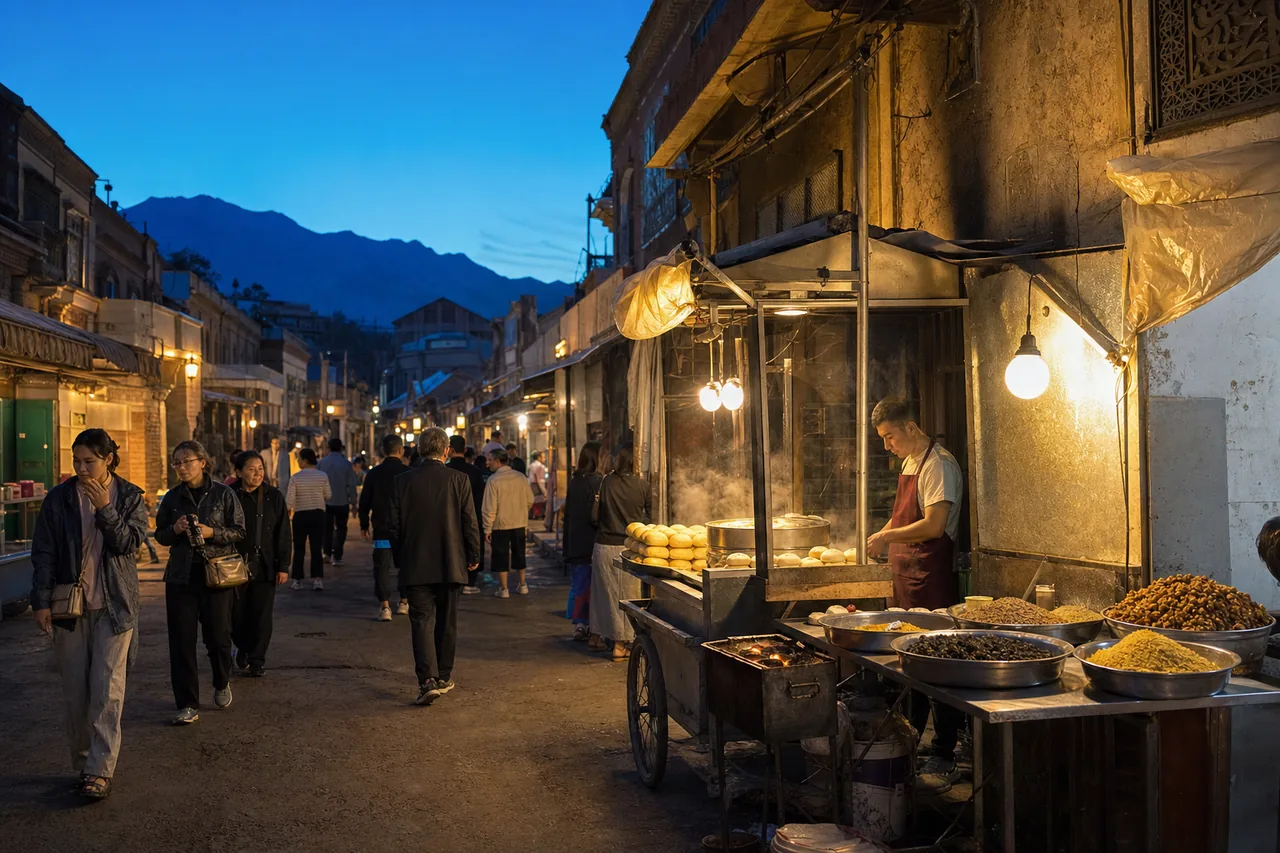
Night in Urumqi does not fall all at once. It comes like a piece of blue velvet slowly pushed from the foot of the Tianshan Mountains, first covering distant rooftops, then treetops at intersections, and finally resting on the lamps that light up one by one along the old street. At dusk I walked into this neighborhood, where the day’s remaining heat still clung to the walls and the smell of baked buns drifted from deep lanes, mixed with cumin, coal fire, raisins, and dust. The lamps of the old street were not orderly. Some hung above doorframes, some drooped from iron frames of food stalls, and some were half-covered by plastic awnings, making the light uneven, like a manuscript written by the city itself. They did not have the standardized brightness of shopping malls, but they felt more like human eyes, carrying fatigue, warmth, alertness, and tenderness. I slowed down and watched the first lamp turn the cut surface of a melon into honey, the second fall on a tea glass in an old man’s hand, and the third stretch the shadow of a running child. The old street lamps of Urumqi are not merely for illumination; they are the opening lines of night, gradually brightening the memory of a frontier city.
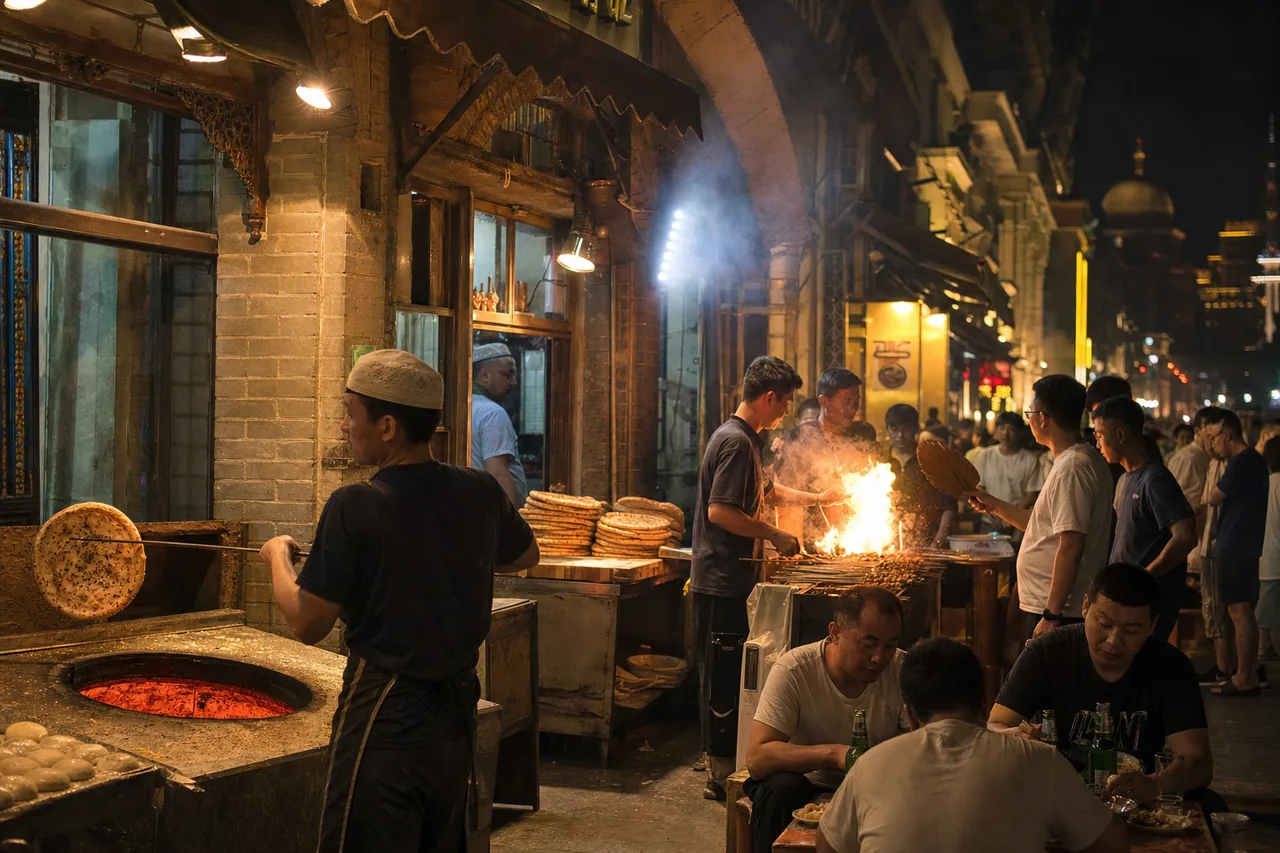
Shops on both sides of the street lit up one after another. Their signs carried Chinese characters and Uyghur script, straight strokes and curved letters leaning toward each other under the lamps. The naan oven glowed red at its mouth, and the baker used a long hook to remove round breads from the oven wall with a skill that made it seem as though he were lifting small moons out of time. Next to him, several people had gathered around a lamb skewer stall. Iron skewers turned over the fire, and when fat dripped down, flames leapt up, lighting the vendor’s face clearly for a second before it retreated into smoke. The light spread through the smoke with a soft graininess, making everything appear as if seen through memory. Someone stood by the road talking on the phone with laughter in his voice; someone rode an electric scooter through the crowd with vegetables in the basket; tourists raised phones, trying to place lamps, smoke, signs, and pedestrians inside one frame. But the beauty of old street lights is difficult to capture whole, because it does not live only in images. It lives in smells, temperature, vendors’ calls, and the slight unevenness of old bricks underfoot.
I stopped at a stall selling dried fruit, where the vendor arranged figs, almonds, dried apricots, and raisins into small hills. A bulb hung above them, making the piles look like quiet glowing stones. He handed me a raisin to taste, and its sweetness was so dense that it seemed to carry the weight of sunlight. I asked where the dried fruit came from. He said some from Turpan, some from southern Xinjiang, and his tone was ordinary when naming these places, yet I felt a vast map opening under the lamp. This is what Urumqi does: it gathers distant places into one street, folding mountains, basins, oases, deserts, and city life between stalls. The old street lamps illuminate not only trade, but also migration, encounter, and staying. A city’s identity is sometimes not in the outline of tall buildings, but in place names casually spoken by a night-market vendor, in the sweetness of a raisin, and in the second when you realize you are standing at the crossing of many roads.
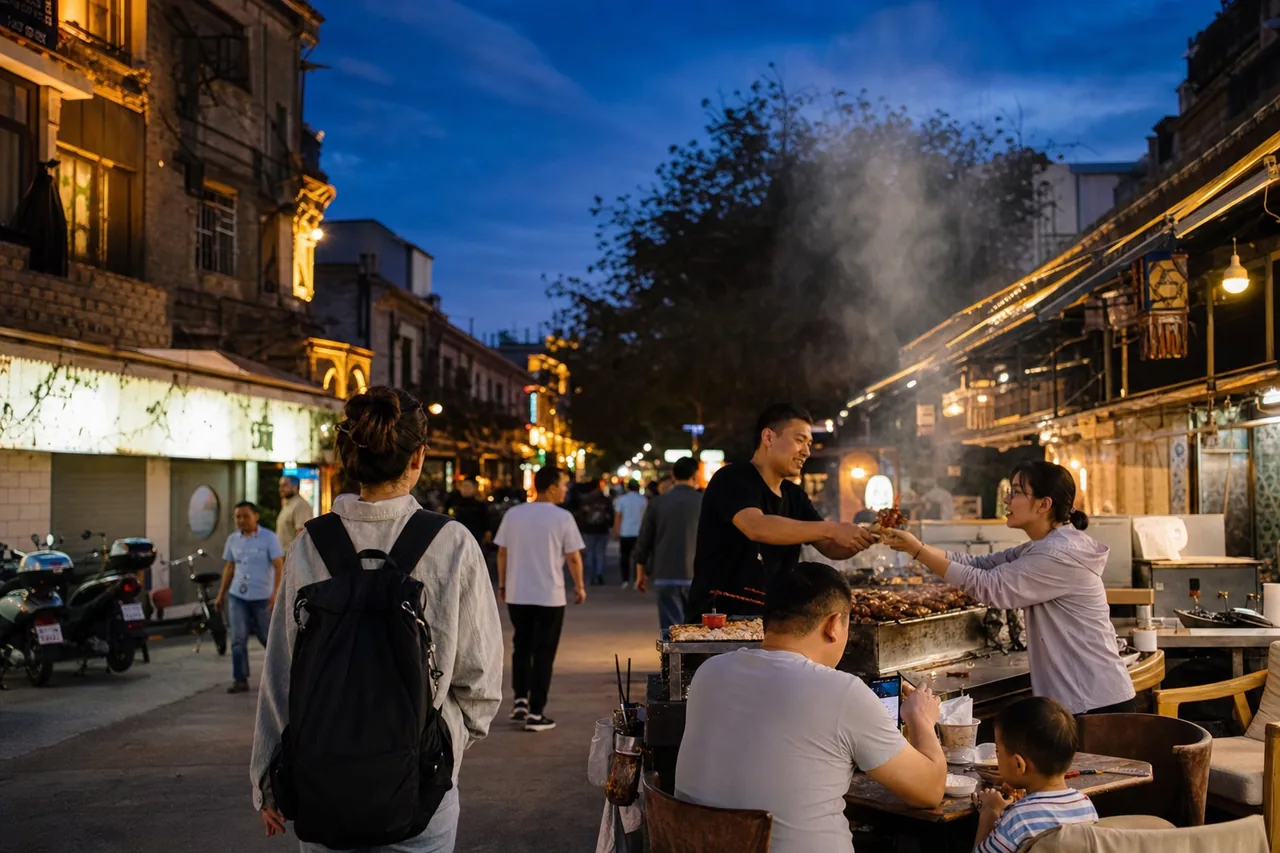
As I continued forward, the old street grew livelier. Music drifted from a small shop, its rhythm brisk, and several young people at the entrance moved their shoulders to the beat. Across the way, in a restaurant, a waiter carried a large plate of chicken between tables, the peppers and potatoes shining with oil under the lights. Menus were pasted on the glass window, and the writing blurred slightly as indoor and outdoor light reflected over it again and again. People waiting at the entrance did not seem impatient. They chatted while standing in line: some in Mandarin, some in Uyghur, and some in accents mixed from several places. Here language does not feel like a boundary. It feels more like lines crossing in the night wind, winding around lamp posts, stalls, and everyone willing to stop for something to eat. I could not understand every word, but I understood laughter and the tones of bargaining. The old street lamps gave these sounds a shape, making me feel that a city’s openness is not only in slogans, but in the ability of people at night to stand together under the same patch of light.
One section of the road was lit with a particularly dim yellow. Old air-conditioning units and rows of wires hung from the wall, their shadows crossing like a rough net. Such places are easy for tourists to pass quickly because they are not pretty enough, not tidy enough, and have no obvious sign for taking photos. Yet I stayed there for a long time. In the corner sat a shoe repairman with a small stool, glue, needles, thread, and several pairs of shoes waiting to be mended. His lamp was a small desk light clipped to a board; its circle of light was only large enough to illuminate the shoe in his hands, but it also revealed a focused calm on the side of his face. Each stitch passing through the leather seemed to sew together someone’s journey again. Those shoes may have walked through markets, stations, schools, construction sites, and doorways, carrying different bodies to this little lamp. Compared with neon signs, the shoe repair lamp made the old street feel more real to me: it is not responsible for excitement, only for allowing life to continue.
As the night deepened, wind entered from the street corner with a dry coolness. Urumqi’s wind is distinctive, unlike the damp softness of southern cities; it carries the clarity of distant mountains and open land. Bulbs swayed gently, plastic sheets on stalls rustled, and barbecue smoke was blown into slanting lines. People pulled their jackets closer, but they did not leave. Instead, they moved nearer to fire and light. A line formed before a cart selling hot drinks; white steam rose from the pot, cups passed from hand to hand, and fingers briefly met under the lamp. Nights like this make one understand that light never exists alone. It always explains itself through cold. Without wind, light is merely brightness; with wind, it gains the meaning of shelter. The old street lamps shine on everyone who has paused for a while, as if saying that no matter where you come from, there is always a place at night with warmth and light where you can slow your steps.
I reached an intersection where traffic lights overlapped with the old street lamps, red and green changes making pedestrians’ faces brighten and dim. Cars moved along the broader road with the speed and noise of a modern city; turning back toward the old street, I saw stalls, signs, strings of lights, and human silhouettes still tightly connected, like another, slower kind of time. Urumqi does not have only one face. It has overpasses, office towers, and new shopping districts, and it also has lanes like this, lit by old lamps at night. The two kinds of time are not entirely in conflict. They meet at intersections, yield to each other, and then continue separately. A delivery rider stopped before the crosswalk, the cold light of his phone shining on his face, while warm light from the food stall behind him edged his shoulders in gold. He seemed to stand between two layers of the city. The green light came on, and he rode across, disappearing into traffic. In that instant I felt that old street lights are not relics of the past, but the slow heartbeat a modern city still needs.
Back inside the street, I bought a baked bun. The paper bag was hot, and I shifted it from hand to hand by the roadside. When I bit into it, the smell of lamb and onion rushed out, and the juice nearly dripped onto my fingers. Above me a string of small bulbs swayed in the wind, spots of light falling on the paper bag, the back of my hand, and dust on the ground. I finished eating while standing, without looking for a seat and without hurrying away. An old man beside me was eating too. Seeing me inhale because of the heat, he smiled and said, “Slow down.” I nodded and truly slowed down. Many encounters during travel are too brief for names, yet enough to change the speed of a moment. That phrase, “slow down,” felt right under the old street lamps, like the reminder this street gives every outsider: do not treat this place merely as a collection of flavors, and do not chase only the surface of liveliness. Slow down, and the lights will show you the hands behind the food, the days behind the hands, and the roads behind the days.
Near midnight, vendors began packing up. The lamps did not go out all at once; sections of the street darkened one by one. Fruit was covered with cloth, fires in ovens were lowered, tables and chairs were stacked, and the ground kept oil spots, water marks, and crushed paper. After the liveliness withdrew, the old street revealed another face, like someone still spirited after removing makeup. Several cleaners pushed carts in, and the sound of brooms again became the street’s main sound. The remaining lamps stretched their shadows long and clearly illuminated the final labor of the night market. People often remember the brightest, most fragrant, most crowded moments of night, but easily forget those who close it. Without this closing work, the next evening’s lamps could not shine cleanly again. I stood by the road watching for a while, suddenly feeling that the old street lamps do not illuminate one kind of person, but the entire cycle: preparation, welcome, noise, fatigue, cleaning, and waiting for dawn.
As I left, I looked back at the last few lamps still burning. They were not dazzling; they were even a little old, with dust on the edges of their shades and wires that were not perfectly straight. Yet this imperfection made them believable as part of real life. The old street lamps of Urumqi made me think of many things unseen by day: sunlight in distant orchards, the fragrance of bread baked on oven walls, calluses on the shoe repairman’s fingers, the back of a rider crossing an intersection, the patience of cleaners sweeping between bricks. The lamps tied these scattered fragments of life into a line through the night, allowing even a stranger to follow it briefly into the city’s interior. Perhaps the meaning of travel is not to see a place at its neatest, but to see how it preserves warmth amid disorder. When I walked out of the old street, the lights behind me were gradually blocked by the corner, but their warmth remained. I know many cities have lamps, but not every city’s lamps can make you feel that you are being gently seen by a life both vast and specific.