Morning Mist at a Guilin Pier Taught Me Not to Treat Landscape as Background
On my second morning in Guilin, I walked to the pier before the sky had fully opened. The streetlights looked newly awake, their pale glow lying gently on the wet stone, while mist pulled the river close and left only the faint outlines of the karst hills in the distance. I had come with practical concerns in mind: tickets, departure time, seats, and camera battery. Then I saw a boatman loosen a rope from a wooden post, slowly and without drama, and I realized I had arrived too quickly. This was not a postcard waiting for my shutter. It was a place breathing, working, and handing the last of the night over to the morning.
I used to treat landscapes as the rear half of a picture: people in front, mountains behind; boats in front, water behind; a bowl of rice noodles in front, a city behind it. After enough trips, that habit becomes so convenient that it can feel like understanding. But the mist at the Guilin pier disturbed every layer. The hills were not standing far away to decorate my frame, and the river was not a flat surface laid out for me to pass over. They lowered the volume, slowed the movements, and gathered footsteps, swaying boats, and the soft knock of a pole against water into one breath. In that moment, I understood that landscape was not background; it was the grammar of the scene.
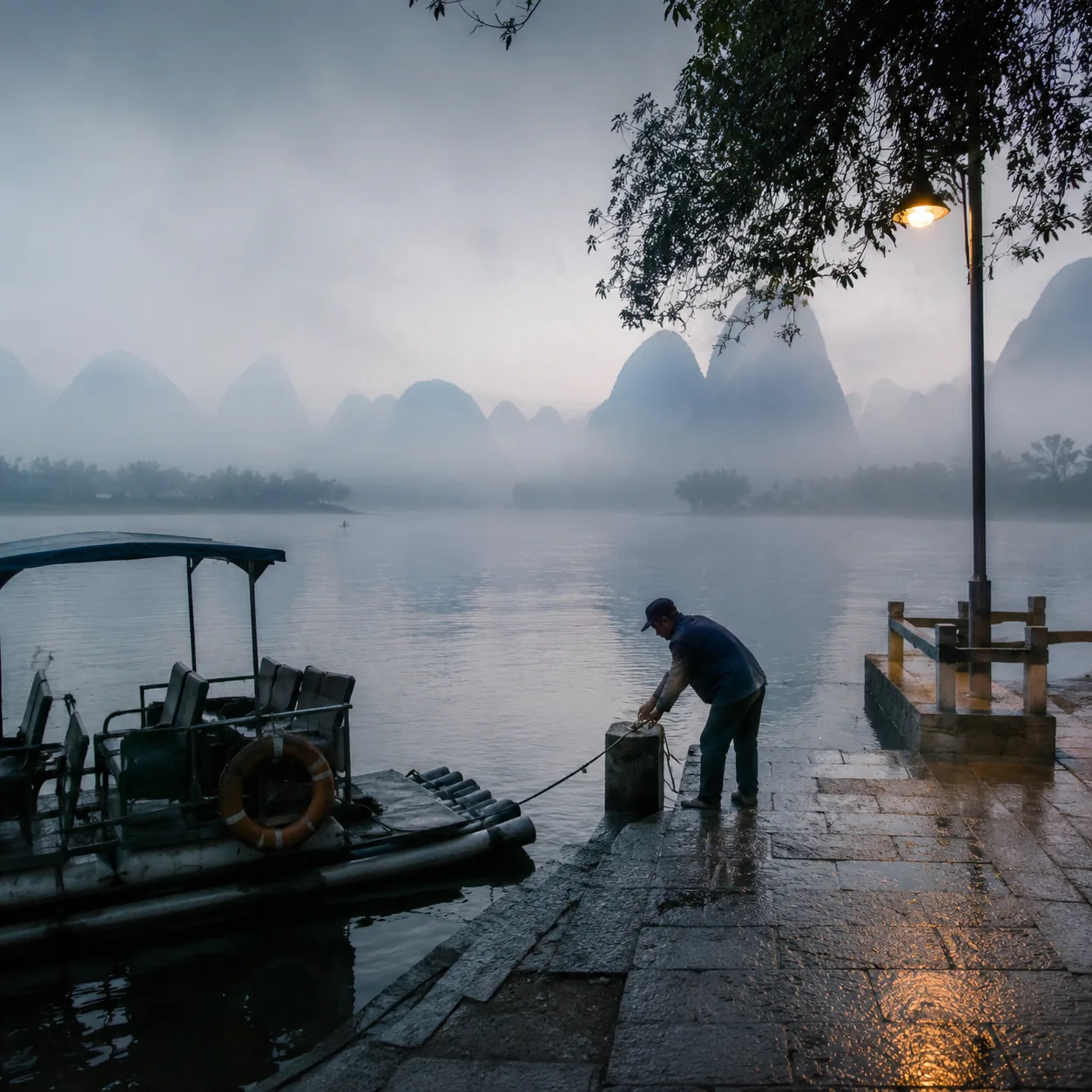
The morning at the pier did not begin with the clean, polished opening of a travel film. A breakfast vendor lifted the lid from a steamer, and the white vapor mixed with river mist until it was impossible to tell which strand came from the pot and which from the water. Some people hurried toward the boat with plastic bags, some crouched on the steps to tie their shoes, and some asked in low voices when the boat would leave. Everyone seemed lightly wrapped by fog, their outlines softened but not erased. What blurred was my original expectation. I thought early Guilin would arrange its peaks neatly for my appreciation. Instead, it first showed me how a pier wakes up and how the landscape joins an ordinary morning shift.
Before the boat had departed, the river had already begun telling the journey. It did not speak grandly; it relied on details. An empty bottle was nudged toward the bank and then carried back by ripples. A leaf slid along the side of a boat as if searching for a quieter place. The reflection of trees across the water came apart in the fog and slowly assembled itself again. Standing on a pier, a traveler can easily believe he is an observer, but the river does not let that role stay firm. It shifts the boards under your feet, pulls your gaze downward, and makes you admit that you are also a small part being moved by the morning.
After I sat down on the boat, the engine first coughed softly, then settled into a continuous low vibration. We left the bank so slowly that people on the pier still had time to exchange a few more words with people onboard. Some waved, some only nodded, and some raised phones to take pictures but lowered them quickly, because the scene in the mist refused the borders of a screen. Peaks withdrew from the whiteness and slipped back again, as if unwilling to hand themselves over all at once. The bow moved forward, yet the scenery did not rush toward us. It developed layer by layer, like a slow motion sequence in an old film.
This stretch of water taught me to see slowness as something other than delay. Sometimes slowness is an arrangement that gives attention time to move from outcome back to process. Had the weather been clear, I might have rushed to identify which hill looked like a camel, which peak resembled a brush rack, and which reflection was best for a photograph. But the mist hid names, softened shapes, and pressed down the thoughts in me that wanted to classify everything. Without clear labels, I began to notice how the boatman read the current, how an elderly passenger rested his hand on the rail, and how a child did not shout when a mountain shadow appeared, but simply widened his eyes.
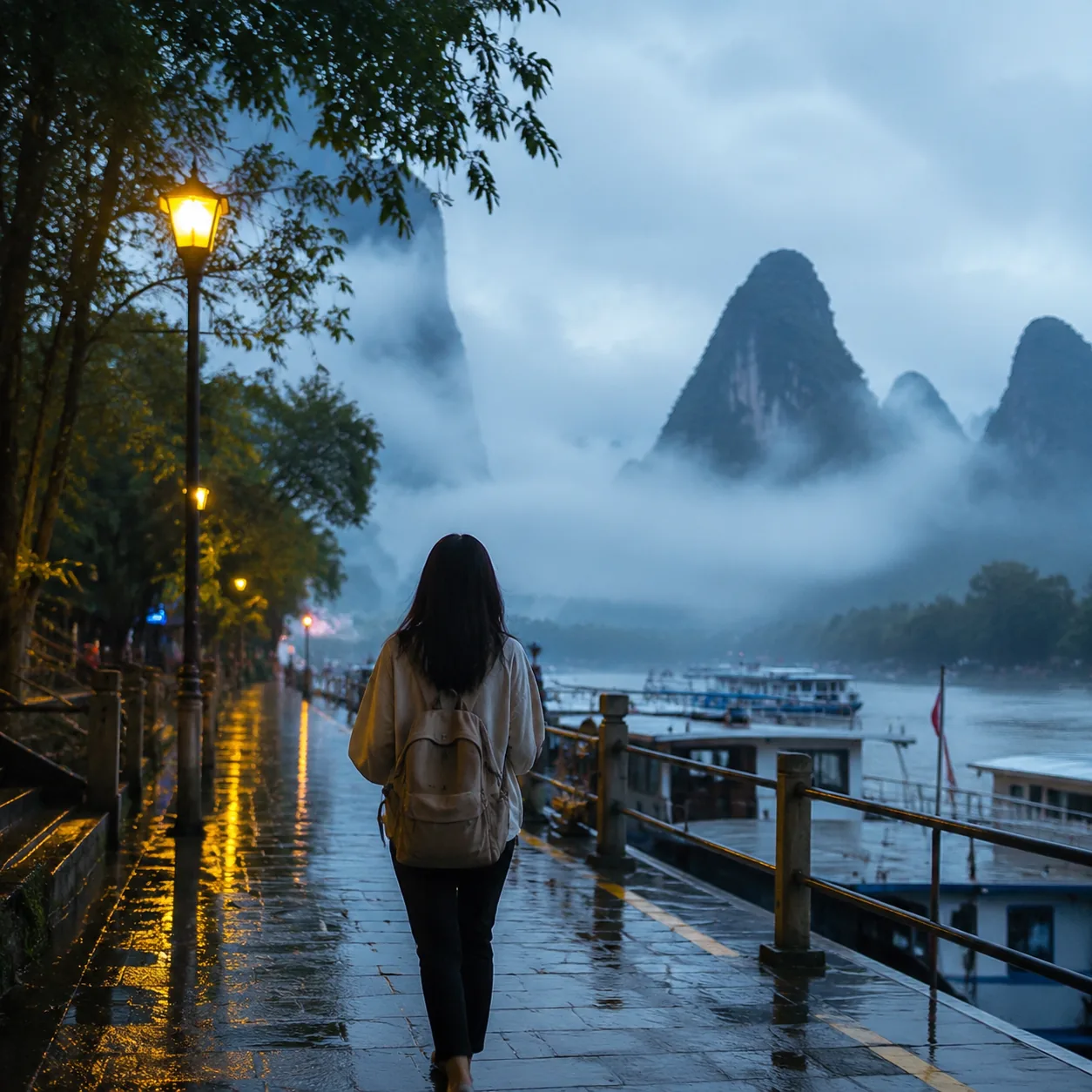
Guilin’s hills are often described as strange, graceful, steep, and clear. Those words are not wrong, but they can too easily turn landscape into an exhibit. Sitting on the river, I felt that such words lacked the weight of daily life. The grace of the hills included dampness, the smell of boat paint, hot soy milk in a breakfast bag, and the lowered wonder of passengers. The clarity of the water included a faint scent of engine oil, marks left by bamboo poles, and the sound of washing from riverside homes. The landscape was not precious because it escaped daily life. It felt believable because it touched daily life everywhere.
When the mist thickened, the boat ahead of us was reduced to a small light. It was not bright, but it was enough for the boat behind to understand direction. The boatman showed no anxiety. He only turned his head from time to time, glancing at the water and then at the line of the bank. I asked whether fog like this was common. He said it often appeared between winter and spring, and that one simply needed to go slower. The sentence was ordinary, but it stayed with me. Many travel tips teach people how to arrive faster, miss less, and fill a day completely. The mist at the pier taught something else: some places do not ask for more speed, but for the willingness to admit unclear vision and move only as fast as seeing allows.
I did not take a single sharp photograph on the boat. The hills in my pictures all seemed veiled, and the water lacked the postcard blue-green I had expected. At first I felt a little disappointed, but when I reviewed the images later, they seemed closer to that morning than clearer pictures would have been. Guilin in mist was never something to possess at one glance. It kept me between understanding and not understanding, asking me to postpone the simple judgment of beauty and first ask: Who lives here? Who works here? How is this water route used every day? In someone else’s eyes, are these peaks also just markers on the way to work?
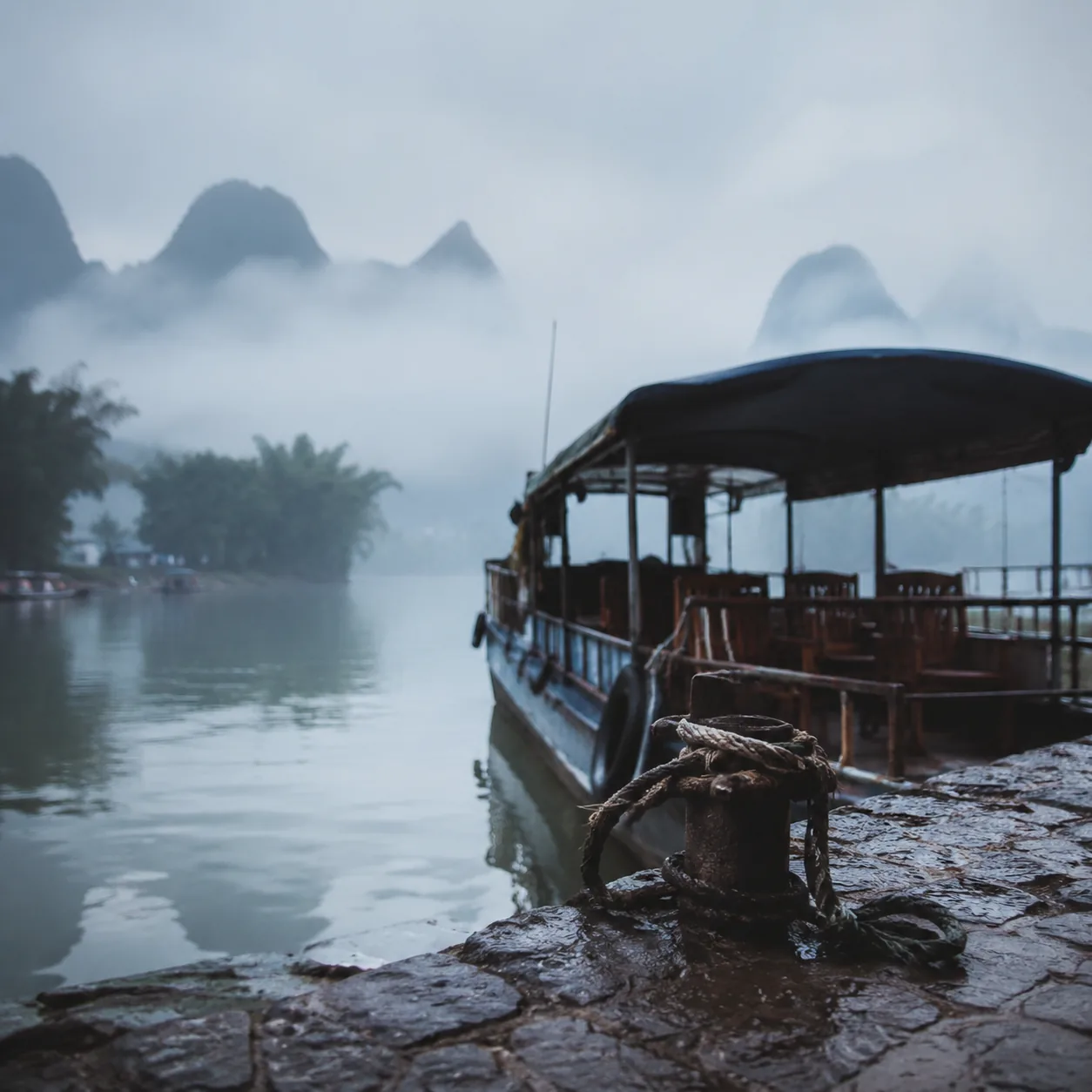
Near a small ferry stop, our boat paused for a while. On the bank, people unloaded goods from a three-wheeled cart; plastic sheets covered the cardboard boxes to keep out dampness. A woman stood on the steps calling someone’s name. The mist swallowed half her voice, and the water returned a little of it. The tourists grew quiet, as if suddenly aware that we were not passing through a pure scenic zone but through other people’s schedules. At that moment, the landscape was no longer suspended in an aesthetic position. It became route, weather, income, waiting, and exchange. Scenery does not become purer by moving farther from life. Often, it gains depth exactly where life is exerting itself.
I began to understand that the phrase “traveling inside a painting” loses half its meaning if it is understood only as prettiness. People are inside the painting not merely because the surroundings are beautiful, but because people change the painting’s rhythm. The boatman’s hands, steam from breakfast stalls, calls from the bank, and passengers’ silence all keep the picture in motion. Without them, hills would still be hills and water would still be water, but the morning would lack its temperature. I used to wait for a scene without clutter, strangers, wires, or traces of use before taking a clean landscape photo. That day I felt that what I called clutter might be the very way a place explains itself.
The mist dispersed slowly. It was not pushed away all at once by sunlight. It first thinned around the waists of the hills, then rose from the water, and finally lingered between treetops and roofs. As visibility improved, the tourists became lively again. Phone shutters clicked more often, the guide began naming the peaks, and someone in the cabin discussed what to eat at the next stop. I listened and looked, but I no longer hurried to turn the information into a checklist. Names are useful, and routes are useful, but they should not replace the scene itself. The most powerful part of a place is often not how much introduction you remember, but whether it changes the order in which you observe.
After getting off the boat, I stood beside the pier for a few minutes. The sun had thinned the mist, the river showed a clearer color, and the places that had seemed mysterious began to look ordinary. Some people cleaned the cabin, some gathered empty cups into a bag, and some called the next group of passengers aboard. I suddenly felt that this return from mystery to daily life was more worth remembering than any fixed angle. Guilin’s landscape does not exist only in its most beautiful second. It also exists in the sound of queuing at the ticket window, in cautious warnings on wet steps, and in the slight bump of a boat touching the bank.
If someone asks me how to see a Guilin pier in the morning, I would not begin by recommending a camera position. A camera position can make a traveler feel secure, but it can also decide the answer too early. I would rather say: stand for a while first, and do not raise the camera too soon. Listen to how water mixes with voices, watch how mist changes distance, and notice how the boatman finds a route on a river that appears nearly the same everywhere. When you realize that the landscape is not merely waiting far away for praise but shaping the scene through every small movement, then you can take a photograph. It may not be clearer, but it may be more honest.
When I left the pier that day, I did not feel that I had completed a sight. I felt as if I had just learned a slower way to read. Guilin placed its landscape before my eyes without rushing to explain it. It let the mist appear first, wearing down my confidence a little, and then allowed boats, banks, breakfast, calls, and ripples to complete the meaning together. Perhaps the hardest part of travel is not finding beauty, but admitting that beauty does not exist alone. It has the background of labor, the temperament of weather, the rhythm of local people, and the gaze of outsiders who must adjust themselves. The morning mist did not hide Guilin; it stopped me from flattening Guilin too quickly.
Looking back, what I remember most is not which hill resembled which legend, nor which stretch of river was best for photography, but the almost imperceptible movement when the boat left the bank. The pier remained behind us, the voices had not yet dispersed, the mist still pressed on the water, and the mountain shadows had not fully steadied themselves, yet the journey had begun. It was not a declared beginning, but a permeating one. It taught me that a place does not always enter you through grandeur. Sometimes it enters through damp air, a low cough from an engine, a waterway whose end cannot be seen, and the moment when you finally allow the background to become the subject.