Я проехал на зелёном поезде из Куньмина в Пекин
I’ll admit it — I’d had a few drinks when I booked this ticket.
Kunming to Beijing, train K474, hard sleeper, 34 hours total. Friends said I was insane — the bullet train takes 10 hours, why spend a day and a half on an old green train? I said: precisely because there are too many fast options, I wanted to try the slow one.
Hour One: Regret
I regretted it the moment I boarded. The carriage smelled like instant noodles mixed with Laoganma chili sauce. My berth was the top bunk — once I climbed up, I could barely roll over. The air conditioning was loud but its effectiveness was questionable.
The lower bunk across from me held a man in his sixties, reading a newspaper through reading glasses. The middle bunk was a college student heading home, scrolling his phone with earbuds in. None of us spoke. I leaned against my pillow and thought: 33 hours to go.
Somewhere in Guizhou, Things Changed
The train left Kunming and first cut through the mountains of eastern Yunnan, tunnel after tunnel, my ears constantly popping. Once we entered Guizhou, the view outside suddenly opened up — layered terraces, small rivers in gorges, a few lone houses perched on mountainsides.
The old man put down his newspaper and asked where I was headed. Beijing, I said. He was going there too — back to see his grandson. Then he pulled a bag of peanuts and two tea eggs from a cloth sack and handed me one. “You’ll feel miserable on a long train ride if you don’t eat.”
That tea egg was the best thing I ate on the entire trip. Not because it was special, but because inside a sealed metal box on rails, a stranger’s kindness hits different.
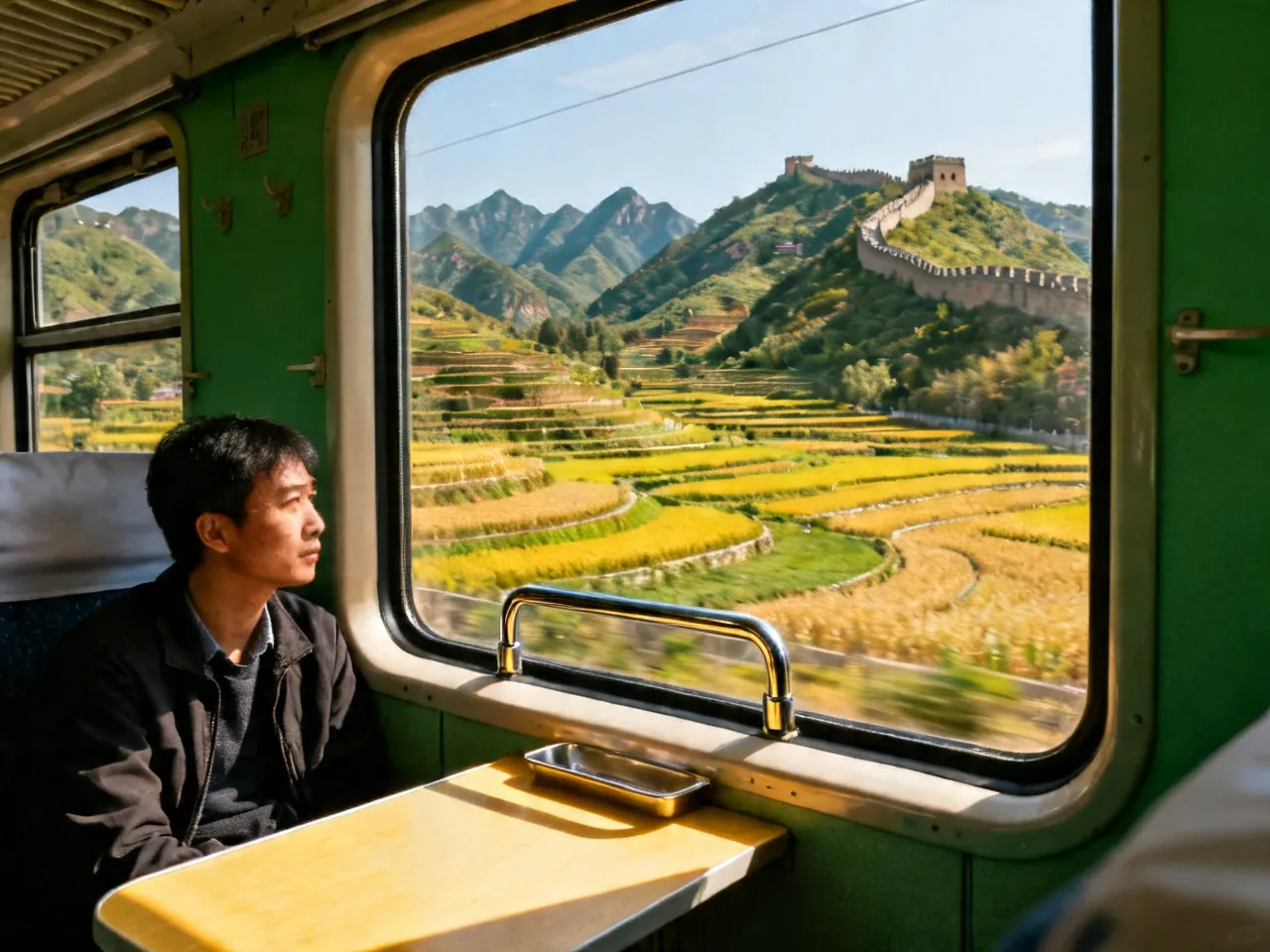
A Cross-Section of China in a Hard Sleeper Car
Thirty-four hours in hard sleeper class, and you’ll see a miniature China.
There were middle-aged migrant workers heading to the city with woven plastic bags stuffed with bedding and homemade pickled vegetables. College students going home for break, playing short videos on speaker — at a volume that, by slow-train standards, counted as polite. A young mother holding a baby who cried from departure until falling asleep, the mother’s eyes reddening right along with the child’s.
And there was an elderly couple who boarded in Hunan, riding all the way to Shijiazhuang. The wife got motion-sick, so the husband fanned her with a hand fan from afternoon until dark. I asked why they didn’t take the bullet train. “Too expensive,” he said. “The money we save is enough for a new school bag for our granddaughter.”
In that moment I suddenly understood: the slow train isn’t just a mode of transport — it’s a parallel world that still exists. In an era when bullet trains compress China into a few hours, people on these green trains are still measuring the width of this country at the slowest possible speed.
3 AM: Whose Hometown Is Outside the Window
Slow trains have a unique nighttime experience: you’ll be jolted awake at 3 AM by the train stopping, pull back a corner of the curtain, and see a tiny station you’ll probably never visit. Dim yellow lights, a station name you can’t pronounce, a few silhouettes smoking on the platform. Then the train moves again, and that place disappears from your life forever.
I woke twice at 3 AM. The first time, outside was some small station in Hunan — heavy rain, water pooled on the platform, a worker in a rain poncho checking something. The second time we’d reached Henan, dawn barely breaking, and outside was an endless wheat field, golden, as if someone had spilled an entire can of paint across the horizon.
Arrival: Beijing West
At hour 34, the train rumbled into Beijing West Station. I grabbed my bag and stepped off, legs slightly numb, neck a bit stiff, but in good spirits. Everyone on the platform was rushing somewhere. Only I stood still for a few seconds — from Kunming’s 25°C to Beijing’s 38°C, from Yunnan’s mountains to the North China Plain, I had spent a day and a half crossing most of China, and every scene along the way was still warm in my mind.
For Those Considering a Slow Train Ride
If you genuinely want to try China’s old green trains, here’s my advice:
Pick the right route. Not every slow-train line is worth the ride. Classic scenic routes include: Kunming→Guiyang→Beijing (crossing the Yunnan-Guizhou Plateau and Central China plains), Chengdu→Xi’an (through the Qinling Mountains), Lanzhou→Ürümqi (Hexi Corridor and Gobi Desert). Pure flatland routes aren’t worth the suffering — 12 hours of cornfields will make you question your life choices.
Get a hard sleeper, not a hard seat. Hard seats beyond 8 hours are genuine torture. Hard sleepers are cramped but at least you can lie flat. Lower bunks are priciest but most comfortable — you can sit up and watch the scenery during the day. Upper bunks are cheapest but most claustrophobic — good only for sleeping. Middle bunks are the sweet spot. Kunming to Beijing in hard sleeper costs around ¥400; bullet train second class is over ¥800.
Bring enough food, but don’t rely entirely on instant noodles. There’s hot water on board, so noodles are convenient, but three meals of them will break you. I suggest bringing a mix of fruit, braised snacks, bread, and munchies. The dining car sells boxed meals for about ¥25-40 — mediocre but at least it’s hot food. At major stations with longer stops, vendors sometimes sell local snacks on the platform — worth a try.
Talk to people. The best part of a slow train isn’t the scenery outside — it’s the people inside. Put down your phone, say something to whoever’s in the bunk across from you, and you’ll hear incredible stories. The old man on my trip ended up talking to me for four hours, from mining coal in the 1960s to babysitting his grandson today — better than any documentary.
I’ve since taken slow trains twice more — once from Chengdu to Xi’an, once from Lanzhou to Zhangye. Exhausting every time, worth it every time. In an era where everything keeps getting faster, occasionally allowing yourself to slow down reveals a China much larger, and much gentler, than you imagined.
Related Reads
- 10-Day East China Five-City Loop
- Lijiang Old Town: Naxi Culture & Snow Mountain Views
- Zhangjiajie Glass Bridge & Tianmen Mountain Guide
- Guilin Li River Scenic Tour Complete Guide
- Spring Bloom Map: China’s Most Beautiful Flower Fields