Дым от ночного гриля научил меня не гоняться только за модными ресторанами
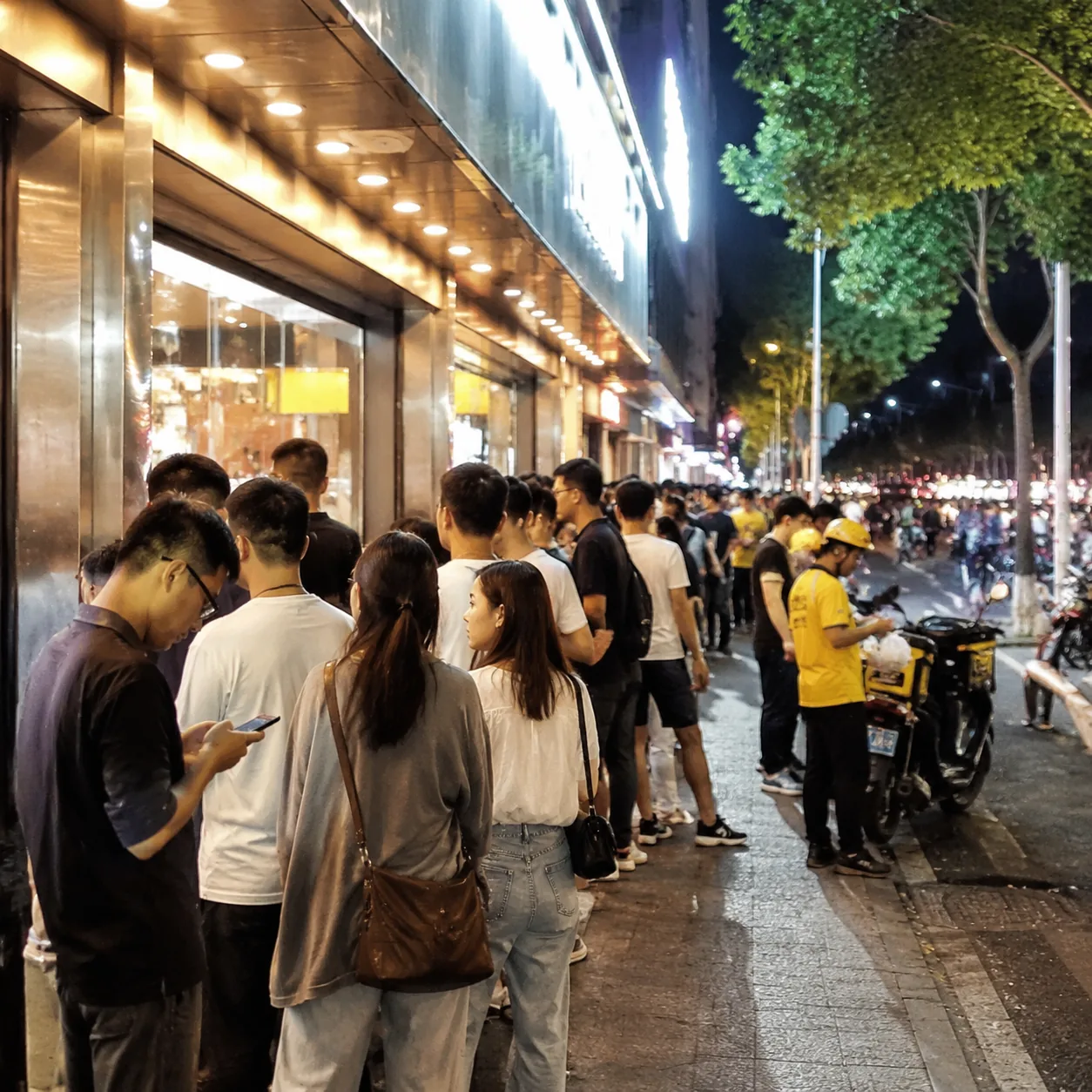
On my second evening in that northern city, I thought dinner had already been arranged. I had saved three restaurants on my phone, all names repeated again and again in short videos: one with a huge sign, one said to be popular even with locals, and one that every blogger called a “must eat.” I followed the map to the first place, and the line had already bent from the door to the roadside. People held number tickets, delivery riders moved in and out beside them, and of course there was fragrance in the air. But the fragrance felt squeezed between neon signs, number calls, and people taking photos. After standing there for ten minutes, I suddenly realized I was not especially hungry for that restaurant’s food. I was only afraid of missing an answer that many others had already approved.
My companion that evening was a local colleague from the company, surnamed Zhou. When he saw me sliding back and forth through my saved list, he did not immediately say, “Don’t line up.” He only asked, “Do you want to eat dinner tonight, or do you want to finish an assignment?” The question stopped me. Of course I wanted dinner, but my movements really did look like completing an assignment: check in, line up, take photos, confirm that I had been there. Zhou smiled and said that if I did not mind walking a bit, he could take me to a street that was not so famous. It did not have dramatic shop names, and he could not promise every stall was delicious, but as long as my nose still worked, it would not go too wrong.
We left the main road and turned into a side street shaded by trees. In the daytime it was probably just an ordinary neighborhood, but at night it opened slowly like a kitchen. First came the smoke, gray-white, drifting low from several charcoal grills and pushed by the evening wind under the streetlights. Then came sound: metal skewers tapping against trays, beer caps being pried open, vendors calling “ready” in short bursts. Only after that did the people come into focus. Plastic tables stood along the sidewalk, and low stools came in mismatched colors: red, blue, and faded pink. No one had arranged the place as an attraction, yet it felt far more like where dinner should happen than the long line we had just left.
At the first grill stall, I made the old tourist mistake again and wanted to ask, “What is the best thing here?” The vendor was a middle-aged man wearing thick gloves, turning a row of lamb skewers. He did not answer directly. Instead, he asked whether I could handle spice, whether I ate fatty meat, and whether I wanted beer that evening. Zhou added from the side that I should not begin by asking for the signature item; I should first let the owner know my taste. The vendor nodded and said lamb skewers should be eaten hot, chicken gizzards were for chewiness, grilled chives absorbed oil easily, and toasted mantou slices were good at the end to settle the stomach. In that moment I understood that people who truly know how to order barbecue are not those who memorize the menu, but those who can explain their appetite clearly.
We did not sit indoors. Instead, we found two plastic stools by the roadside. The stools were low, and once I sat down my knees almost touched the table edge, while my backpack could only fit between my feet. The tabletop had just been wiped, but a little oil still shone at the corners, and the tissue box moved lightly in the wind. At first I felt awkward, as if I was not sitting in a sufficiently proper way. Zhou said the comfort of a grill stall was not in the chair back, but in the distance: close enough to the fire to see how food cooks, close enough to the vendor to hear when to pick things up, close enough to your tablemates that conversation does not need to be formal. Some places in travel are not meant to keep your posture elegant. They ask you to lower your body and sit at the same height as the city.
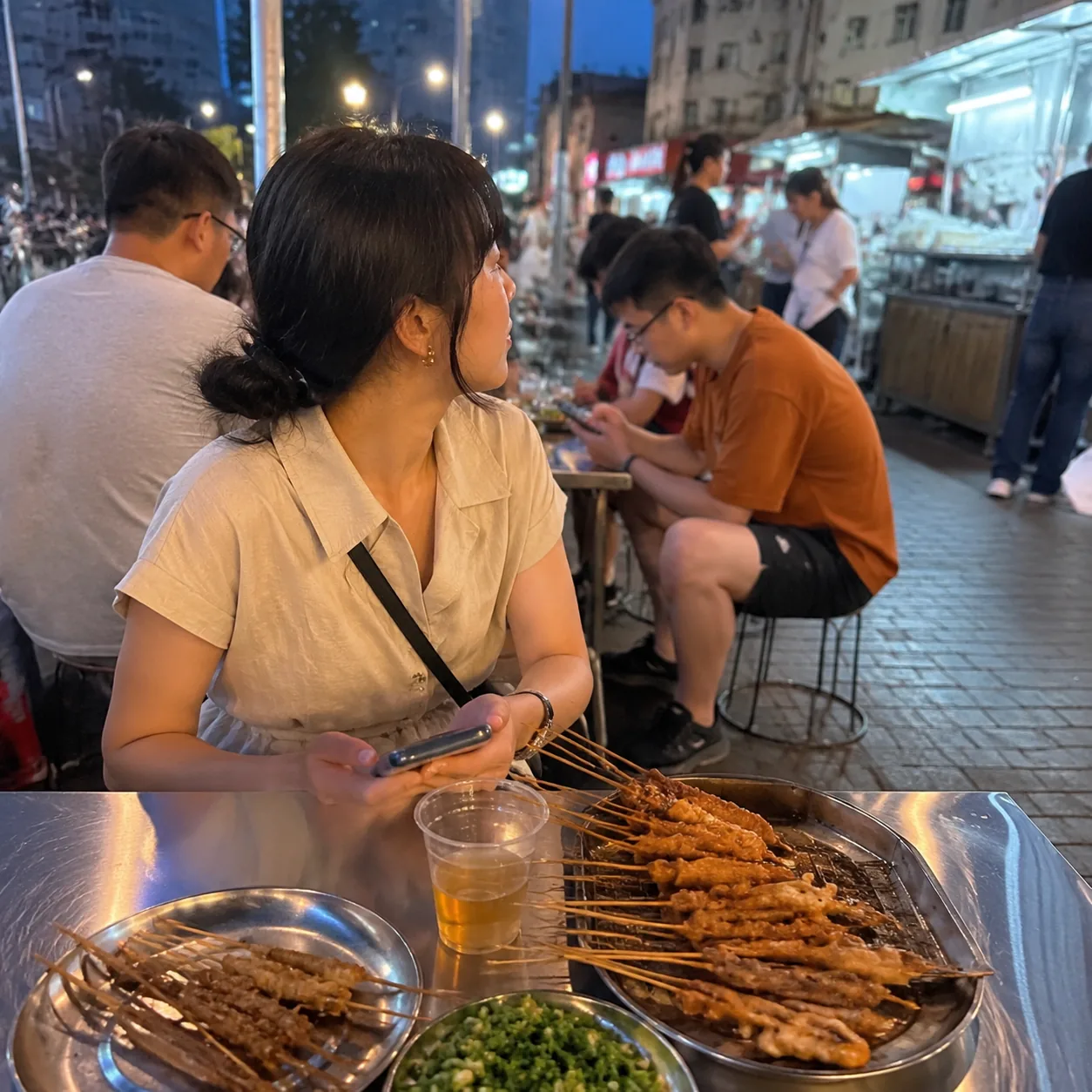
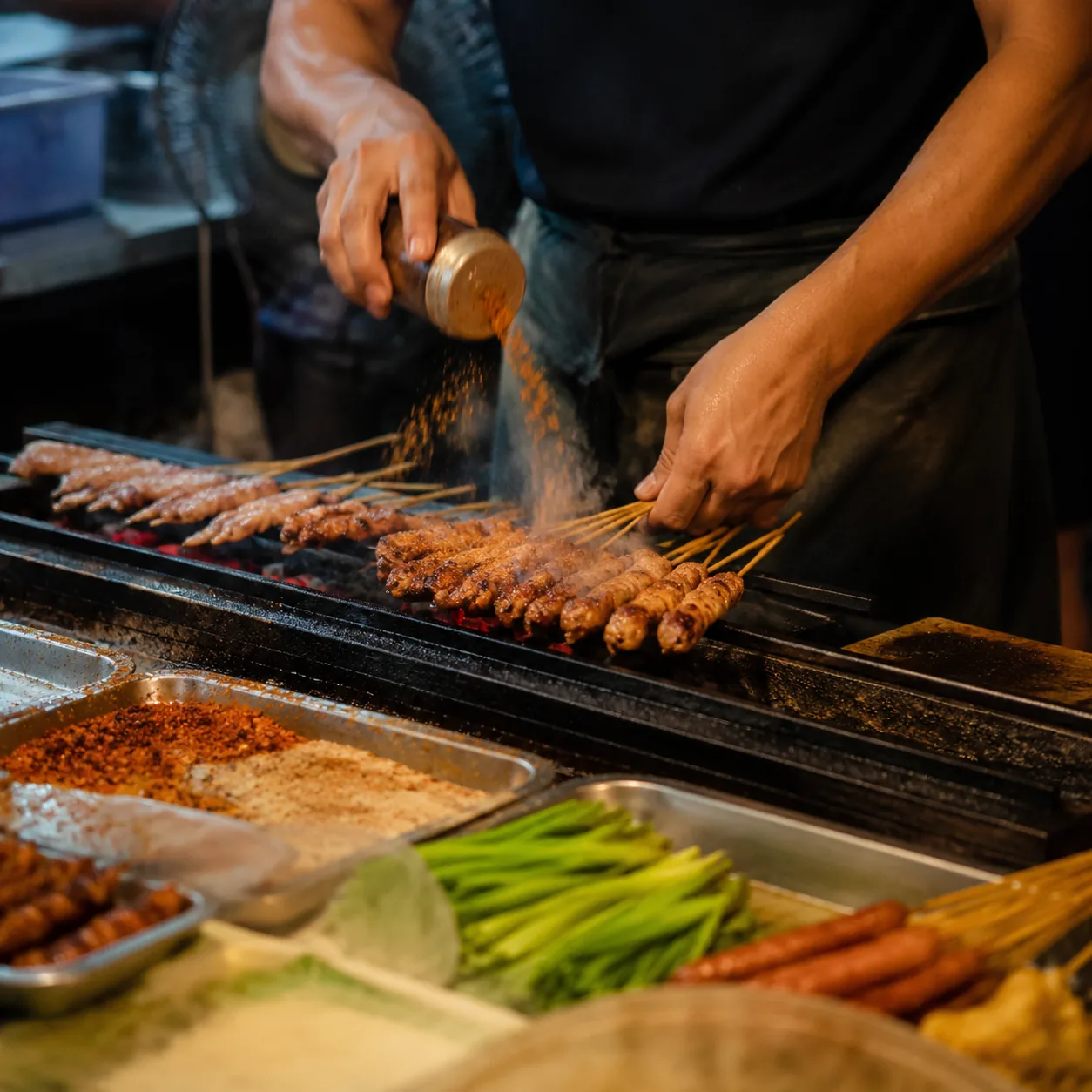
The ordering rhythm was different from a restaurant too. You did not hand over the entire meal to the kitchen at once and then sit waiting. You ordered a small handful first, ate while watching, and then decided whether to add more. The vendor placed our lamb, chicken wings, potato slices, and green peppers in different spots: meat over stronger heat, vegetables slowly grilling near the side. As he scattered salt and cumin, he reminded me not to rush him; heat cannot be hurried. At a nearby table, a group of young people halfway through eating called out, “Boss, ten more skewers.” Their tone was natural, as if the meal was meant to be extended section by section. Zhou said the worst thing at a late-night grill was ordering too much at the beginning. Food cools, taste drops, and waste becomes easy. Adding slowly keeps pace with both the fire and the stomach.
When the first lamb skewer reached my hand, oil was still bubbling slightly along the metal stick. I was eager to bite, and the vendor immediately said, “Hot, blow on it first.” It was not polite filler; it was practical protection. I held the skewer a little farther away and saw the meat edges charred, the fatty parts clear and shiny, and cumin seeds clinging to the surface. When I bit down, the outside was slightly crisp while the inside still held juice. Chili powder arrived first, followed by the fragrance of charcoal. It was not more refined than the famous shops saved in my phone, but it answered that evening’s hunger more precisely: wind moving, fire glowing, people sitting roadside, food leaving the heat and entering the mouth a few seconds later.
After a few skewers, I began to understand that “following the smoke” did not mean being blind. Zhou asked me to watch several details: whether the charcoal heat was steady, whether ingredients were separated, whether raw and cooked skewers were mixed, whether the vendor roughly distinguished between the hand used for money and the hand used for food, and whether trash near the tables was cleared in time. He said this was not fussiness, but common sense. A stall could be plain and have no beautiful sign, but it should not feel so chaotic that judgment becomes impossible. In travel, safety sometimes does not mean choosing the most expensive place. It means seeing that the other person has a working order, while you do not throw away basic caution.
Payment had its own details too. The vendor’s QR code was pasted beside the seasoning box, its edges slightly curled from oil smoke. I took out my phone, and Zhou reminded me to confirm the stall name and amount first, and not to keep the payment screen shining for a long time in the busiest spot. After I paid, the vendor’s device made a confirmation sound, and I glanced at my bill as well. The whole action took less than half a minute, but it made me feel much calmer. Zhou said most people in a night market are simply eating, doing business, or relaxing after work, so there is no need to be tense. But do not put your passport in an outer coat pocket, do not leave your phone casually on the table corner, and keep your backpack zipper facing you. When these small things are done, you do not have to worry constantly.
For the second round, we added grilled eggplant and mantou slices. The eggplant was split open and covered with minced garlic, oil and juices bubbling inside the foil. The mantou slices had golden edges, scattered with a little chili and cumin, making even the staple food feel like part of the night. Beside me sat an auntie who had just finished work. Seeing me clumsily use chopsticks to pick up the eggplant, she smiled and reminded me to separate it from the edge first instead of trying to put a whole piece into my mouth. She was not a guide and not a server, just another person eating a late snack at the table. That reminder was more concrete than any travel guide because it came from the same oil-shiny tabletop.
I had worried that I would not understand the order of the stall, but later I found that much of the order did not depend entirely on language. The vendor usually knew who arrived first, who added more later, and who had already paid. Regular customers might pause briefly near the fire, but they did not block the pickup area. People waiting for skewers stood to the side, leaving space for scanning the payment code. Those who finished eating placed their sticks on the same plate, allowing the owner to estimate the number at a glance. This rhythm was not quiet, but it was clear. It had shouting, urging, teasing complaints, and a shared sense of measure. As an outsider, if I simply slowed down half a beat, watched first, and moved afterward, I created much less confusion.
That night I did not go looking for the second and third restaurants in my saved list. Not because viral restaurants are bad, and not because lines are always worthless. Some places become popular for real reasons; some long queues are backed by real skill. But if I hand every meal over to rankings, I use my own judgment less and less. A Chinese city at night offers too much information to ignore: which lane is lit, which grill has steady smoke, which table turns over quickly, which owner is busy but not messy, and which group of customers eats with relaxed confidence. These clues do not appear neatly in travel guides, but if you are willing to stop, they reveal themselves little by little.
On the walk back to the hotel, my jacket carried a light layer of barbecue smell. For a moment in the elevator I even felt embarrassed, afraid others would notice it. But after entering my room, that smell instead brought back the scene beside the fire: the vendor’s wrist turning metal skewers, Zhou’s tone when he reminded me to order a little first, the auntie’s smile when she taught me how to eat the eggplant, and the plastic stool wobbling slightly because the pavement was uneven. Many travel memories are not preserved by beautiful photos, but by smells like this: not very clean, not very orderly, yet completely real. It proved that I had not chosen the city through a screen that night. I had truly sat inside its smoke and daily warmth.
Later I deleted two of the three viral restaurants from my saved list and kept only the one I truly wanted to try for lunch the next day. The change was small, but it made me much lighter. I stopped treating popular recommendations as commands and began treating them as possibilities. I stopped treating a local person’s reminder as a mysterious secret and began seeing it as part of on-site judgment. I also stopped thinking safety and adventure were opposites. Good travel often lives between them: willing to walk toward a stream of smoke that makes you pause, yet still watching the fire, the people, and the road; willing to sit on a low stool, yet still remembering your phone and bag.
If someone asks me what the most important lesson is when eating grill food in a Chinese night market, I will not begin by naming the best meat or listing fixed stall names. I will say: do not rush to execute every answer saved in your phone. Stand somewhere that does not block the way, smell the smoke, watch the fire, and listen to how the owner and customers cooperate. Order a little first, eat it hot, and add more if you like it. If you do not understand, explain your taste clearly and let a local friend or the vendor help you judge. Stay basically careful with payment and belongings, but do not turn every person into a potential problem. What the smoke and fire taught me that night was this plain balance: do not only chase the excitement pushed in front of you by algorithms, and do not pretend you are much smarter than guides either. Walk closer with curiosity, sit down with common sense, and the night of a city will slowly place its real flavor into your hands.