杭州で私は「先にバス停の路線表示を見てから乗る」ことを学んだ
When I used to travel in China, I depended heavily on the metro because the lines were clear, the station names were fixed, and phone navigation was easier to follow. But after staying in a residential area near West Lake in Hangzhou, I realized that the system that truly pulled me into everyday life was not the metro. It was the bus. On my first evening, I stood beneath a stop shaded by heavy trees. Several routes were arriving at once, the electronic board was scrolling quickly, and an older local woman beside me had already taken one calm step forward to board. What made me nervous was not payment. It was the fear of queuing at the wrong door, taking the wrong direction, or freezing while everyone else was already moving. For a foreigner, this kind of tiny hesitation in a few seconds often exposes more travel anxiety than any major attraction.
I later realized that buses do not test your memory as much as they test the order in which you observe things. I used to rush forward the moment I saw my route arriving, as if the bus might vanish at once. But Hangzhou taught me something more useful: read the stop sign first, check the direction second, confirm the logic of the next few stops third, and board only after that. Once the order is right, the movement no longer has to be panicked. I increasingly understood why people who slowly build steadiness in China end up focusing on ordinary scenes like this. Those ideas had once felt abstract when I read them. At a bus stop, they suddenly became concrete.
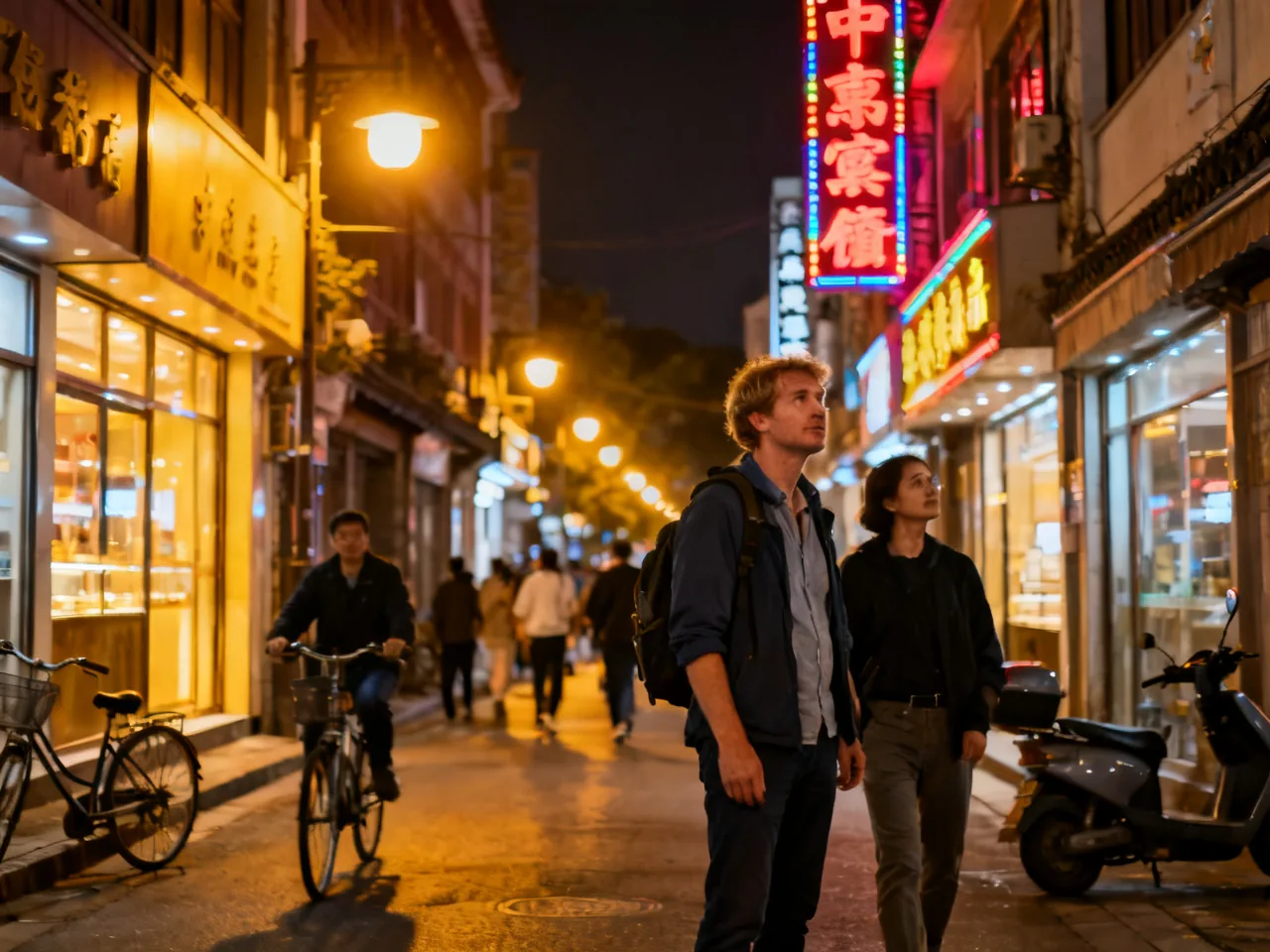
That evening I was trying to reach a small street not far from the lake, but awkward on foot. My map said taking the bus for two stops would be easiest. Yet while staring at the stop board, I realized the useful information was not only which route to board. It also included where that route was headed, which larger landmarks it passed, and what my recovery option would be if I missed my stop. I began forcing myself not to read only one station name, but to read the structure of a section of the route. Would the bus pass a hospital, a mall, a recognizable intersection? Did the stop names match the district names on the map? The method resembled what I had later learned in other cities about late arrivals: do not cling to a single point; check whether the whole chain makes sense. Once I did that, the bus system stopped feeling like an exam and started feeling like a public system whose information was actually quite open.
After boarding, I also corrected another bad habit: sitting down and relying entirely on navigation. Maps are useful, of course, but when the connection slows or the location drifts, my nerves drift with it. Now I first check the interior screen, then listen to the stop announcements, then compare the main road outside the window with the map. As long as those three sources confirm one another, I feel much calmer. Once I nearly missed my stop because I was watching only my phone; I was saved by looking up and recognizing both the bus display and a familiar convenience store outside. That tiny lesson made me believe strongly in the idea from everyday street safety depends on layered confirmation, not raw tension. For foreigners, steadiness matters more than quick cleverness.
I also slowly discovered that what relaxed me about Chinese buses was how naturally they exposed the living surface of a city. The metro is more efficient, but buses pass residential gates, wet markets, school walls, corner fruit shops, and benches where older people sit talking under trees. Sitting there, I felt for the first time that I was not merely moving between attractions. I was watching how a city organized an ordinary day. Precisely for that reason, buses also reveal the most practical travel questions: when to move toward the exit in advance, when not to squeeze, which time windows are emptier, and which hours are worth avoiding if you have luggage. These are not the favorite topics of sightseeing guides, but for foreigners actually moving through China, they matter a great deal.
I later summarized a few bus habits for friends coming to Hangzhou. First, do not confirm only the route number at the stop; confirm the direction and the walking environment after you get off. Second, if it is your first time taking a specific line, start paying attention two stops early rather than waiting until the last moment. Third, during rush hour, if you have a large backpack or suitcase, do not force yourself onto a crowded bus; the next one usually comes sooner than you fear. Fourth, prepare payment and your exit timing in advance instead of searching for your code only when the bus stops. Fifth, if your judgment gets scrambled, the best solution is not stubbornness. Get off, stand aside, and reread the stop board and map. Many Chinese bus stops are near convenience stores, bright shops, or clear intersections, and those places give you room to reorganize information calmly.
The dinner itself turned out to be an ordinary bowl of piàn er chuān noodles with a small cold side dish, but what I remembered was not the taste. It was the fact that I got off the bus without panic. Before the doors opened, I was already standing in the right place. After the bus stopped, I stepped off naturally with a few local passengers, neither blocking anyone nor rushing the wrong way. Standing at the curb, I felt a very concrete relief: I had not suddenly become some highly skilled traveler. I had simply learned how to process information in the right order at a Chinese bus stop. The skill looks small, but it spreads into everything else. It makes you more willing to stay in residential neighborhoods, enter small restaurants, and make decisions on streets you do not yet fully know. For me, real integration is often not a breakthrough in a dramatic setting. It is the moment ordinary movement stops draining me.