揚州で雨上がりに最も心を動かすのは、庭園の名声ではなく、靴底が濡れた石畳に触れるその一瞬だ
Yangzhou after the rain seemed to have been wiped by a gentle hand. The sky had not fully cleared; thin clouds spread above, and light leaked through the gaps without dazzling the eyes, making the streets look moist and distinct. Shallow water rested on the stone pavement, leaves shone after being washed by rain, and one or two drops still fell from the eaves now and then. This kind of weather is not suited for rushing, nor for a packed schedule. It seems to remind people that in Yangzhou, the best thing after rain is simply to walk slowly.
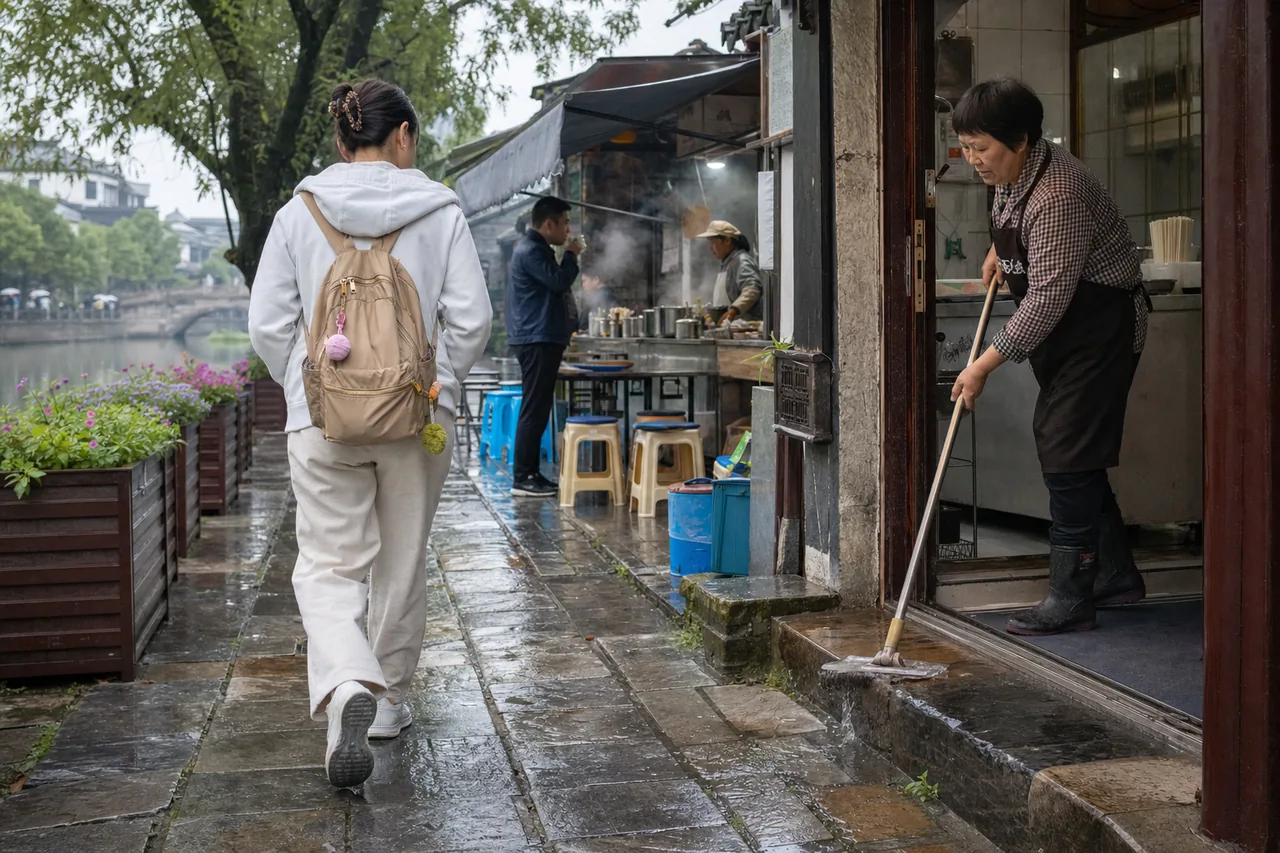
When I stepped out of my lodging, I did not immediately open the navigation app. The air after the rain carried the smell of plants and river water, mixed with a little damp earth. Shops along the road had just opened, and owners used mops to push water away from the entrances, moving without hurry. Breakfast stalls still steamed, people stood under awnings drinking soy milk, and raindrops remained on plastic stools. The city had not stopped because of the rain; its rhythm had only been lowered by the water, making every sound softer.
Yangzhou suits slow walking not only because it has old lanes, gardens, and Slender West Lake, but because much of its beauty hides in corners and pauses. After rain, the walls deepen in color. White walls are no longer merely white, but carry a little gray and age. Black tiles are no longer merely black; their edges hold waterlight, as if redrawn. A pomegranate tree in an alley stretches beyond a wall, with drops hanging from the tips of its leaves. When a passerby brushes it lightly, water falls onto the shoulder. Such details, if one walks too fast, seem never to have happened.
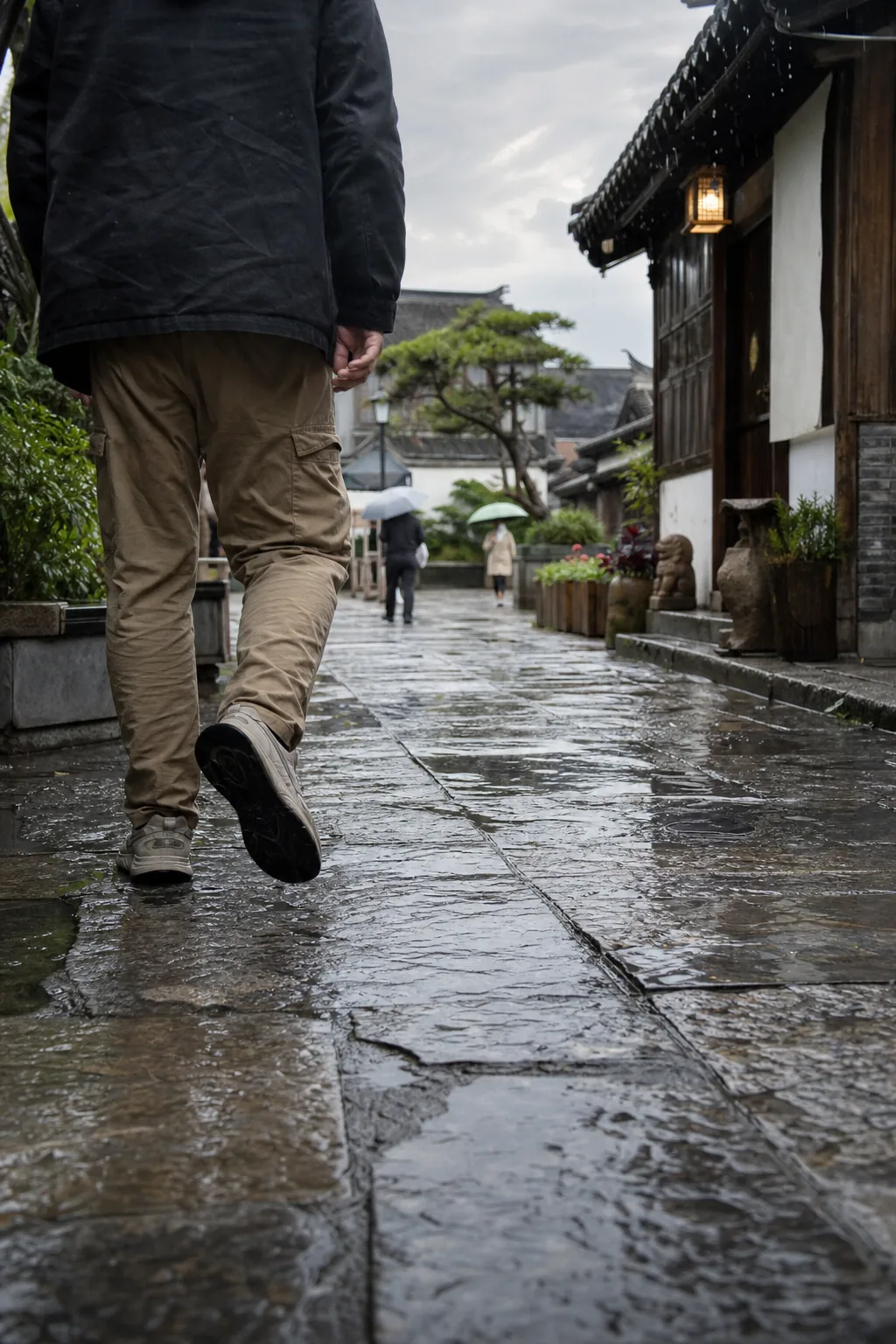
I walked along a street that was not very wide, my steps landing on the wet ground with a softer sound than usual. A small river ran beside the road. Because of the recent rain, the water looked somewhat muddy, but not unpleasant. Several small boats were moored by the bank, water collected on their awnings, and wet ropes wound around wooden posts. From beneath a bridge came the repeated, brief sound of water. Water in Yangzhou is not placed far away for people to admire; it is often right beside you, close to streets, bridges, and back doors, quietly taking part in daily life.
When I reached the bridge, I stopped for a while. The surface was wet and slippery, and the stone railing felt cool after being washed by rain. Holding the railing, I looked down. The river surface carried rain marks scattered by wind, as well as circles widening after drops fell from eaves. On the opposite bank, an old man walked slowly with an umbrella. The umbrella was no longer necessary, but it remained in his hand like a habit. He walked steadily, and as he passed a half-open wooden door, the sound of a radio came from inside. At that moment, I felt that Yangzhou after rain was not scenery, but a state in which life had been gently slowed.
I was in no hurry to reach any famous place; I simply followed the lanes. Passing a small noodle shop, I saw steam at the entrance meet the cool air after rain, forming a white mist. The owner was arranging stools outside. Seeing me pass, he casually said, “Be careful, the ground is slippery.” I nodded and thanked him. I did not go in, but carried the sentence forward with me. Kindness during travel is often brief, too brief to be recorded in a guide, yet it changes the temperature of a place. Because of such a reminder, Yangzhou after rain felt a little closer.
A gust of wind passed, and drops fell from the leaves as if another tiny rain had begun. I reached a stretch of white wall and dark tiles, where moss grew at the base, its color fresh as if just lit. Behind the wall there might have been a home, or perhaps a small garden. From outside, I could only see a few bamboo branches. Rain had pressed the bamboo leaves slightly downward, and when the wind came, they lifted gently again. Yangzhou’s restraint often appears in places like this: it does not push all its scenery before you, but leaves a little cover, allowing you to imagine the rest.
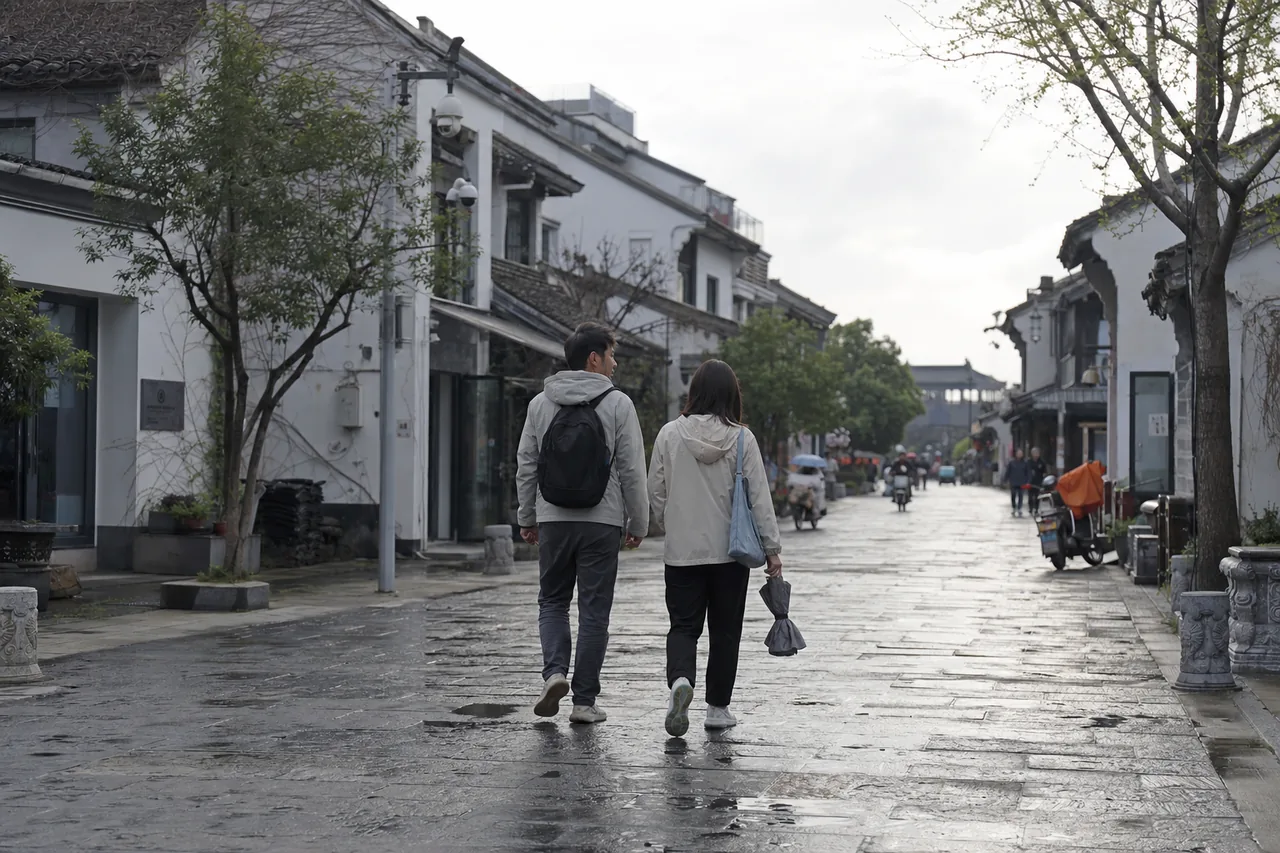
The advantage of walking slowly is that one begins to notice sounds again. After rain, there was no intense cicada cry and not much noise, only the soft sound of bicycle tires pressing over water, vendors’ calls from a distant market, the rhythm of drops from eaves, and occasional laughter from an alley entrance. No sound was loud, yet each seemed clear because the air was moist. The city was like a freshly washed garment, wrung out and hung up, its texture easier to see than usual.
I entered a narrower lane, where houses on both sides stood close together. Flowerpots and drying racks sat on windowsills. Rainwater still hung from the wires of the racks; several garments had been taken indoors, leaving only clips lined up in a row. At the end of the lane, a cat crouched on a step, carefully licking its paw. It saw me but did not run, only lifted its head for a glance before lowering it again to arrange its fur. Animals after rain also seemed to know that time had slowed, with no hurry to avoid people or go elsewhere.
The lane opened onto a slightly wider road, where small shops sold lotus root starch and pastries. The glass counters had been wiped bright, and the pastries inside were gentle in color, not exaggerated. In my imagination, Yangzhou’s sweetness is always restrained, not like forceful sugar, but like fragrance slowly spreading through moisture. I bought a small pastry and ate it under the shop eaves. It was soft in the mouth, and the sweetness did not rush forward; it left a faint aftertaste after chewing. Water dripped from the corner of the eaves and landed right beside my feet.
As I continued, more visitors gradually appeared on the road. Some raised cameras to photograph walls after rain, some stood by the bridge waiting for companions, and some opened umbrellas only because they looked good in photos. Even so, Yangzhou did not become noisy. Perhaps the moisture absorbed the sound, or perhaps people instinctively lowered their voices after rain. Everyone walked more slowly than on a sunny day, soles wet, trouser legs occasionally splashed. Slowness was not a deliberately created posture, but the natural pace given by the weather.
I finally opened the navigation app and found that I had wandered far from the place I originally meant to visit. The blue dot on the screen rested on a small road I did not recognize, as if reminding me that I had deviated from the plan. But I did not correct it immediately. In travel, an occasional detour is not a loss, especially in a city like Yangzhou. Straight roads take people to destinations, while winding roads let them encounter what lies outside destinations. The most important thing about walking slowly after rain may not be arriving somewhere, but allowing oneself to be temporarily held by a drop of water, a wall, or a gust of wind.
In the afternoon, the clouds slowly broke apart, and sunlight fell onto the wet ground, reflecting into tiny bright points. The street that had been quiet a moment earlier suddenly gained brighter colors. Walls began to dry, and fewer drops remained on the leaves. I felt a little reluctant, because the after-rain state was disappearing. The city would return to its daily speed, traffic noise would become clearer, tourists would increase, and shopkeepers’ calls would grow louder. But I knew that the slow walk I had just taken had already been saved, not in phone photos, but in bodily memory.
I found a bench by the river and sat down, the soles of my shoes still a little wet. The light on the river was much brighter than in the morning. A boat passed slowly, its stern opening a long, thin ripple. Willow branches hung low along the bank, their leaves half-dried by the sun, changing from deep green back to soft green. Someone nearby peeled an orange, and the scent of orange peel mixed with damp wood and river water. Yangzhou did not give me a startling moment; it simply filled the time after rain with many small sensations.
As I sat there, I thought of how much travel pursues speed: how many sights in one day, how many steps walked, how many photos taken, how many restaurants visited. Speed can bring a sense of completion, but not necessarily a sense of closeness. Slowing down does not mean doing nothing; it simply moves attention from the checklist to the present. Yangzhou after rain is especially suited to this, because its beauty is not shouted loudly, but slowly seeps out from wet stone slabs, half-open doors, drooping willow branches, and a sentence like “be careful, the ground is slippery.”
When I left the riverside, I did not take the same route back, but followed another small street slowly. On the way, I passed a school. Notices were pasted outside the wall, and the plane trees at the gate were still dripping. Several children ran out with schoolbags, stepping into puddles and splashing small bursts of water. They laughed loudly, creating a lively contrast with the quiet lanes after rain. The city’s slowness is not stillness; it simply allows different rhythms to exist side by side: old people walking slowly, children running, river water flowing, visitors stopping.
Before evening, a small patch of blue finally appeared in the sky. I looked back at the road I had taken. The ground was already half dry, with wet marks remaining only at the base of walls and under tree shade. Yangzhou after rain was turning back into ordinary Yangzhou, but I did not feel regret. Precisely because that period was brief, it felt precious. Rain had temporarily added a transparent layer of annotation to the city, letting me see lines, smells, and sounds I might normally overlook. Slow walking was the way to read that annotation, without rushing to turn the page or summarize.
Near my lodging, I realized that I had not taken many photos that day. A few wet walls, several river surfaces, one cat, one pastry, and a blurry picture of drops from an eave. They all looked ordinary, and could not even prove exactly where I had been. But that felt right. Walking slowly after rain was never about proving a route; it was about briefly lowering my speed within a city. Fewer photos, in a way, meant that my eyes had spent more time without a screen between them and the world.
At night, a little wind rose outside the window, and the streetlights shone on ground that had not completely dried, reflecting a faint glow. I thought that if I remembered Yangzhou in the future, I might not first recall a complete scenic site, but the cool air after the rain stopped, the water marks on bridge railings, the gaze of the cat at the lane entrance, the sweetness slowly spreading in a pastry, and the feeling of my steps slowing almost by themselves. A city does not always need grandeur to keep a person. If, on an afternoon after rain, it makes someone willing to walk slowly, that is already enough.