After I Learned to Say Máfan Le, My Social Distance in China Suddenly Became Smoother
After I Learned to Say “Máfan Le,” My Social Distance in China Suddenly Became Smoother
If you ask me what the most useful phrase I learned in China was, I would not answer “thank you” first, and I would not answer “hello” first either. I would say “máfan le.” The first time I used it was on a drizzly afternoon in Chengdu. It was 4:50 p.m., and I was waiting for a ride on a side street near the Jinjiang River where cars did not stop easily. The rain was light, but it had polished the pavement into a reflective shine. My driver had to circle around before finding me. I climbed in with one hand carrying a shopping bag damp from the rain and the other pulling the door shut, worried that I had already made him wait too long. The moment the door closed, I said almost by instinct, “Máfan le.” The driver looked at me in the rearview mirror, smiled, and answered in a softer tone, “It’s okay. Rainy days are like this.” That tiny exchange stayed with me for days.
In other languages, I use polite words too, but “máfan le” feels different from a simple “thank you.” “Thank you” often comes after something is completed. “Máfan le,” by contrast, often appears while something is still happening. It is like saying: I know you had to do a little extra for me, detour a bit, wait a moment, explain one more time, so I want to acknowledge that effort now. For a foreigner, that tone is incredibly useful because it sets the distance between me and a stranger at a point that is neither stiff nor overly intimate.
I Used to Rely Too Much on “Thank You,” and Later Realized It Sometimes Comes Too Late
When I first arrived in China, my understanding of politeness was simple: say hello when meeting someone, say thank you when the task is done, say sorry when confused. That was not exactly wrong, but it cut each interaction into neat blocks—as if you open the door, do the thing, then close the door. Yet many interactions in Chinese cities are not so tidy. You ask someone to hold the elevator, ask a café worker for less ice, ask a metro guard whether one exit is shorter, ask the package-station auntie to search one more time for your parcel, or ask a restaurant server for an extra pair of chopsticks. None of these are huge favors, but they all require someone to shift a little energy toward you in the moment. In those situations, saying thank you only at the end can feel like it misses the courtesy that belongs inside the process.
I fully noticed the difference in a coffee shop near Taikoo Li in Chengdu. It was crowded in the afternoon, with seven or eight people lined up before the register. While ordering, I decided at the last second to switch to oat milk, then asked for less ice, then added that I had no membership code and my phone signal was slow. Somewhere else, I might have stacked all those requests and then offered one thank you at the end. But that day, almost unconsciously, I placed “máfan le” before each little request. “Máfan le, is oat milk okay?” “Máfan le, less ice.” “Máfan le, my internet is a bit slow.” The barista showed no impatience. She simply received each request naturally. When my drink was ready, she handed it over and added with a smile, “The floor is a little slippery—be careful.” That was when I understood that politeness is not only the thank-you at the end. It can also be the lubricant that makes the whole process run more smoothly.
What Exactly “Máfan Le” Helps With
Later I spent a long time thinking about why this phrase worked so well. At least three things changed for me. First, it let me avoid acting as if other people’s time naturally belonged to me. Second, it shifted my requests from sounding like instructions back into something closer to consultation. Third, as a foreigner, it reduced that tight fear of saying the wrong thing, doing the wrong thing, or sounding too direct. Once I expressed consideration first, even a very simple sentence that followed felt softer.
Many of my best experiences in China happened in exactly these tiny interactions: a residential compound guard helping me confirm how visitor registration worked; a convenience-store clerk reaching to the very back of the hot shelf to get the last rice ball; a taxi driver nudging forward another few meters at an awkward curb so I would not have to step into standing rainwater. Strictly speaking, all of them were still doing part of their jobs. But the human feeling between people often changes in that extra little bit. Saying “máfan le” is not exaggerating a small favor into a grand debt. It is recognizing the care contained in that slight extra effort.

The High-Frequency Expressions I Ended Up Using Most
After learning “máfan le,” I started connecting it with a whole set of softer Chinese courtesy phrases. These were the ones I used most. First, “máfan le,” for asking someone to do a specific thing. Second, “bù hǎo yì si,” which works when you need to interrupt, squeeze past, or take up a little space. Third, “xīn kǔ le,” which I use with delivery workers, package couriers, cleaners, and front-desk staff—people who are clearly still in the middle of labor. It is not mandatory, but it often lets them hear that you noticed their effort. Fourth, “thank you,” which of course still matters and should not be replaced by the others. To me, these phrases are not mutually exclusive. They are more like a toolkit.
In taxis, I now often say something like, “Driver, máfan le, dropping me at that doorway ahead is perfect.” If the driver detours in rain or stops in a safer place for me, I add, “Xīn kǔ le, thank you,” when getting out. In a coffee shop, I might say, “Sorry, máfan le, I’d like less ice.” At a residential gate, when asking directions, I say, “Hello, máfan le, I’m looking for this building—where should I enter?” At an elevator, if someone holds the door, I say “thank you,” and if I am dragging luggage and entering slowly, I add “sorry, máfan le.” Layered together, these phrases do not sound complicated. They sound natural.
Language Changed Not Only Politeness, but Also My Physical Sense of Safety
This may sound surprising, but part of how I built a sense of safety in China came through these courtesy phrases. The reason is simple: once you can make a small request in a way that feels familiar to local people, many situations no longer require you to struggle silently. You ask directions more naturally. If you enter the wrong door, you feel more comfortable turning back to confirm. If you cannot find your order, you are more willing to ask staff to check once more. If you return to your hotel late and need the front desk to help call a car, it no longer feels like you are creating a burden. Polite language lifts asking for help out of embarrassment and returns it to ordinary life.
When I traveled before, I had a bad habit: I was so afraid of troubling others that I would rather wander twenty extra minutes than ask a question. In China, though, the most efficient and often the safest move is often to say “máfan le” at the right moment. That matches what I later read in this related experience about asking for help in China: speaking up is not a sign of helplessness. Many everyday systems here already support the idea that you may ask. Knowing the polite language just makes the asking smoother.
I Also Learned to Match the Setting Instead of Performing Politeness
Of course, no phrase becomes better simply by being used more. At first I overused “máfan le” so much that I almost wanted to insert it into every sentence, and the result started sounding like a memorized textbook. Later, a Chinese friend reminded me that natural politeness is not about stacking vocabulary but about reading the scene. In a fast-moving breakfast shop, one quick “máfan le” is plenty. At a quiet hotel front desk, you can speak in a fuller sentence. When squeezing past people on the street, “Excuse me, sorry” works better than a long explanation. Only then did I understand that courtesy phrases are like clothes: fit matters more than decoration.
Another change that helped me a great deal was learning to listen carefully to how other people said these things. Chengdu is full of scenes where your ears can practice: drivers and passengers, shop staff and customers, guards and residents. Politeness there is not always formal speech. It is often a relaxed but clear calibration. Some people say “máfan nǐ le,” some say “máfan le ha,” and sometimes a slight smile does half the work. For foreigners, this kind of observation matters because it prevents Chinese politeness from turning into a rigid script. You are not memorizing one correct answer. You are joining a living rhythm.
If You’re Visiting China for the First Time, These Are the Phrases I’d Practice First
If I could recommend only four expressions to start with, they would be: “hello,” “sorry/excuse me,” “máfan le,” and “thank you.” Getting these to feel natural in your mouth helps more than rushing to memorize much more complicated sentences. In China, many travel interactions only require you to get the opening and the attitude right. The route, payment, ticket, or exit details are often then filled in by the system or by the person in front of you. If you like the idea of making everyday travel feel smooth before anything else, this related piece on travel rhythm in China echoes my experience closely.
I also developed a small exercise that I still use all the time: do not chase perfect pronunciation first; chase correct timing first. Say hello before entering, say excuse me before interrupting, place máfan le before a request, and do not forget thank you at the end. You quickly discover that even if your Chinese still carries an accent, most people understand your attitude immediately when the timing is right. For travelers, that is often more useful than memorizing ten complicated phrases. What makes an interaction flow is usually not advanced grammar. It is whether you placed consideration into the sentence at the right moment.
Sometimes I even feel that máfan le is not just a phrase I learned in China but a whole attitude. It reminds me that dealing with strangers does not require stubborn self-sufficiency, nor does it require carrying every problem alone, nor staying silent all the way because you fear awkwardness. You can politely take one minute of someone’s time, and you can politely accept that they did a little extra for you. Many scenes that might otherwise jam up—asking for the restroom, asking someone to hold the elevator, confirming a pickup number, asking the front desk to repeat something more slowly—become much easier this way.
So if a friend asks me now what they should learn first in Chinese before coming to China, my answer is no longer simply “memorize common words.” I would say: learn how to shape a sentence so that people want to receive it. Even if you know only a small amount of language, the right order and tone often produce a much warmer response. And once that warmth begins to loop back toward you, the tension of living in a foreign country—the fear of entering the wrong place, saying the wrong thing, or occupying the wrong space—starts loosening bit by bit.
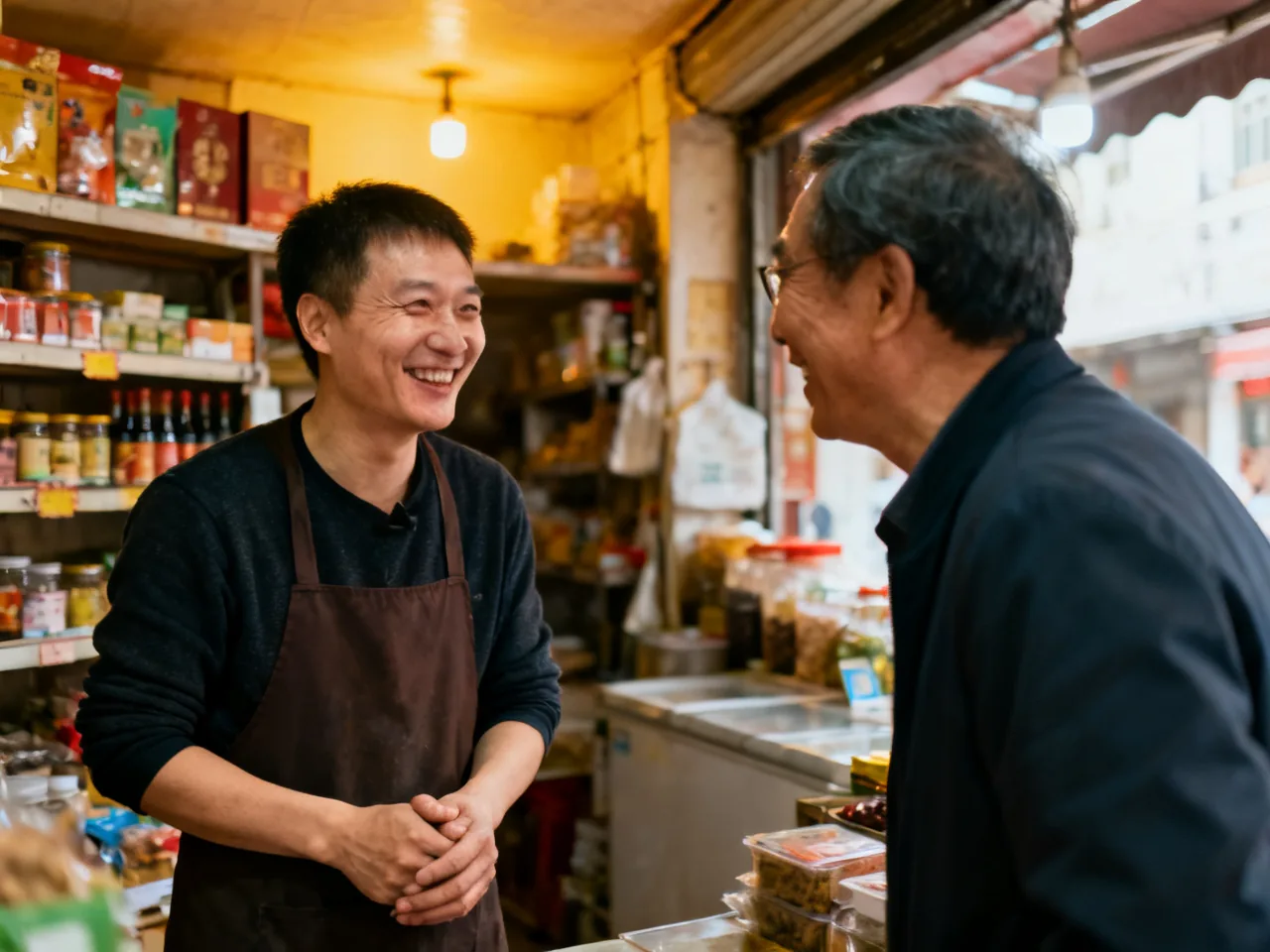
Now, whenever a small thing goes smoothly for me in China, I think back to that rainy day in Chengdu. Not because the taxi ride was dramatic, but because from that moment on I understood that social distance is not always shortened by time. Sometimes it is simply eased into place by one well-timed phrase. You may not become instantly familiar with someone, but you become easier to receive, and it becomes easier to receive the kindness they offer in return. Now when I step into a café, get into a taxi, ask a front desk question, enter a residential compound, or squeeze through a crowd, I often place that little “máfan le” at the front of the sentence. It has not made my Chinese suddenly perfect, but it has made my daily life in China feel softer, smoother, and much more human.