西安の城壁の下を少しゆっくり歩いてこそ、歴史は一枚の写真ではなくなる
On the morning I arrived in Xi’an, wind came down through the seams of the city wall, carrying a dry smell of earth. I stood outside Yongning Gate and watched the gate tower slowly gain shape in the early light, like an old ship resting on land. Many visitors raised their phones before lifting their eyes to the wall; I almost did the same. But just before pressing the shutter, a bicycle passed along the base, its bell brief, its shadow sliding across gray bricks. I suddenly felt that if I turned this place into only a photograph, history would become too light.
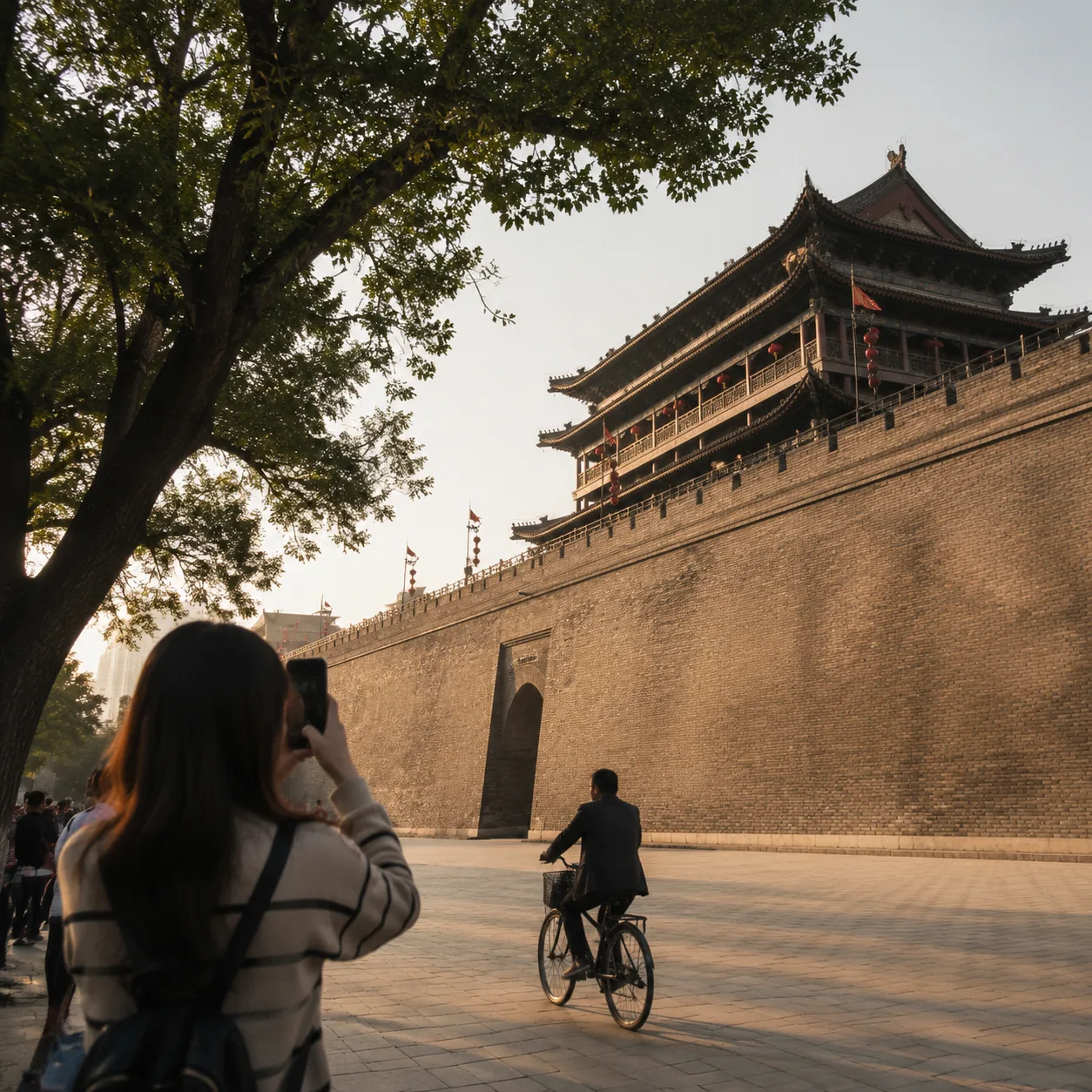
The weight of Xi’an City Wall comes not only from its height, width, and length, but from the slowness with which it holds time. Standing beneath it, you cannot finish seeing it at once. It refuses to be understood like an exhibit after one circle around it, and it refuses to explain itself like a paragraph on a sign. It simply lies there in silence, letting traffic pass through the gate opening, pedestrians emerge from shade, and pigeons pause on the eaves of the tower. It places the ancient and the everyday on the same street, without explanation and without hurry to prove anything.
I did not climb the wall immediately, but walked east along its base. The moat was quiet in the morning, and leaves sifted sunlight into small bright flecks that fell on joggers’ shoulders. Some bricks were darker, some paler, like pages repeatedly turned in a book. Here and there, repairs were visible; old and new did not match perfectly, and that made the wall feel more real. If history kept only a flawless surface, it would resemble glass wiped too clean: shape visible, human warmth missing.
Walking beneath the wall, you keep meeting the life of today. Someone carries breakfast out through the gate opening, steam rising inside a plastic bag. Someone parks an electric scooter in the shade and bends over a message. An old man sits on a stone bench by the moat, moving a palm-leaf fan again and again. The wall does not turn them into background; because of them, it remains alive. An ancient capital is not a place that pushes modern life away and displays relics separately. It lets old bricks and new footsteps acknowledge each other.
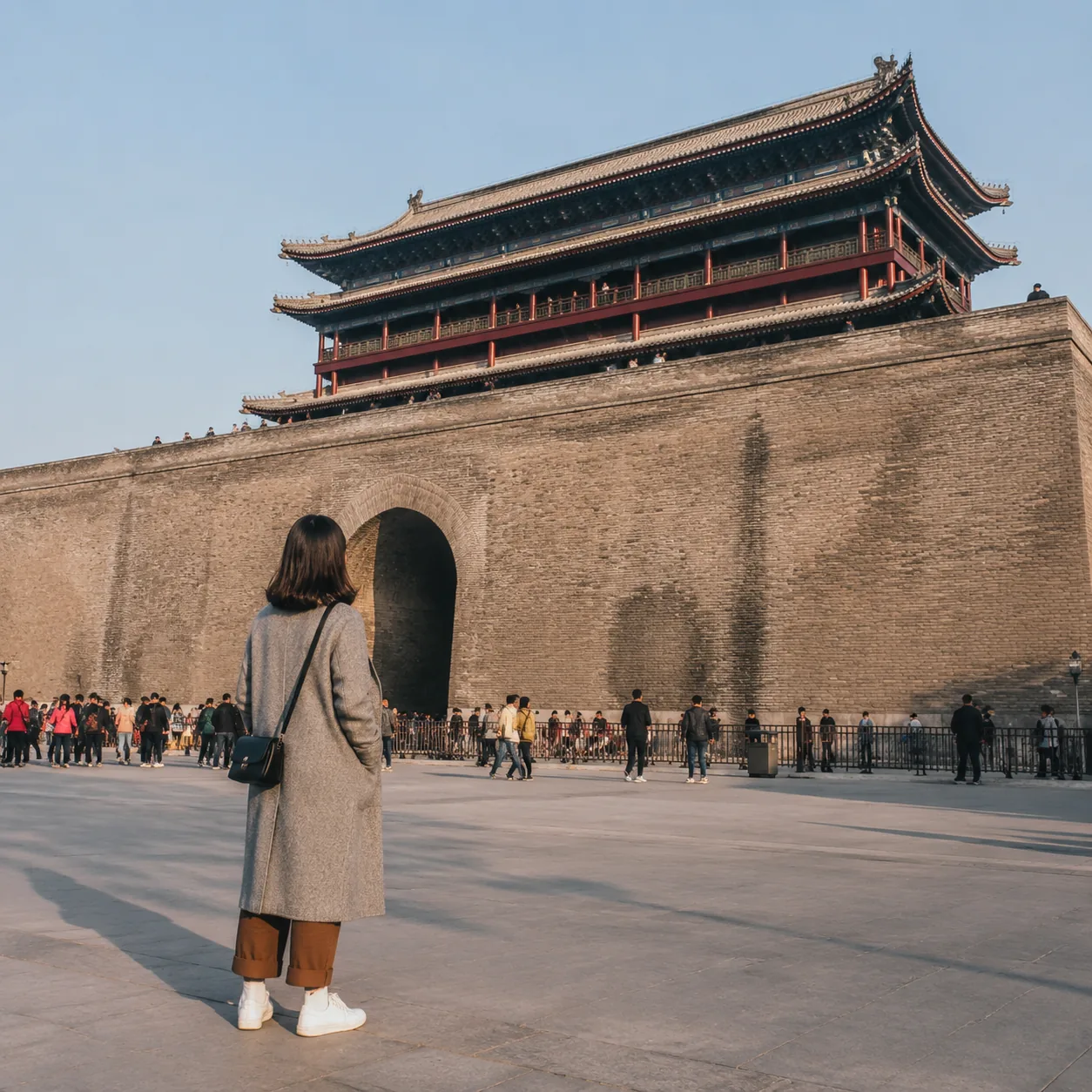
When I finally climbed onto the wall, the city’s sound changed. Traffic below was blocked by the body of the wall and became a low tide, while wind moved back and forth through the battlements. The top was wide enough to make me forget I was standing on a boundary. In the distance were high-rises, temple pagodas, sunlit roofs, and lanes not fully awake. You suddenly understand that the wall is not merely a line that encloses the city. It is a walkable memory, gently stitching different eras of Xi’an together.
I have seen visitors move quickly along the wall. They rent bicycles, calculate how long a full loop will take, stop before a tower for a photograph, and continue to the next point. That is also a way to travel: wind passing the ears, brick road sounding softly under wheels, the city unfolding fast. But that day I wanted to go more slowly. Every so often I stopped to compare inside and outside the wall: on one side broad roads and traffic, on the other lanes and eaves; on one side brighter noise, on the other more reserved sound. The wall seemed like a boundary, yet not a separation. It reminded me that a city has many layers.
The most moving part of a historical scene is often not a grand moment, but details that convince you people truly lived in the past. Shadows of battlements fall on the bricks like slow-moving squares of time. The wooden doors of the tower carry an old color, as if remembering many palms that once pushed them. A sparrow hops onto the wall edge and quickly flies away, making the solemn space a little lighter. Such details do not approach you in haste. Only when your steps slow do they rise from the background.
Near a corner tower, I met a father explaining the wall to his child. He did not recite many dynasties or dates. He pointed at the body of the wall and said, “Look, it is this thick because it once protected the people inside.” The child touched a brick and asked, “Does it still protect now?” The father thought for a moment and said, “Now it protects our remembering.” The sentence was simple, yet closer to my feeling than many formal explanations. The wall no longer resists armies in the same way, but it still resists forgetting.
This is also why I like Xi’an. It does not tell you it is ancient only through ruins and museums. It reminds you through a bowl of hot soup, the echo inside a gate passage, and a stone step polished by rain that the past has not completely left; it has only found another way to remain in the present. If you move too fast, you see only what is famous. If you slow down, you see what is connected. A photograph records that you stood here; slowness records how this place entered you.
When I came down from the wall, the sun was higher, visitors had increased, and the gate area was lively again. Some adjusted hats, some lined up for tickets, and some posed with gestures before the tower. That liveliness did not spoil my mood. Instead, it made me feel the wall had completed a transformation: in the morning it was like a history book opened in a low voice, and before noon it became part of the city square. If history could only be watched in silence, it would be too fragile. Its ability to endure noise and stand beside daily life proves that it is truly rooted here.
Before leaving, I looked back at the gate tower. Of course there were photographs on my phone, but I knew what truly remained was not those images. It was the rough feel of brick, the sudden coolness of wind inside the gate passage, the child’s question, and my repeated decision to slow my steps on the wall. Xi’an City Wall does not teach you how to place history into an album. It teaches you how to recover patience before history. Walk a little slower, and time will step out of the attraction and stand beside you.