中国の景勝地の入口にできる手荷物検査の列には、実は独自のリズムがある
The first time I really noticed the security line at the entrance of a Chinese scenic spot was on a misty morning. The plaza had just been washed by a street-cleaning truck, and the stone tiles still shone with damp light. A grilled-sausage cart waited outside the railings, while a loudspeaker repeated reminders about identity documents and tickets. I had a stuffed backpack with a camera, a light jacket, a folded map, and half a bottle of water. From a distance, the line looked like a river bent into several sections by metal barriers, moving slowly but not chaotically.
At first I thought I only needed to stand in line, as at an airport, wait my turn, and place my bag on the scanner. But the rhythm at a scenic spot felt closer to a morning market. People were looking for companions, increasing phone brightness, asking children where the tickets were, or listening to volunteers in red vests who walked along the railings and reminded everyone to take out umbrellas, power banks, and water bottles early. Everyone was moving, but everyone was also pausing, as if the whole line had a slow beat that depended on the breathing of the people beside you.
The entrance plaza was wide, but it had been divided into several kinds of routes. On the left was the group channel, where guides held small flags and visitors in matching caps followed behind them. In the middle was the individual visitor channel, the longest and the most likely to stop without warning. On the right was a narrower fast lane for local annual passes, senior discount cards, and staff. I stood in the middle line and watched a family of three move a backpack from the father’s shoulder to the mother’s hand, simply so the child could free both hands for documents.
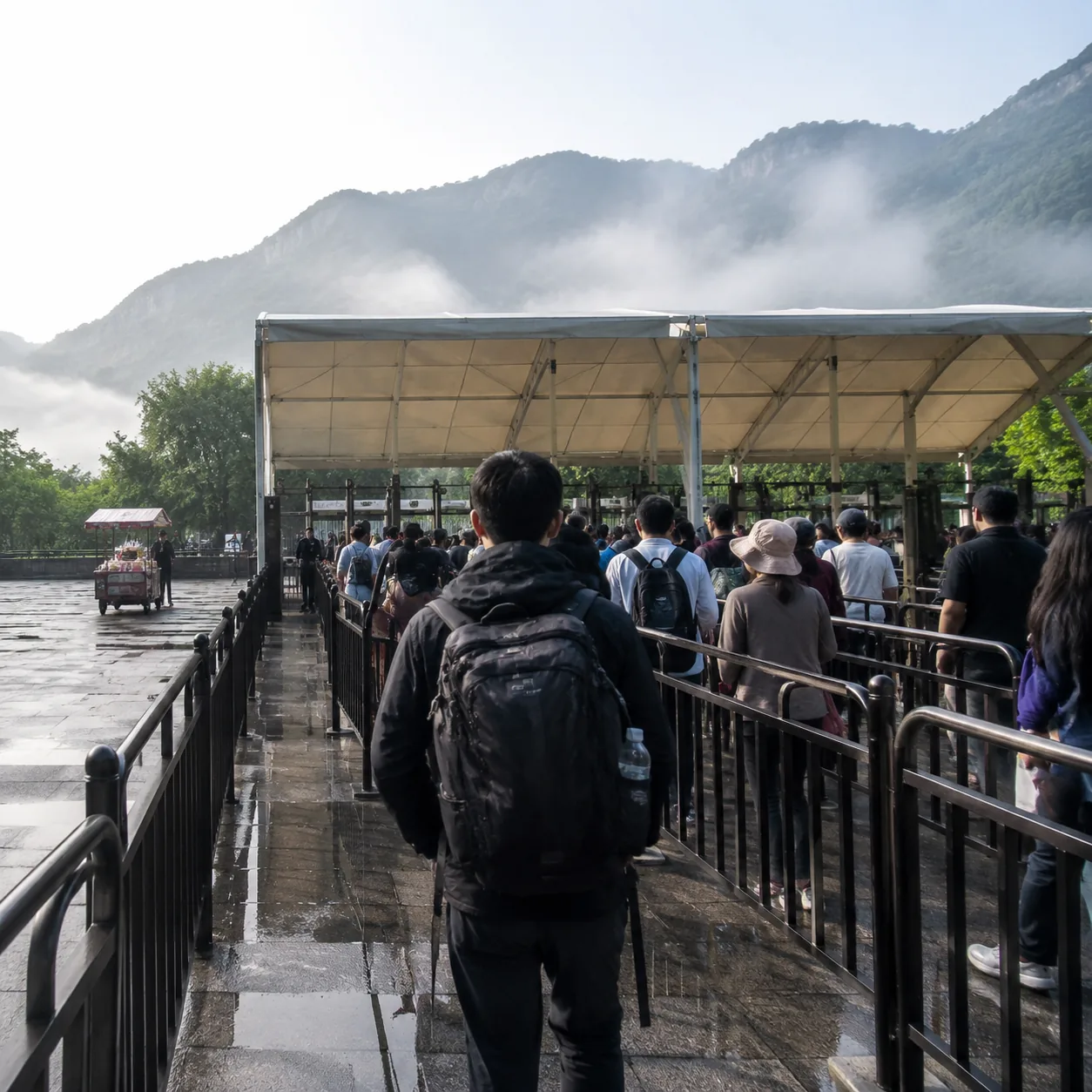
After ten minutes in line, I understood that the split in the queue was not fixed from the beginning. Two staff members stood near the security entrance: one watched the scanner screen, and another stood at the corner of the railing. He did not shout much. He arranged the crowd with gestures. A palm pressed to the left sent a dozen people toward a newly opened lane. Two fingers pointing forward brought families with small children closer to the table. The back of his hand raised slightly stopped anyone whose backpack was not yet open at the yellow line. The gestures were brief, but they worked.
In front of me stood an auntie from Guangzhou with a cloth bag and a thermos. Seeing me watching the line too carefully, she smiled and said, “Don’t be fooled by the crowd. It moves fast. Hold your water first.” She loosened the lid of her cup and opened the zipper of her cloth bag halfway, with the ease of someone who entered scenic spots every day. I copied her, pulling my mineral water from the side pocket of my backpack. The bottle was still cool from the morning air, and my palm became wet at once.
The water bottle was one of the first details I learned. Many scenic spots do not ban ordinary drinking water, but the security staff need to confirm that it is not another liquid. A young man ahead of me placed an unopened bottle into the tray, and the staff member only glanced at it. Another visitor carried a dark thermos and was asked to step aside, open it, and let it be checked. Nobody seemed tense. People treated it as a small temporary inspection, still chatting while their eyes were already moving toward the next ticket gate.
What truly slowed the line was not the scanner, but the bags. A backpack can hide many small complications: a folding umbrella stuck in a side pocket, charging cables tangled with keys, a biscuit box pressing on a camera, a child’s toy gun buried at the bottom. Whenever someone began searching only after reaching the machine, the line behind them behaved like water blocked by a stone. It paused, then looked for another gap beside it. The staff usually did not rush people harshly. They simply pushed an empty tray closer, making the message clear.
Behind me stood a French couple on their first trip to China. They carried trekking poles and two large camera bags, clearly treating the day as a light hike. The man asked whether he could keep the camera on his body. I was not sure, so I pointed at the trays ahead. The auntie from Guangzhou heard him and said in simple English, “Bag, machine. Camera, maybe hand.” A security worker nearby nodded and made a gesture: put the bag down, keep the camera in your hand.
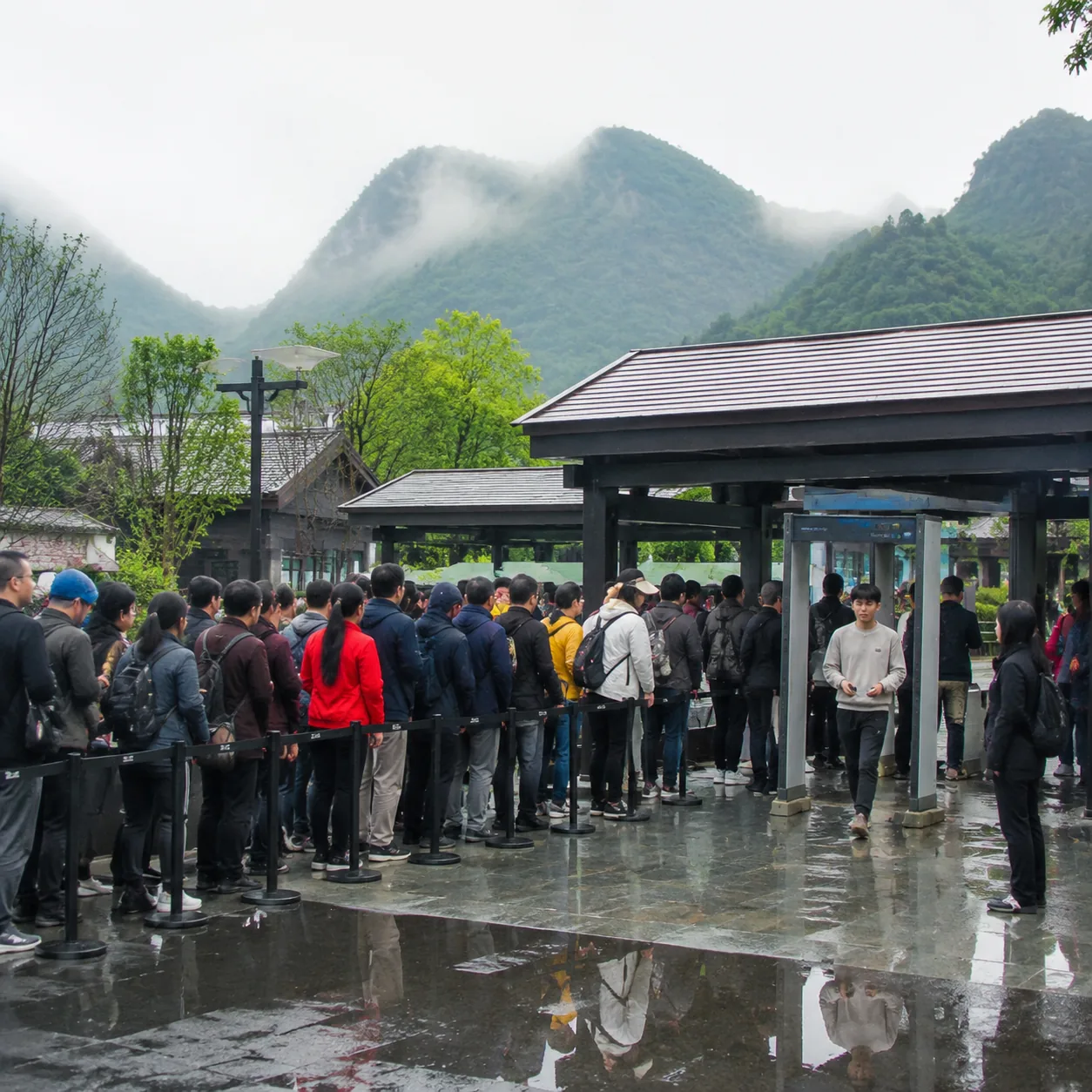
At that moment I realized that communication at scenic spot entrances often does not depend on complete sentences. The staff’s gestures, the visitors’ eyes, the opening in the railing, and the yellow line on the ground all tell you what to do next. Even people who do not speak Chinese can follow, as long as they do not rush to imagine themselves as exceptions. The smoothest people in the line are not always those who know every rule, but those who watch the three people in front of them and copy the useful parts twenty seconds early.
The line suddenly advanced by a large step because a temporary opening had been made beside the group channel. The guides looked unhappy at first, worried that their groups would be broken apart by individual visitors. The security worker placed his arm across the railing like a gate between two streams of water. He let the end of one tour group pass, then five or six individual visitors, then another group. There was no loudspeaker and no complicated explanation, only a repeated beat that everyone quickly accepted.
When my turn brought me close to the security table, the sounds of the plaza became sharper. The scanner belt hummed softly, plastic trays tapped the table corner, and ticket gates made short beeps after each scan. A child did not want to place his toy sword in the tray. His father crouched and said, “It has to ride the little train too.” Only then did the child let go. The security worker beside them did not laugh aloud; he merely pushed the tray forward a little and waited until the toy sword lay flat before starting the belt.
I placed my backpack in a tray, held the mineral water in my right hand, and kept the camera around my neck. The security worker looked at my bag, then at the water, and signaled for me to open the cap. After I twisted it open, he did not take the bottle from me. He only asked me to shake it lightly. The surface moved under the cap, and he nodded for me to continue. The entire process took less than twenty seconds, yet it felt less like passing a machine than passing a small exam in local order.
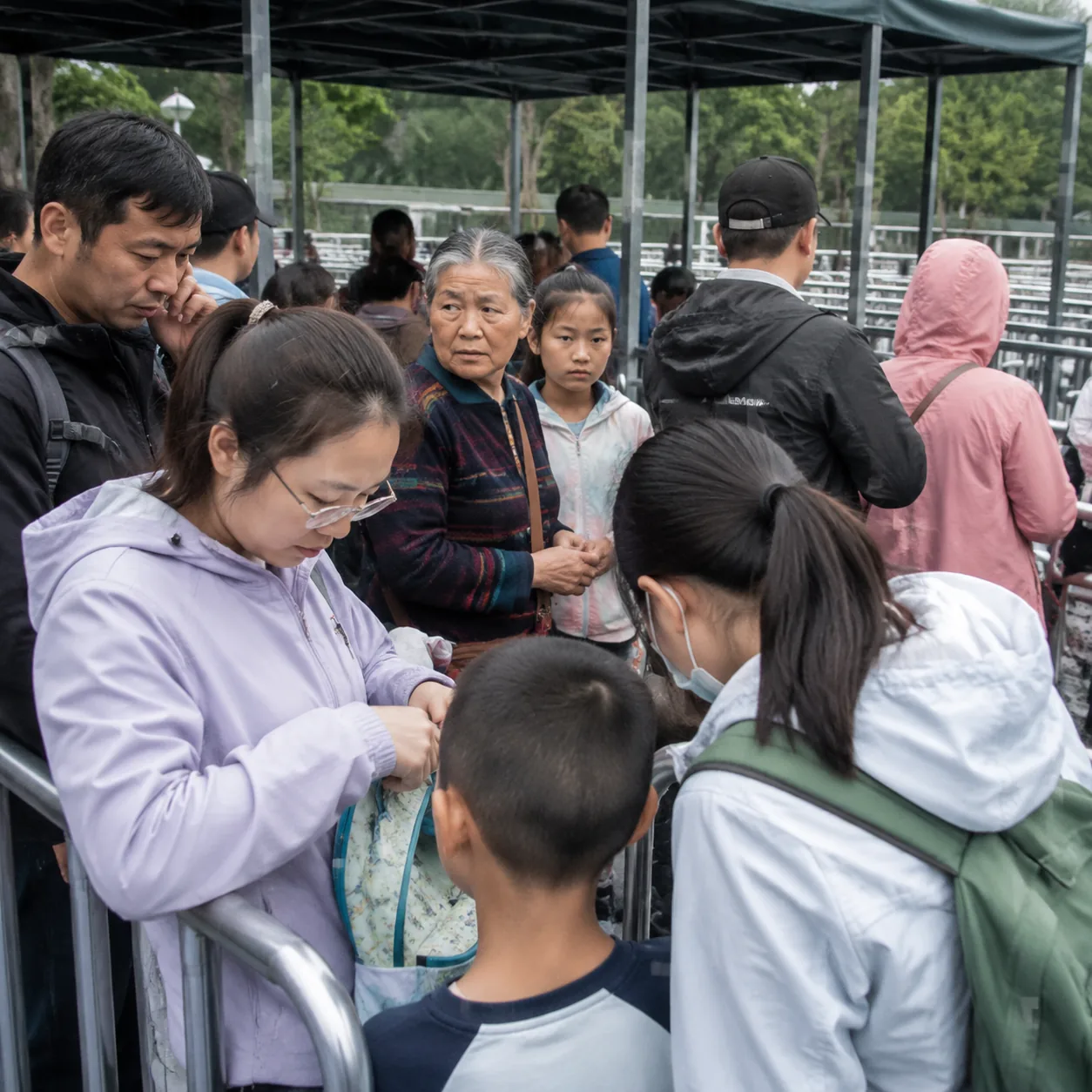
Passing the scanner was not the true end. Many visitors stopped at the machine exit, eager to restore every item to its original place, and this created a small blockage after the inspection. The auntie from Guangzhou had already looped her cloth bag over her wrist; when it came out, she zipped it once and left. The French couple were slower. Their trekking poles rolled toward the edge of the tray, and I held them in place. The man thanked me several times. The people behind us did not complain; they simply moved around from the other side.
I later saw similar rhythms at different scenic spots. Lines at mountain gates usually began earlier because visitors wanted the first cable car. Lines at ancient town entrances were looser because snack stalls nearby kept distracting people. Museum-style attractions felt more formal, with staff more clearly asking visitors to place metal items in trays. The places differed, and so did the tempo, but the center of the experience was similar: observe first, prepare next, then move with the current.
Once, at a lakeside scenic area just after rain, everyone carried a wet umbrella. The ground before the security entrance was marked by small wet dots from umbrella tips. Staff quickly placed two plastic buckets there, one for long umbrellas and one for folding umbrellas to be checked. The line split into two streams: long umbrellas moved slowly, folding umbrellas faster. An uncle did not understand why he had been sent left. A girl beside him pointed at his umbrella, and he suddenly understood, raising it with a grin and saying, “So it is the one standing in line.”
Another time, at a city wall entrance in winter, visitors wore thick coats, and their bags looked bulkier than usual. Thermoses, heat packs, gloves, and scarves all added a few seconds to the inspection. The security workers’ gestures became more patient because people moved slowly while searching coat pockets. A young mother removed her child’s gloves and forgot them on the table. She had already reached the ticket gate when a worker took two quick steps and returned them. The line paused briefly, then continued as if nothing had happened.
These scenes changed the way I prepared before entering a scenic spot. Before reaching the plaza, I started arranging my bag by layers: documents and phone on the outside, water bottle in hand, power bank placed where it could be seen easily, camera strap untangled, coins and keys gathered from my pockets. I did not do this to look especially experienced. I did it to avoid adding an unnecessary pause for the people behind me, and to make myself less flustered.
I also learned not to treat the entrance plaza as a mere waiting area. It is actually the opening scene of the scenic experience. There you can see the structure of the day’s visitors: tour groups, families, photographers, walkers, and local residents who decided to come on a whim. You can see details of urban management: how railings are arranged, where signs are placed, and how staff maintain speed without creating anxiety. Before the ticket is truly used, the scenic spot has already begun teaching you its pace.
Of course, this rhythm can still make people impatient. When the sun becomes strong and the line stops in a place without shade, children cry, older visitors become tired, phone pages fail to refresh, and every small issue grows larger. But I found that complaining rarely makes the line faster. It often makes you miss the information that actually helps. Which lane has just opened, which worker is signaling a split, where empty trays are available, and who is already ready to move—these clues hide inside ordinary seconds.
That morning, after passing the ticket gate, I waited for a while. The auntie from Guangzhou went to buy hot soy milk, the French couple adjusted their lenses, and I stood under a camphor tree still dripping from the mist, sliding my mineral water back into the side pocket of my backpack. Looking back at the entrance, the line was still long, but it no longer looked like the strange dragon I had seen on arrival. It felt more like a piece of music constantly correcting itself, with some people half a beat fast and others half a beat slow, while the security workers’ gestures brought them back together.
After I entered the scenic area, the mist lifted from the lake, and the roofline of the first pavilion appeared. Behind me I could still hear the soft sound of the scanner and the beeps from the ticket gates, like echoes left in the air by the entrance plaza. I suddenly felt that the most easily overlooked part of travel is not always the scenery, but the few minutes of shared practice before reaching it. Backpacks, water bottles, railings, gestures, and reminders from strangers temporarily weave unrelated people into one line, then gently release them again along the mountain path and beside the lake.