貴陽の夕食で最初に人を目覚めさせるのは、看板料理ではなく、あの一口の酸湯であることが多い
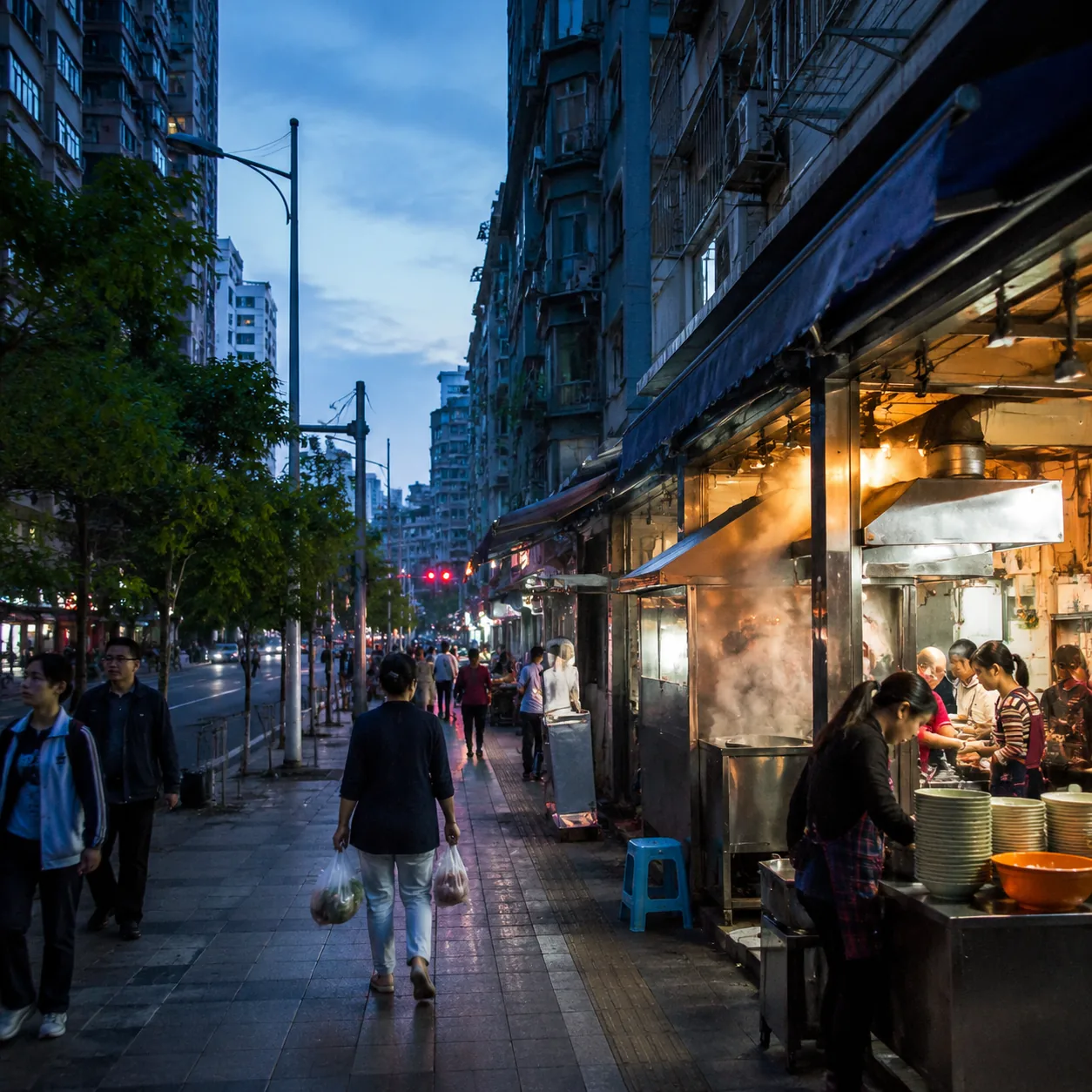
At half past six in the evening, the sky in Guiyang has not gone fully dark, and a damp blue still remains between the buildings. The heat of the day is slowly pushed away by mountain wind, while the roadside leaves seem to hold invisible moisture. An ordinary dinner begins at just such a moment, without a reservation and without a special reason. People off work step out from bus stops, students with backpacks pass the doorway of noodle shops, and older residents returning from the market shift plastic bags from one hand to the other. Lamps in small corner restaurants turn on one by one. Cooking smoke slips from exhaust vents and mixes with the smells of fish mint, fermented chili, and rice, making the stomach feel empty before one has even sat down.
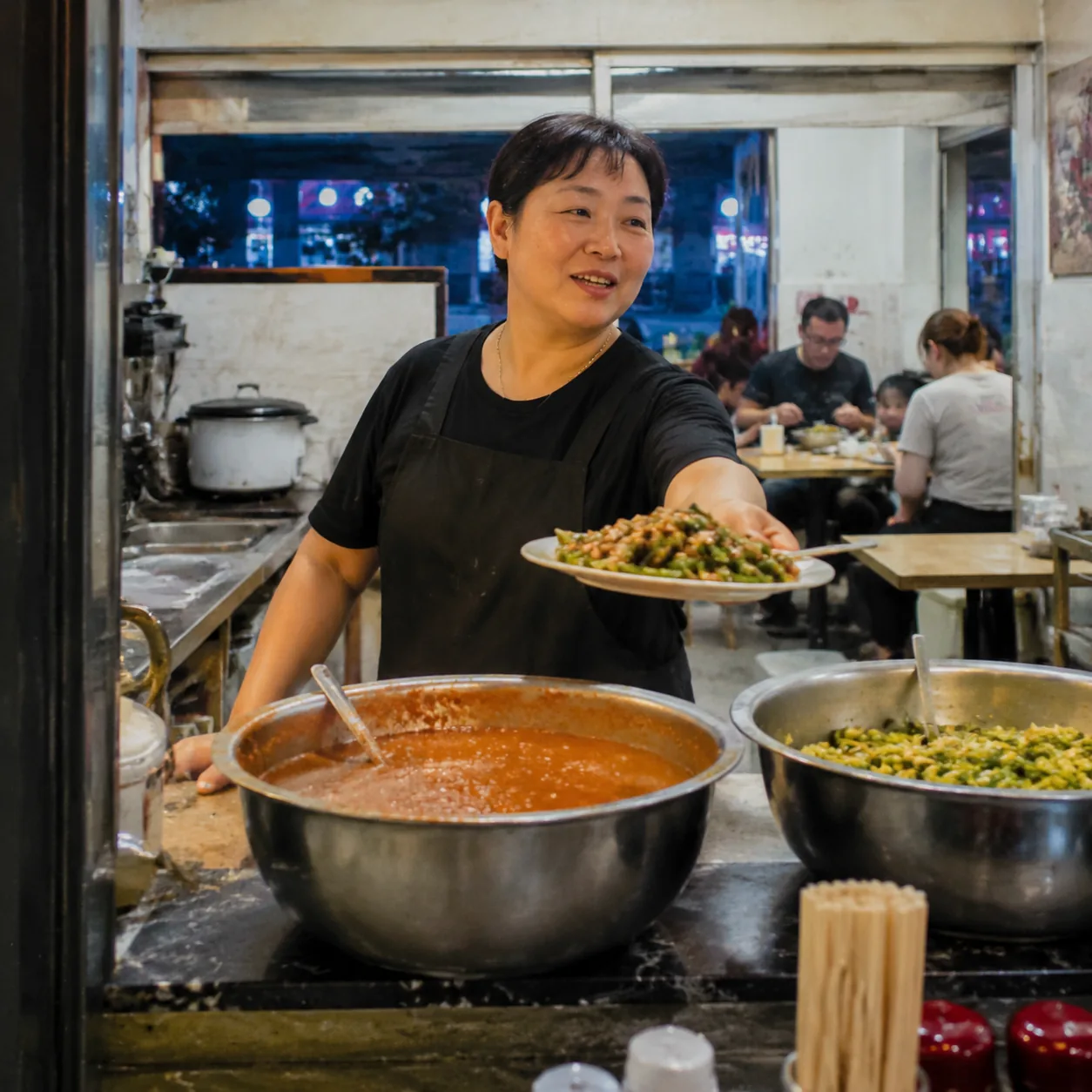
I enter a small restaurant facing the street. Its storefront is modest, and several faded menu photos are pasted on the glass door. Inside are six or seven tables, their surfaces wiped bright, while an electric rice cooker and a row of stainless-steel condiment tins stand against the wall. The owner calls to customers while carrying a fresh plate of shredded pork with green peppers to the serving window. Her voice is not loud, but it crosses the sound of spatulas easily. An ordinary Guiyang dinner is rarely about elegant plating; it is about being hot, fast, and accurate: rice must be properly tender, a dish must carry wok heat, and a spoonful of chili must lift the fatigue of the day. After sitting down, one naturally relaxes the shoulders, as if the city permits you not to look energetic for a while.
The menu lists many familiar names: sour-soup tofu, spicy chicken, stir-fried water spinach, simple squash and beans, twice-cooked pork, and tomato egg soup. They are not emphasized like famous dishes in travel guides, but they are closer to what Guiyang people actually order every day. I choose sour-soup tofu, a plate of fish mint mixed with cucumber, and a bowl of plain rice. At the next table, two office workers have spicy chicken and greens while discussing a form due tomorrow. Near the door, a family of three orders tomato egg soup that is not too spicy for the child; the father places meat into the child’s bowl, and the mother tells him to blow on it first. The beauty of an ordinary dinner is that it places everyone’s life inside the same steam without requiring them to explain themselves to one another.
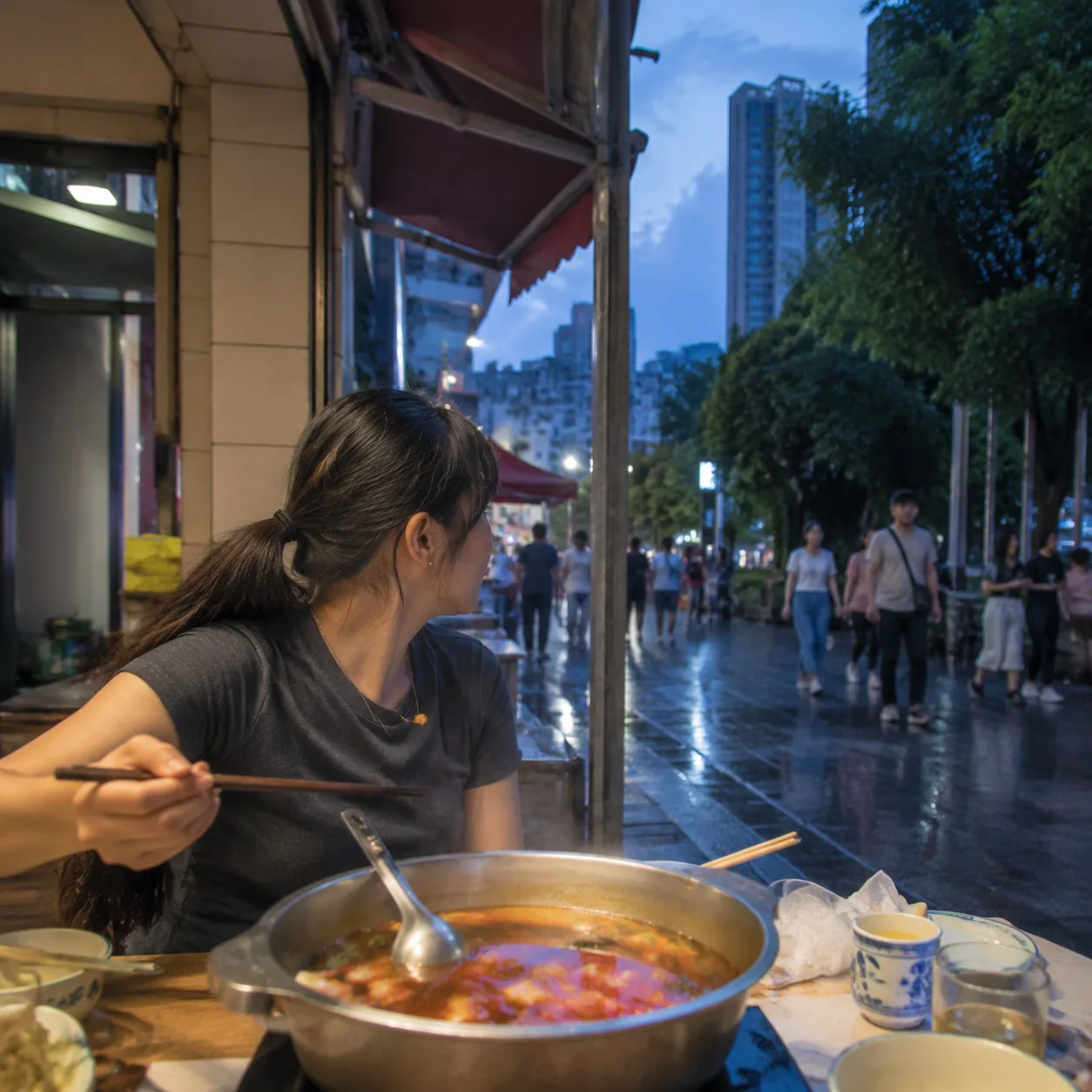
When the sour-soup tofu arrives, bubbles still rise along the rim of the bowl. The broth is not a heavy red but a bright sour fragrance carrying tomato and fermentation. The tofu trembles lightly inside it, as if moved by evening wind. With the first sip, the sourness wakes the tongue before the heat slowly spreads. Guiyang’s sour flavor is not mere sharpness; it is more like a window opened in humid weather, letting a person breathe out of stuffiness. The tofu is tender and breaks easily, so it should be spooned over rice together with the soup. Plain rice absorbs the sour broth and gains both color and personality. Food like this does not need a refined order. A hungry person knows how to eat it: first a sip of soup, then a mouthful of rice, finally a slice of fish mint lifted with chopsticks.
Fish mint is a side character with strong attitude at a Guiyang dinner. Visitors often need time to accept it, while locals eat it as something entirely ordinary. Mixed with cucumber, soy sauce, vinegar, roasted chili, and a little garlic, it first tastes crisp, and then releases a smell like soil, grass, and the foot of a wall after rain. Some people call it pungent, others call it fragrant, but at a Guiyang dinner table it does not need to defend itself. It is part of the city’s damp temperament, like rain that does not fall exactly on time on a cloudy day, or mist that suddenly appears on a slope. Take one mouthful of sour soup and another of fish mint, and the sense of taste seems better able to understand the local weather.
At the busiest moment, nearly every table is full. People keep leaning in through the doorway to ask whether seats are available, and the owner looks around before saying, wait two minutes, someone is almost finished. Guiyang people do not necessarily linger long over dinner, especially on an ordinary workday. They speak if there is something to say, pick up food when it arrives, unzip jackets when the meal warms them, wipe their mouths after eating, scan to pay, and push the door open to leave. The table is quickly wiped again, the next guests sit down, and chopsticks strike bowls with a clear sound. The city’s rhythm continues through these repeated motions: someone ends a day, someone is about to begin a night shift, someone still has to pick up a child, and someone simply wants to go home and shower.
I notice that the sound of an ordinary Guiyang dinner is also rich. A spatula scrapes a wok, steam rises when the rice cooker lid opens, the freezer door clicks shut, a customer asks in dialect whether the chili can be reduced, and a short alert announces successful mobile payment. Traffic outside is not quiet. Electric bikes stop and leave in front of the door, and occasional raindrops hit the awning like fingers tapping plastic. Yet these sounds are not noisy. They are the background music of dinner, proof that food is being made and life is being tended. Sitting inside, one feels not alone before the night, but surrounded by the warmth of an entire street.
Guiyang dinners often cannot be separated from chili, but the heat here is not a single thing. Oil chili has fragrance, roasted chili has a dry fire-touched aroma, fermented chili carries sour sweetness, and the heat in dipping sauce is divided into layers by scallions, cilantro, and Sichuan pepper. When the owner asks whether I want dipping sauce, I nod, and she brings a small saucer, bright red with a little oil shining on the surface. I roll a piece of tofu through it gently. In the mouth comes first the clearness of sour soup, then the thickness of the dip. An ordinary dinner is often memorable not because expensive ingredients are used, but because the flavors have such layers: inexpensive, direct, and serious.
Halfway through the meal, a fine rain begins outside. Guiyang rain sometimes feels less like formal weather than like the air suddenly deciding to become wetter. Passersby do not panic. Some lower their hats, some wait under eaves for a while, and others continue riding as if nothing has happened. People in the restaurant merely glance up and then keep eating. The sound of rain makes the lights seem warmer, small water lines appear on the glass door, and the fruit stall across the street pulls its plastic sheet forward. This kind of rain is perfect for continuing dinner because it pushes the outside world slightly farther away. Steam rises from the bowl, the chopsticks at hand remain dry, the food before the eyes still has a few bites left, and a simple satisfaction appears in the heart.
Perhaps the most important quality of an ordinary dinner is precisely that it is not special. It has no holiday ritual, no banquet politeness, and no pressure to be photographed and recorded. It is simply a landing point within the day, allowing floating matters to settle slowly. The rushed emails of daytime, the crowding on buses, unfinished plans, and weather that suddenly turned cool can all be placed beside the table for the moment. A person only needs to face the food, the person across from them, or themselves. Guiyang’s small restaurants understand the value of this unspecialness, so they do not make the lights too bright, do not play music too loudly, and do not urge anyone to be cheerful at once. They simply bring hot rice and give people a place to recover.
After finishing, I do not leave immediately. Instead, I drink the last bit of sour soup from the bottom of the bowl. The rain has weakened, the street surface has been washed bright, and car lights drag red and white lines through the water. The owner clears empty plates from the next table and casually asks whether the food suits me. I say it is very good, and she smiles, saying that here sour and spicy flavors open the appetite and are especially suitable on rainy days. She says it plainly, as if stating something everyone knows. Yet for a passerby, the sentence places a seal on Guiyang dinner: it is not designed to astonish anyone, but to honestly care for appetite, weather, and the road a person takes from day into night.
When I step out of the restaurant, the air still smells of chili and rainwater. Street lamps reflect on the wet ground, young people carry umbrellas to buy milk tea, an older person walks slowly toward a residential gate with leftovers, and a delivery rider closes the food box before entering the drizzle again. I look back at the small shop. New customers have already sat down, and the sound of the wok begins again. An ordinary Guiyang dinner is like this: it does not end because one person leaves, and it does not deliberately begin because one person arrives. It is like a fixed cloud of steam rising from the city every day, plain yet reliable. As long as someone is hungry, someone is willing to light the stove, and someone is willing to push open the door in the rain, this dinner will continue.
When I later think of Guiyang, I may not first remember a scenic spot. Instead, I may first remember that bowl of sour-soup tofu. It has no complicated story, yet it places the city’s character very close: damp, direct, slightly spicy, and also somewhat gentle. An ordinary dinner teaches that understanding a city does not always need to begin from grand places. Sit in a small restaurant, listen for a while to the wok, watch the rain outside the door, and eat a bowl of food that makes the forehead sweat slightly; one has already touched a very real side of it. Guiyang lives among mountains, and it also lives at dinner tables one after another. Those tables are not large, but every day they steadily receive many people’s fatigue, appetite, and desire to go home.