中国文化
敦煌の老街で本当に人を引き留めるのは、たいてい夜の広がりではなく、灯りの下のあの杏皮水と炉の火だ
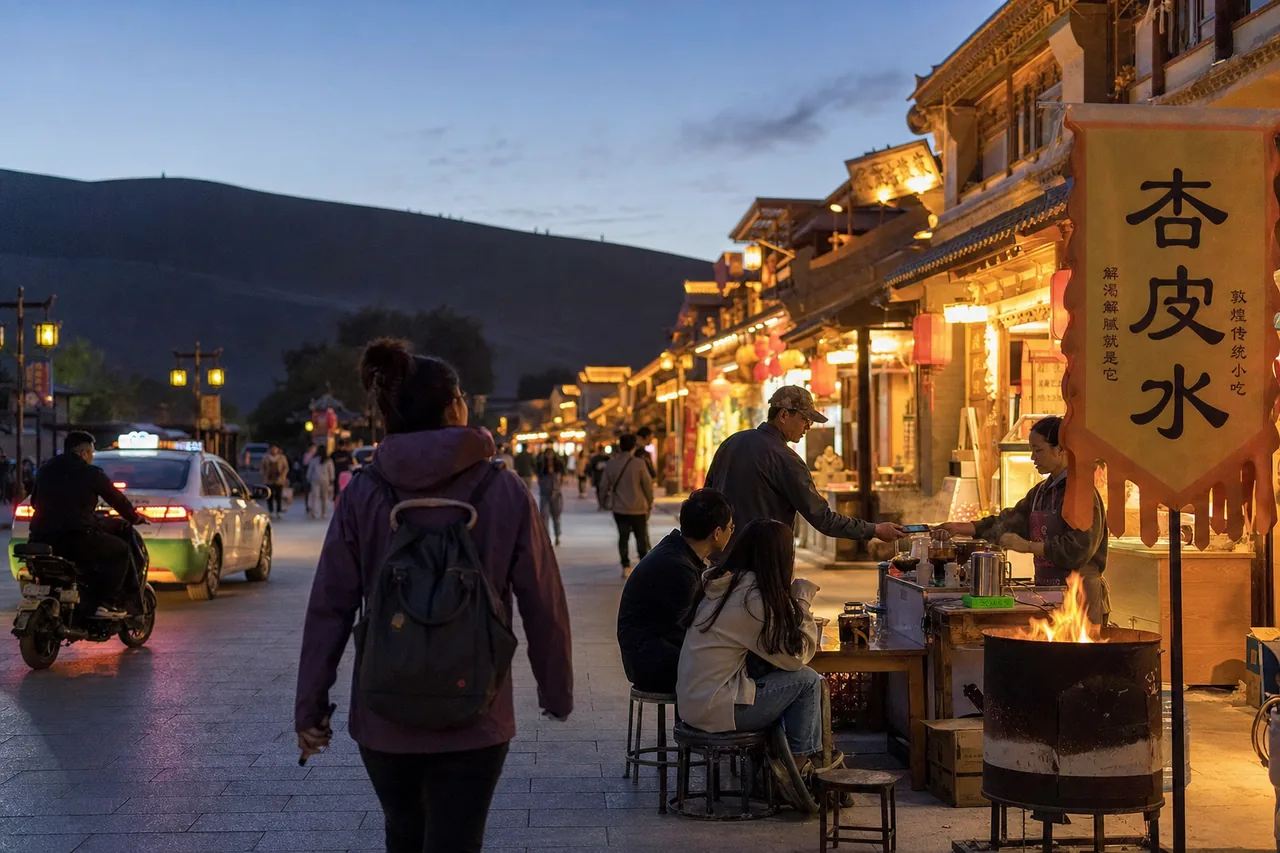
- Night in Dunhuang does not arrive suddenly. It is like a shadow on the dunes, moving inch by inch from outside the city into the old street. I entered the street at dusk, when a pale orange layer still remained at the horizon, while shop lights had begun to appear one after another. The light was not the sharp white of big cities; it carried a touch of amber, falling on wooden signs, brick walls, and stall cloth, giving everything an old warmth. Wind came from the sandy direction, dry and fine, stirring tassels under lanterns and plastic signs before stands selling apricot peel drink. Once the lamps of Dunhuang’s old street are lit, the vastness of daytime folds into a night that can be walked slowly.
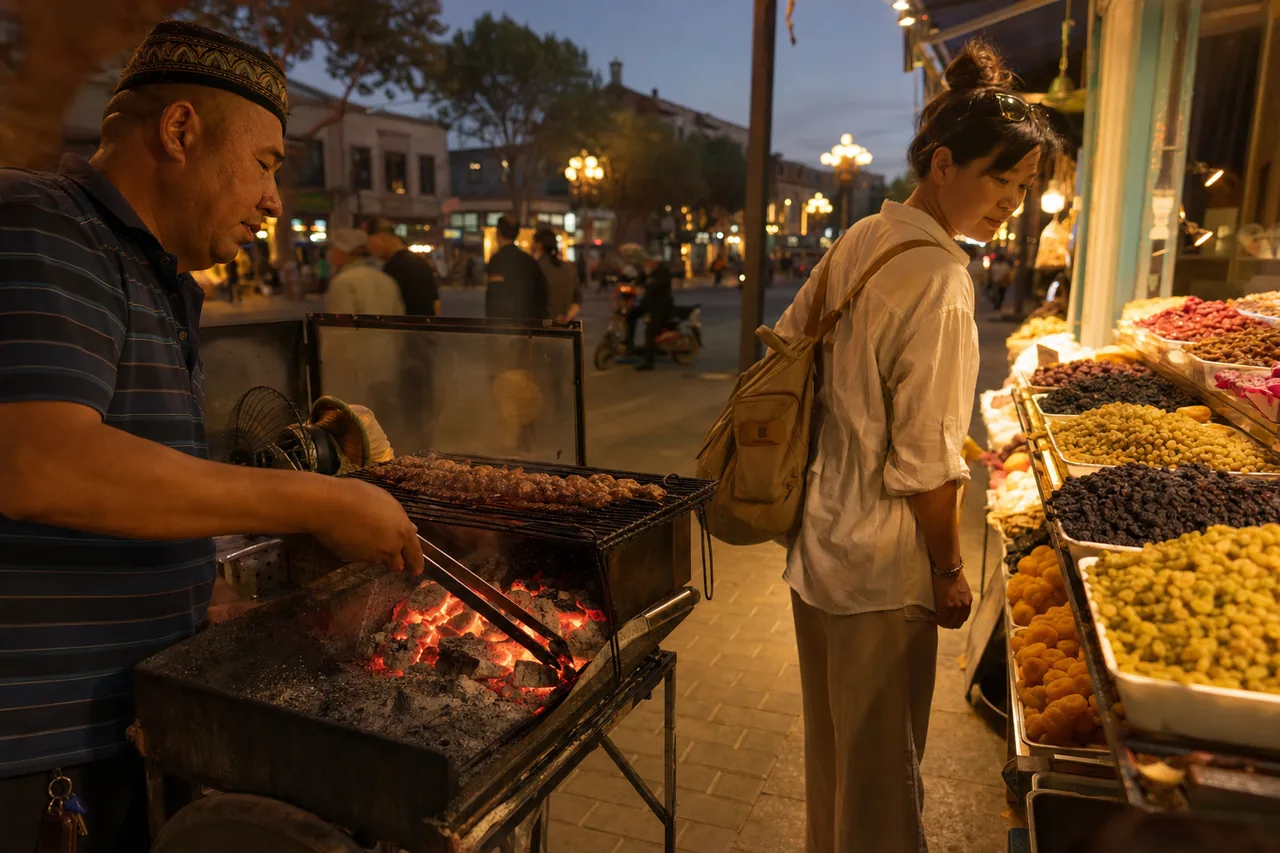
- I like looking at a street when its lamps have just come on, before it has fully surrendered to night and many details still sway between light and shadow. A grill master spread the charcoal, and red light rose from beneath the iron rack, answering the bulbs overhead. Beside him, a vendor arranged raisins, dried apricots, and Li Guang apricots in neat rows, their yellows, browns, and deep purples growing richer under the light. Travelers slowed as they passed, first caught by scent, then held by color. Dunhuang’s old street does not create grandeur with tall buildings. It relies on lamps close to the ground: lighting hands, food, smiling faces, and the everyday warmth accumulated by a frontier city over a long time.
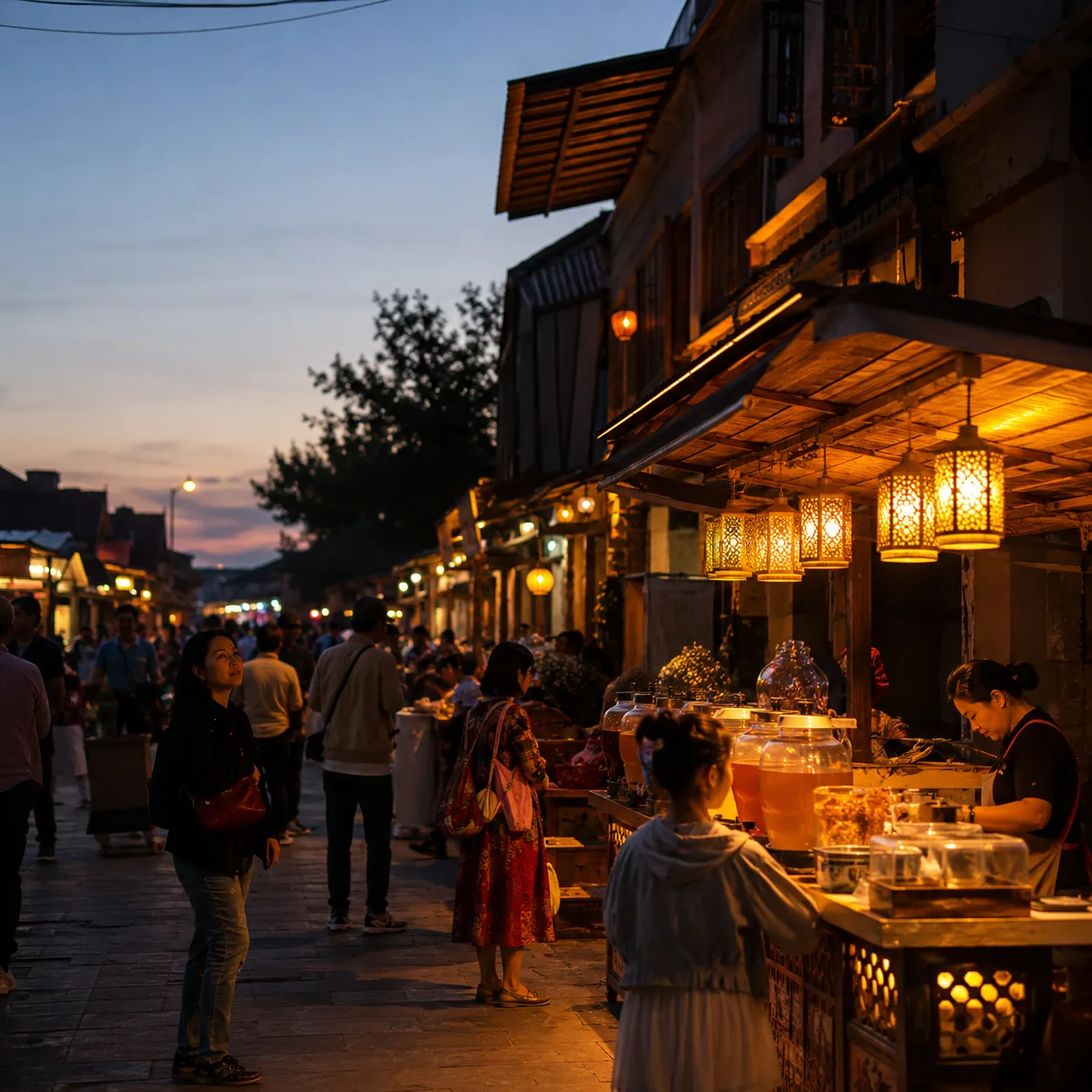
- The lamps on the old street come in many forms. Antique-style palace lanterns hang at shop doors, their red shades coloring the lintels with festivity. Bare white bulbs dangle above snack stalls, directly lighting pot rims and cooking smoke. In souvenir shops, tiny camel-bell lamps cast metal shadows on the walls, like a miniature caravan crossing the desert. What drew me most was the lamp outside a calligraphy and painting shop. Light spread through a translucent paper shade, falling on apsara patterns and fans bearing the characters for Dunhuang. It was not strong, but it had a quiet persistence, as if the colors of Mogao’s murals, after a thousand years in dimness, were still willing to glow softly on the street.
- More people came to eat, and the lights seemed to brighten with their voices. Smoke from skewers rose under bulbs and became fragrant clouds. In a noodle shop, someone carried out donkey meat yellow noodles, steam curling over the bowl’s rim. A shopkeeper selling poplar-wood ornaments sat by the door, fanning himself while watching the street. Dunhuang’s night market is lively like many places, yet it has its own undertone. Behind the liveliness here stand desert, grottoes, passes, and ancient roads. Even if you are only sitting on a plastic stool eating a bowl of noodles, you feel that the lamp above you shines not only on the present but also on countless people who once passed through and moved on.
- I stopped before a small shop selling postcards, seals, and booklets of reproduced murals. At the entrance stood an old-style desk lamp, its green glass shade pressing warm yellow light onto the grain of a wooden table. The owner, a middle-aged man, noticed me looking and said the lamp was not an antique, only something used for many years and too hard to discard whenever the shop moved. He said the old street had changed several times: signs replaced, pavement repaired, visitors more and fewer, fewer and more. But when certain lamps came on, they seemed to call old days back. Listening, I suddenly understood that an old street is not necessarily made only of old buildings; it may also be made of light repeatedly used and repeatedly cherished.
- Walking on, I saw camel shadows projected on a wall. They came from a decorative lamp in a nearby shop: several small camels in a line, carrying tiny bundles on their backs. Children were delighted and reached out to touch them, only for the shadows to disappear under their palms and return again. Dunhuang easily makes one think of distant roads, while the lamps of the old street make distance feel intimate. In textbooks, the Silk Road is a grand line; in museums, it is a collection of objects. On a night street, it may simply be a row of swaying camel shadows on a wall, a cup of sweet-sour apricot peel drink, or a coin handed back by a vendor as change.
- The most charming thing about the old street lamps is that they do not only illuminate goods; they also illuminate expressions during brief encounters. A young man asked which dried apricot was more sour, and the vendor simply picked one up for him to taste. Two elders sat chatting at a doorway, the light deepening their wrinkles while softening them too. A backpacker looked down at a map, the cold glow of a phone and the warm glow of a lantern falling on the same face. Everyone stays here only for a while, but the lamps act as patient witnesses, remembering these moments for the street. They do not ask where you came from or whether tomorrow you will go to Mingsha Mountain or Mogao Caves; they only make this small stretch of tonight clear.
- I bought a cup of apricot peel drink, tiny droplets clinging to the cup wall and looking especially cool in the dry wind. The bulb above the stall lit the amber liquid like a small cup of sunset. The first sip was sweet and tart, with the dense flavor of boiled fruit peel, immediately soothing my throat. Standing under the lamp, I noticed my shadow stretched long at my feet, overlapping with and separating from the shadows of passersby. The ridgelines I had seen at Mingsha Mountain by day seemed now transformed into lines of shadow on the street. This is Dunhuang’s way: folding grand landscapes and small daily life into each other until you cannot tell whether you are traveling or briefly making a home beneath a lamp.
- In the middle of the street, a lit sign announced an old-established shop, its characters designed in a retro style and worn slightly at the edges. Many travelers took photos there, posing beneath the sign as laughter spread in waves. I intended to avoid the crowd, but one instant held me: a mother adjusted her child’s hat, and the child looked up at the lamp, two points of brightness reflected in the eyes. The scene was ordinary, yet it felt more like a travel souvenir than any arranged pose. Dunhuang’s lamps do not only help people see the road; they let people see themselves far from home. In an unfamiliar city, one often becomes sensitive. When the light softens, the heart softens too.
- Later in the night, the colors of the old street grew full. Red lanterns became redder, blue signs bluer, bronze objects reflected a little gold, and the fire in grills looked like a low star. Singing and plucked strings came from somewhere ahead, the melody carrying the openness of the northwest, not ornate but direct. Someone passed with food, and the scents of cumin and charcoal met in the air. I thought of the name Dunhuang itself, which resembles a lamp: dun meaning grand, huang meaning brilliant. It once lit routes deep in history, and now, on the old street at night, it continues to shine in a more ordinary way. The lamps are not majestic, but they make the city’s name feel intimate.
- Some shops closed early, their rolling shutters lowered halfway while light still leaked from inside. This half-bright, half-dark state was interesting, as if the day was reluctant to end. Cleaners began collecting paper cups and bamboo skewers along the street, cart wheels making soft sounds over the ground. Travelers gradually moved toward the exit with small bags in their hands, souvenirs swinging under the lamps. I followed the flow slowly but was not eager to leave. Looking back, the old street lamps connected one by one into a line, like someone lowering a small Milky Way to earth. It was not as vast as the desert night sky, but it was closer to palms and breath.
- I think daytime Dunhuang makes people look upward: at caves, mountains, sand, and sky. The Dunhuang of the old street at night makes people look downward: at noodles in a bowl, water in a cup, a vendor’s hands, and one’s own shadow under a lamp. If a place has only grandeur, it can easily inspire respect from a distance. With these lights, it becomes approachable. The old street lamps bring Dunhuang down from the heights of history and geography to the side of ordinary people, giving the distant Silk Road a touchable warmth. Walking beneath them, I no longer thought of Dunhuang only as a legendary node, but also as a night where someone cooks, someone chats, and someone waits for customers.
- When I left the old street, the wind was cooler than before, but the lamps seemed warmer. I threw my empty cup into a bin and stood at the street entrance for a while. Car lights flowed in the distance, nearby lanterns swayed gently, and there were only a few stars overhead, yet they were enough to remind me of the sand outside the city. The lamps of Dunhuang’s old street did not give me astonishment; they gave me a slow kind of care. They cared for late returners, for hands closing stalls, for the mood of travelers briefly stopping, and for the softest part of the city beyond grand narratives. Later, when I remember Dunhuang, besides the solemnity of Mogao Caves and the vastness of Mingsha Mountain, I will surely remember the amber lamps on this street.
…