蘇州でシェアサイクルに乗って二度も道を間違えて、やっと中国の都市で楽に走るコツを覚えた。
In Suzhou in June, at 8:20 in the morning, we stood at the north entrance of Pingjiang Road as the crowd spilling out of the metro moved forward like it was being gently pushed. My friend held phone navigation in one hand and an orange shared bike in the other, while I hurried to adjust my seat by the curb, the soles of my shoes still damp from rain. We only meant to ride to a small classical garden, but on the very first stretch we turned the wrong way and drifted farther and farther down an alley that was much too quiet.
Many first-time riders in Chinese cities assume the difficult part is scanning the code, paying a deposit, or figuring out which bike is cheaper. The real challenge is rhythm: when to ride and when to walk; when to trust navigation and when to look up at the street; when to choose the shortest path and when to choose the smoother one. Suzhou is not the most crowded city, but it is especially good at magnifying all those tiny decisions until you can clearly see them.
The night before, we had studied the route in the hotel and thought we were well prepared. My friend Ayao had ridden in Hangzhou and Nanjing and sounded confident: “Suzhou is flat. Today will be easy.” I believed that sentence and did not seriously examine the waterways and walking segments marked on the map. When we headed out the next morning, the air carried the damp fragrance of gardenias, and each time a breakfast shop lifted a steamer lid, clouds of sweet soy milk heat and the smell of meat buns drifted over. It became even easier to fall for the illusion that in a city this gentle, cycling could not possibly go wrong.
Our first mistake was typical: we saw a straight blue line on the map and instinctively assumed it was a route we could simply ride through. At the corner, however, a small bridge ahead was for pedestrians in practice, packed with retirees doing morning exercise and visitors holding cameras. Ringing the bell was pointless and only made us seem clumsy. We had to get off and push, the tires thudding dully over the seams in the old bluestone bridgehead while a black-canopied boat slid along the canal beside us, its oar stirring rings through gray-green water.
Once across, we realized we had drifted into the interior of a residential quarter. It lacked the bustle of a famous sight, but it offered more truthful details of daily life: bedsheets still damp on clothes poles, electric scooters slipping quietly out of narrow lanes, a folded stool beside a shoe-repair stand, and fresh washwater still shining on the pavement outside a tofu shop. The problem was that roads like this looked atmospheric but were not efficient. You had to slow down, yield, and restart constantly. In less than ten minutes my calves were already sour, and this was nothing like the effortless Jiangnan ride I had imagined.
Ayao realized it before I did. She stopped under a camphor tree and said, “We’re not competing with the map. We’re bargaining with our energy.” That became the most useful sentence of the day. We reopened navigation, let go of our obsession with the shortest route, and switched to roads that were wider and more continuous. When we approached an obvious historic quarter crowded with visitors, we simply assumed we would walk for a stretch. If the next two hundred meters meant a bridge, a lane, and market stalls, there was no point pretending we should stay on the bike.
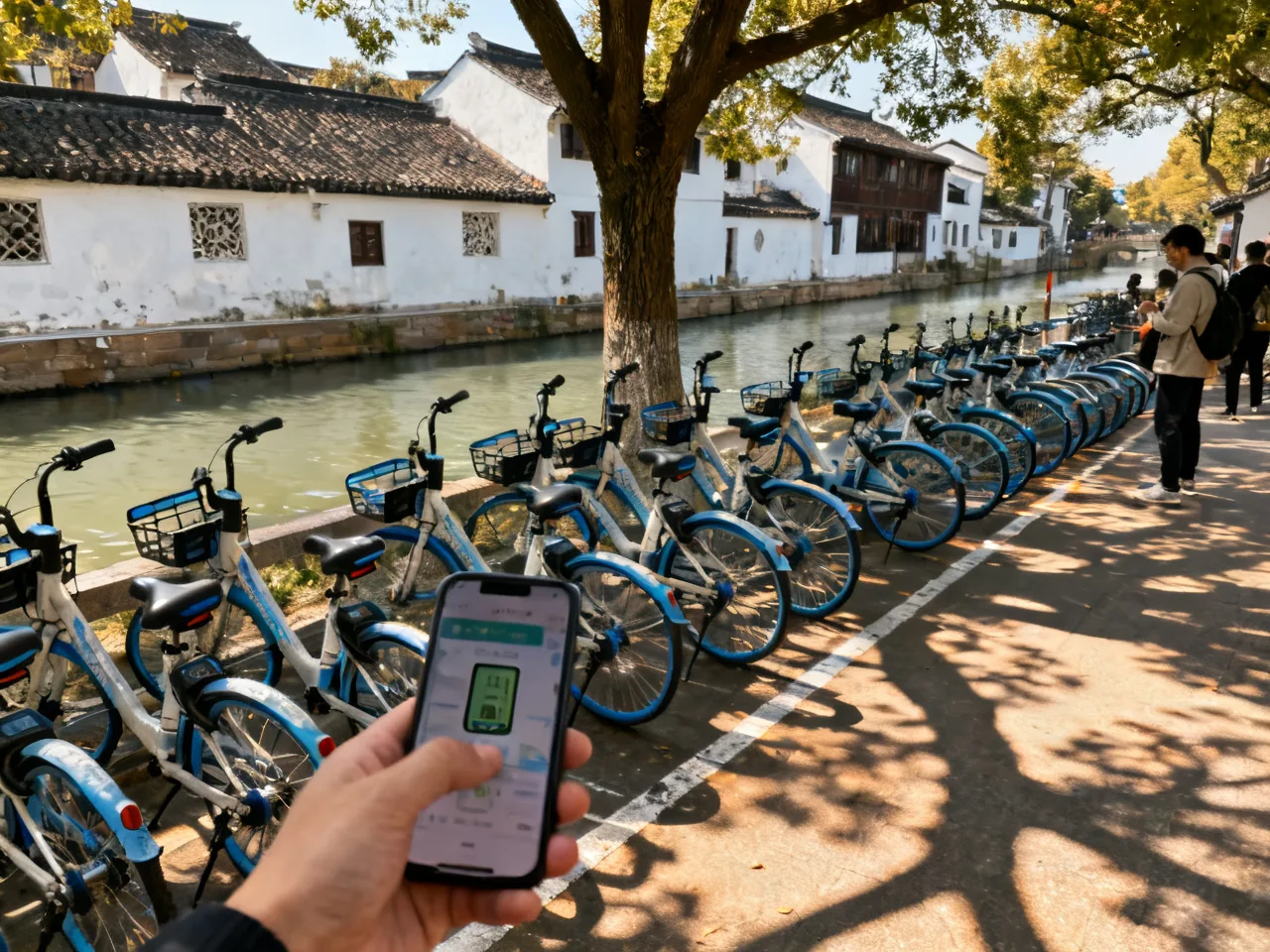
The second wrong turn was more awkward than the first. We tried to cut out through a riverside path that looked smooth enough, only to discover halfway along that temporary construction barriers blocked the way, leaving a slit barely wide enough for pedestrians. By then the sun had climbed higher and flashed off the white walls. Sweat ran down from my temples, and my palms had turned sticky against the handlebars. We had to backtrack, and on the way a delivery rider coming toward us laughed and called out, “The main road is faster. Stop squeezing into little lanes.” I felt slightly embarrassed, but that was the moment I finally accepted that locals understood the phrase “save effort” in a way that was less romantic and far more useful than tourists usually do.
After that, we began to ride using the city’s own logic instead of ours. The first lesson was to treat the metro and the bike as a combined tool rather than an either-or choice. If a section crossed too many canals, had too many lights, or was obviously clogged around a scenic area, it was better to take the metro for one or two stops, skip the most draining portion, and pick up another bike near the exit. This works in many Chinese cities and is especially useful for first-time visitors. If you are still figuring out how different modes connect, a practical guide to choosing urban commuting options in China is more helpful than staring at a map alone.
The second lesson was not to judge by distance alone, but by how smooth the chain of “park, unlock, pass through” would be. Shared bikes save effort not because they are fast, but because they reduce waiting and backtracking. If you keep having to cross barriers to find parking zones, or the geofencing near scenic areas is unusually strict, even one kilometer can feel long. By contrast, roads along main arteries, around universities, and on the outer edges of shopping streets usually make both pickup and return easier. I realized later that Suzhou itself was not difficult to ride. We had simply selected every segment least suitable for uninterrupted cycling.
The third lesson was directly about stamina: raise the seat a little, lighten the backpack a little, and buy water before you need it. It sounds ordinary, but it matters. When we stopped at a convenience store around noon, I drank half a bottle of iced oolong tea in one go, and only when the cold slid from my throat into my stomach did I feel revived. The fan at the entrance pushed out warm air mixed with the smell of oden and coffee steam. Seeing us sweaty and flustered, the clerk even pointed to an open area beside the store where we could leave the bikes for a while. In Chinese cities, that kind of utterly ordinary assistance often makes the whole trip suddenly run better.
Ayao later reminded me not to think of shared bikes as mere transportation between sights, but as a tool for sensing a city’s scale. In a car, Suzhou looks like a horizontal scroll of white walls and dark tiles. On a bike, you begin to notice the vegetable seller calling from a lane entrance, the coolness rising from under a bridge, the flutter of a hand fan beneath tree shade, and even the speed at which a district returns to ordinary life once the tourists move on. Because you are not moving too fast, you realize that a Chinese city is not stitched together by landmarks alone. It is also built from breakfast stalls, convenience stores, bus stops, and countless tiny pauses.
If you plan to combine cycling with longer-distance travel—arriving in Suzhou by high-speed rail and then moving through the city by metro and bike—it helps enormously to understand how the connections work in advance. An end-to-end guide to China’s high-speed rail follows the same underlying logic: not that every step must be fast, but that every step should minimize backtracking.
A little after three in the afternoon, we finally reached a stretch of road that felt genuinely easy. The canal fell away to one side, the lane ran straight, and the plane trees sifted the sunlight into shifting patches. Now and then a bus whispered past. We stopped arguing over which line was shorter, and we stopped trying to prove we could “do it like locals.” We simply rode with the breeze. Passing a pastry shop, we caught the sweet fragrance of osmanthus lotus root drifting out, and Ayao and I slowed at the exact same moment, exchanged a glance, and got off to buy two portions.
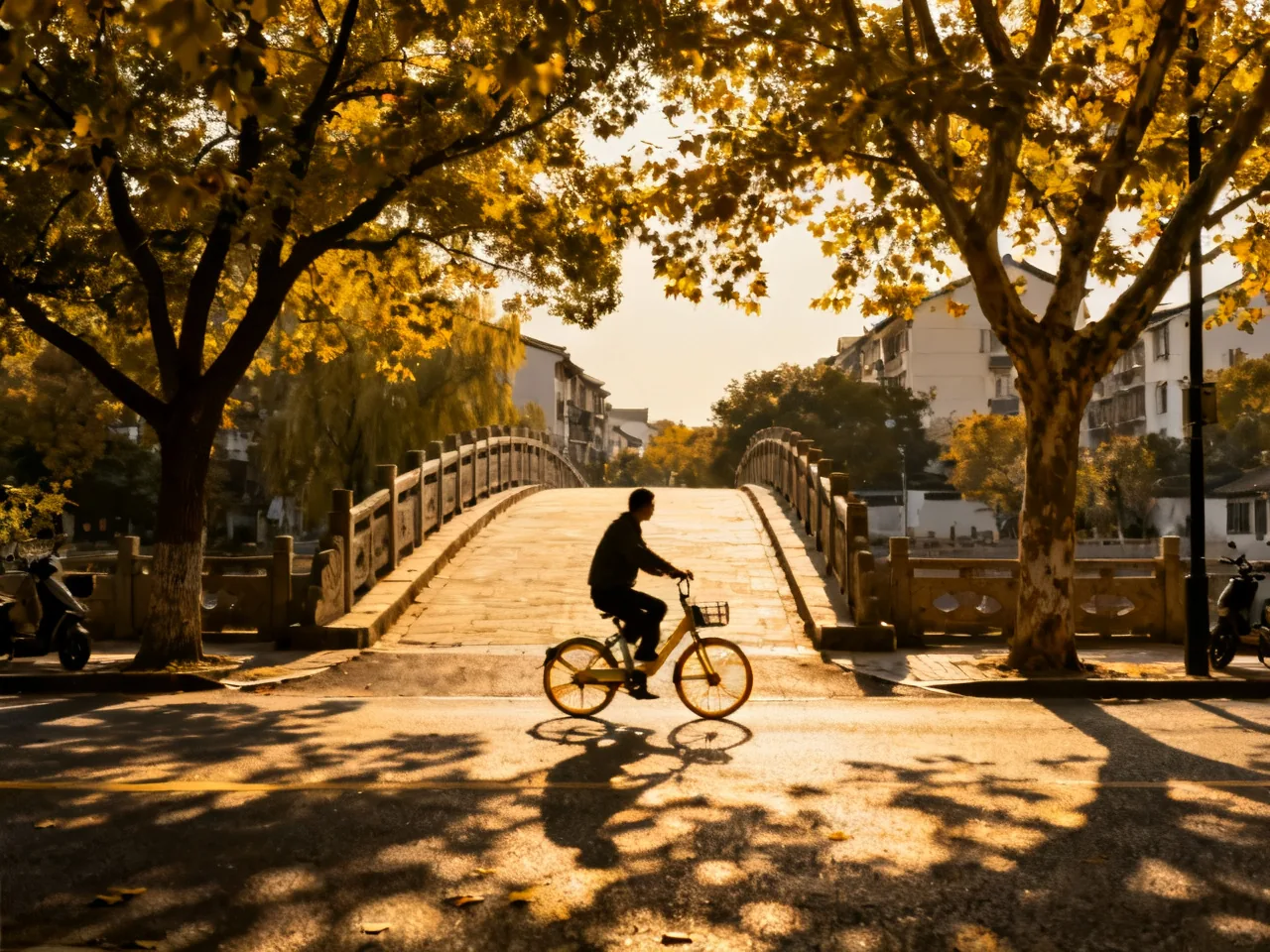
When we returned the bikes near Pingjiang Road at dusk, I looked again at the side street that had sent us astray in the morning and no longer felt the need to conquer it. Learning to ride Chinese cities with less effort does not mean discovering one perfect route. It means accepting that your route will keep being revised by crowds, bridges, weather, and your own condition that day. We parked within the white lines, and the lock clicked shut. Lights had just come on along the canal, a touch of orange shimmered on the water, and a small queue was forming at a stall selling plum drinks. We stood there finishing the last cold mouthfuls, hearing bike bells on the bridge, bursts of laughter, and the soft sound of evening wind moving through leaves. What we had really learned that day was not how to avoid every wrong turn, but how to make the wrong turns less tiring.