絞り染めワークショップ:一枚の白い布を、ゆっくり風景になるまで待った初めての体験
I used to think a tie-dye workshop would probably be one of those tourist activities where you make something small, take a few photos, and leave with a souvenir cloth. But when I actually sat down in a Chinese workshop with white fabric, cotton string, wooden clips, and a basin of deep indigo dye in front of me, I realized that the most fascinating part was not how photogenic the final result would be. It was the fact that I had to accept not knowing the outcome immediately. For me, as someone from France, that rhythm felt unfamiliar and deeply attractive.
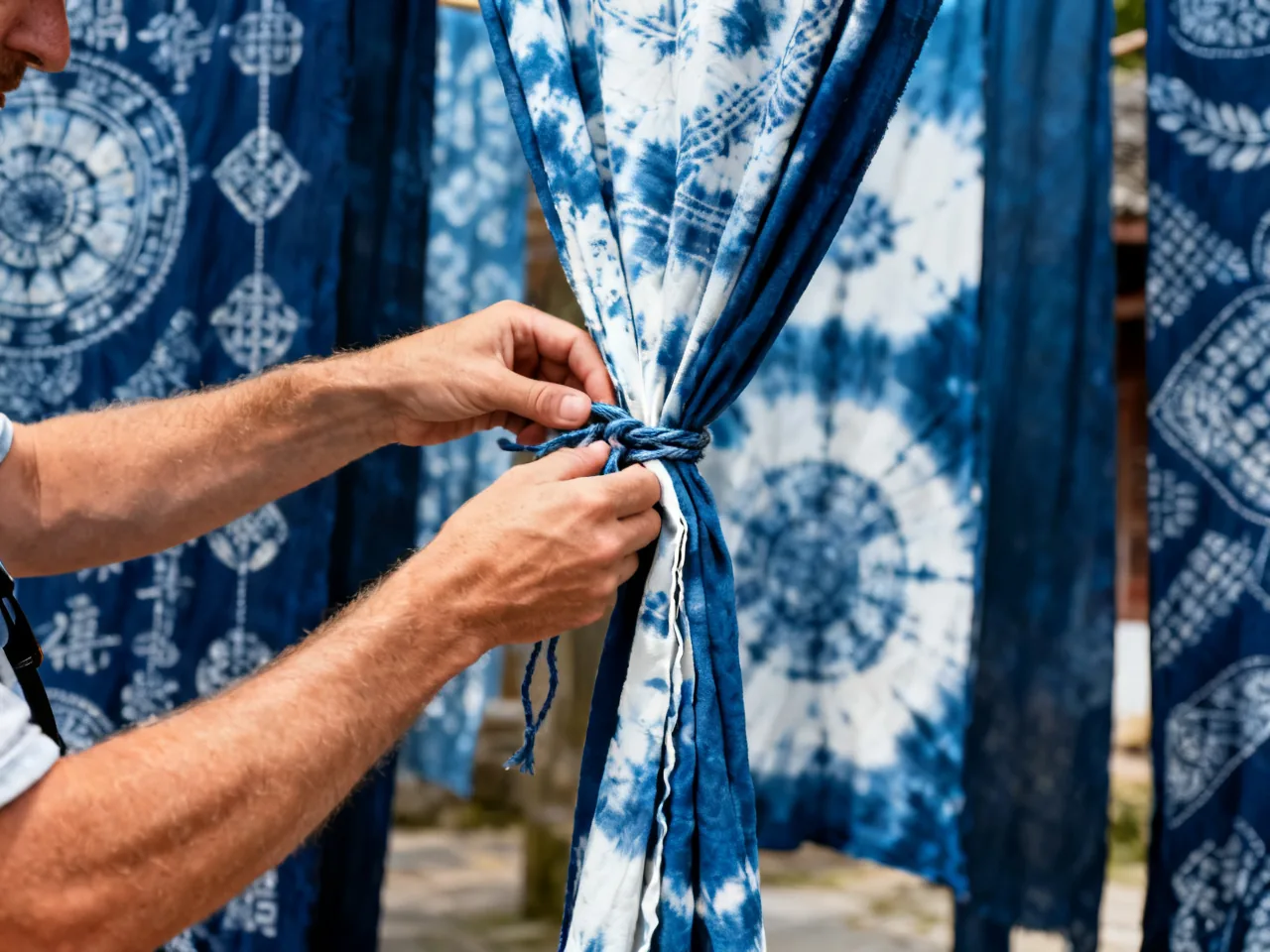
The instructor did not rush us into dyeing. She held up a square of cloth and showed us, fold by fold, why we should first imagine the pattern before deciding how to bind it. She explained that tightly tied areas would remain white, dense folds would create repetition, and every knot was really a small judgment. Listening to her, I suddenly felt that this was not just a decorative craft. It was a way of placing patience directly into cloth. You could not simply rush toward the answer. You had to collaborate with the material first.
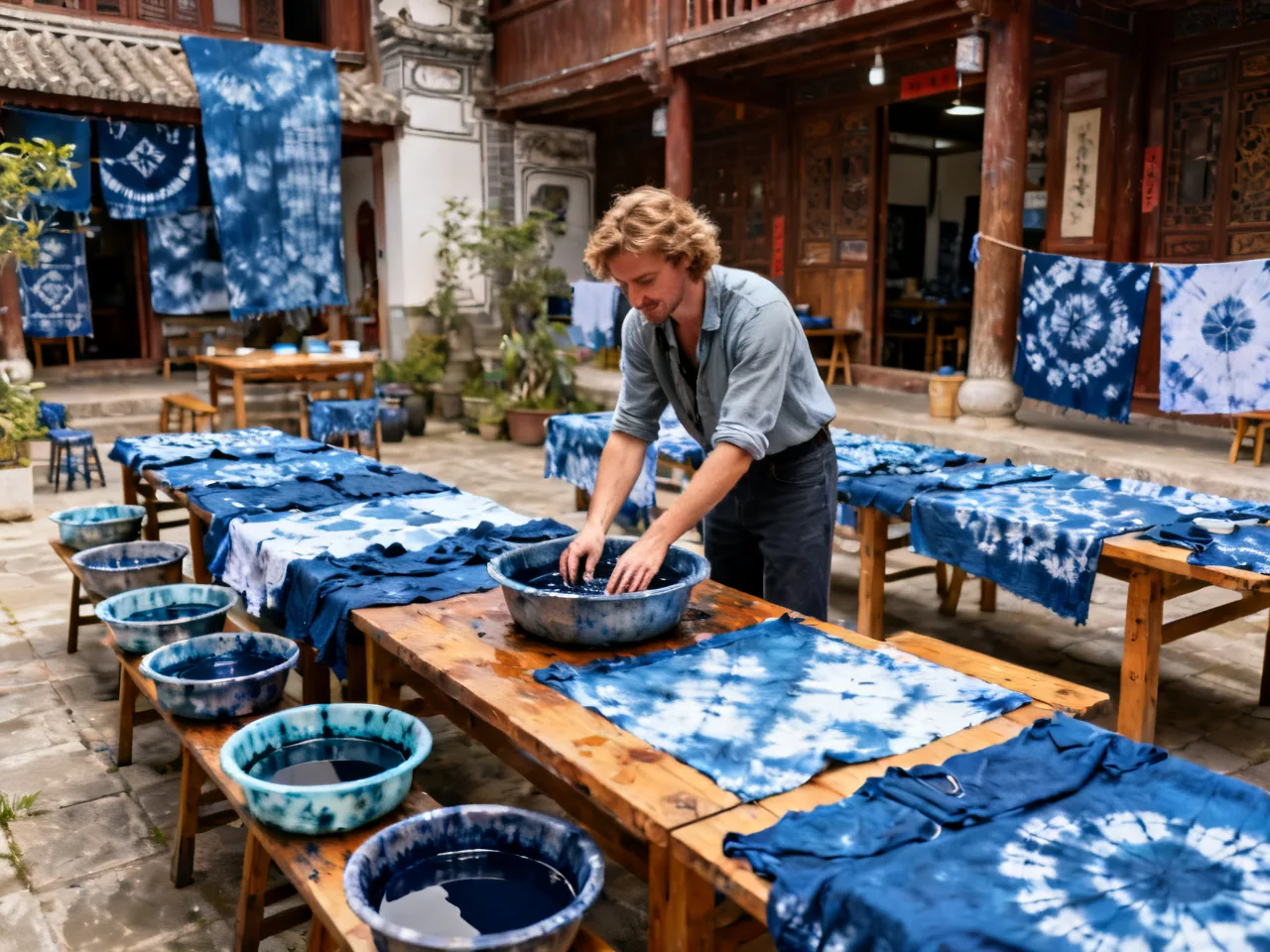
My first design was not ambitious at all. I was afraid of making a mess, so I chose only the most basic folds and a few bindings. But once I actually started, I quickly noticed that even simple gestures reveal personality. Some people tied decisively, others checked every knot twice. Some immediately chased complicated patterns, while others preferred to let the cloth develop its own variation. I was probably in the second group, always pausing to think, “Is this too tight?” or “Will that side stay too empty?” In travel, hesitation is not always a strength, but at a tie-dye table, it slowed me down in a good way.
What truly captivated me was the moment of dyeing. The white cloth was slowly pressed into the blue liquid, tiny ripples formed on the surface, and the air carried a faint smell of plants and water together. When the instructor lifted the cloth out, it looked like nothing more than a dark blue bundle, not beautiful yet at all. But she was completely unhurried. She only said, “Wait a little. The color is still entering, and the cloth is still remembering what you did.” I loved that sentence. The most moving part of craft is often not what I did, but how the material slowly preserves those gestures.
When it was time to untie the cloth, the whole workshop suddenly became much quieter. Earlier, people had been chatting and comparing whose bindings looked neater. But the moment of revealing the pattern felt private, and everyone instinctively lowered their head toward their own piece. As I loosened the string circle by circle, white lines and blue ground slowly appeared, and the feeling was almost like seeing a landscape emerge through mist. It was not perfect. In some places, the edges were looser than I had expected. But precisely because of that, it felt genuinely made rather than uniformly produced.
At that point I naturally thought about traditional textiles and domestic fabrics from France. We certainly have strong textile traditions too, from rural household cloth to more refined printed and dyed fabrics, all shaped by a close relationship between material, texture, and everyday aesthetics. But what I felt in this Chinese tie-dye workshop was different. In France, textile beauty often emphasizes control, balance, and harmony in the finished piece. Chinese tie-dye, at least in this experience, made me appreciate that accident itself can be part of beauty. Slight asymmetry, uneven tonal diffusion, and white lines that widen and narrow unpredictably were not failures. They were evidence that the hand had truly been there.
Later I understood why so many people say tie-dye is especially suitable for travelers. It is not a craft that can only be admired from a distance. You can genuinely complete a process from blankness to form with your own hands in half a day. At the same time, the experience does not pretend that you suddenly understand the whole tradition. It simply lets you touch the threshold honestly. You begin to see why skilled artisans can control rhythm, anticipate patterns, and make a blue-and-white cloth that looks simple but actually contains a great deal of experience.
If foreign friends ask me which Chinese folk craft gives the quickest sense of real participation, I would probably mention tie-dye first. Not because it is the most ornate, but because it turns waiting, judgment, and acceptance of imperfection into physical experience. When you leave the workshop, what you carry is not only a piece of cloth, but also a stretch of time you made with your own hands. For me, that is the most valuable kind of travel memory. It is not something purchased. It is something you waited into existence in that place.