糖画の屋台の前での数分間で、私は初めて「甘さ」も描けるものだと感じた
I used to think sugar had a simple purpose: it tastes good, gives energy, and lifts the mood. As a foreigner from Turkey, I also grew up with sugar as part of street life and festive life. Whether in shining jars of candy or in sweets sold with a little theatrical flair in open markets, sugar was often part of the excitement. But the first time I stood in front of a Chinese sugar painting stall, I became quiet almost at once. In that moment I suddenly understood that here, sugar is not only flavor. It is also a pen made of liquid light. The artisan held a small ladle, poured melted syrup onto a stone slab, turned the wrist, and a line immediately came alive. A few circles later, a fish, a dragon, a butterfly, or a rabbit slowly appeared. Those few minutes startled me. Sweetness, I realized, does not only enter through the mouth. In this craft, it first arrives through the eyes.
What drew me in was not only the image, but the courage of making it in one continuous motion
One of the most charming things about sugar painting is that it leaves almost no room for hesitation. The moment the syrup leaves the ladle, its temperature is already falling and the line is already beginning to set. You cannot revise it slowly the way you might correct a sketch, nor can you pause repeatedly as if writing on paper. The artisan’s hand must be steady, and the image must already exist in the mind. I found that deeply impressive. Watching from the side, the movements looked effortless, but I knew that if I tried it myself, my first line would probably break and my second would collapse into a sticky lump. Sugar painting appears light and playful, yet it demands quick judgment and highly trained touch.
Later the instructor let me try a very basic line myself. Even shaping a simple curved hook made me tense. If the syrup flowed too quickly, the line became too thick. If I lifted my hand too slowly, the sugar pooled. If my movement lost continuity, the image immediately lost its airy grace. At that moment I truly understood why street folk arts are so often underestimated. Because they seem close to daily life, close to children, and close to festivity, people assume they must be easy. But once you try them, you realize that anything capable of making ordinary passersby understand, enjoy, and marvel within seconds usually rests on years of practice.
What moved me most was the way it turns brevity into beauty
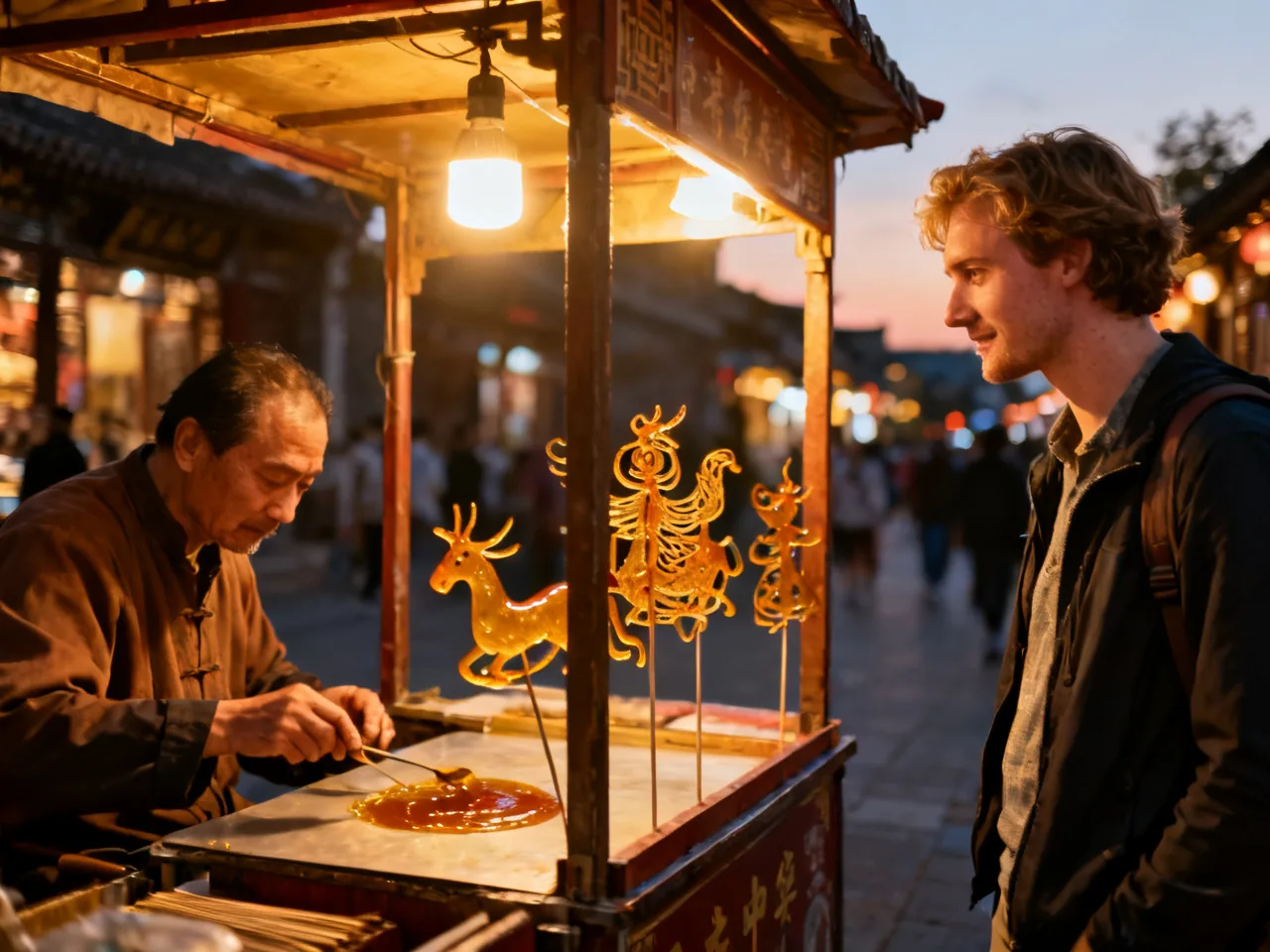
Sugar painting is, of course, not an art meant to last forever. It fears heat, it fears pressure, and even holding it in your hand makes you a little careful. Yet that is precisely why I found it so special. Many art forms derive value from durability, expense, or rarity. Sugar painting almost reverses that logic. It knows it will crack, melt, or be eaten, so it does not place its meaning in permanent preservation. Instead, it places its charm in the act of appearing. First you watch it come into being. Then you marvel at how quickly it is completed. Finally, you may even eat it yourself. The whole process is brief, yet strangely complete.
This sense of brief completeness stayed with me. When we travel, we often want to bring worthy things home: a photograph, a souvenir, a piece of cloth, a cup. But sugar painting reminded me that some of the most valuable cultural experiences are valuable precisely because they cannot really be carried away. What you keep is not the object itself, but the moment when the sugar line curls across the stone, the widened eyes of a child nearby, and the faint shine that appears just as the sugar hardens. It feels like a tiny performance, yet inside it are craft, food, childhood memory, and the atmosphere of the street all at once.
It reminded me of Turkish street sweets, though the mode of expression is completely different
As a Turkish traveler, seeing sugar painting naturally made me think of some street-sweet traditions from home. Turkish candies and festive sweets also often carry a performative quality. Vendors use slightly exaggerated gestures to attract attention, and sweets are made bright and glossy enough to pull children closer at first glance. Some of our sweetest memories are not only about taste, but about the calls of the seller, the rhythm of the street, and the festive atmosphere around them. In that sense, sweets in Turkey also belong not just to flavor, but to the liveliness of public space.
But Chinese sugar painting felt to me more like using sugar to draw a story. It does not depend mainly on piled-up color or exaggerated size. It depends on line. That line carries something almost calligraphic in its speed, turn, and pressure, while also retaining the directness and readability of folk motifs. Many Turkish street sweets strike me first through aroma, liveliness, and festival energy. Chinese sugar painting makes me stop first for the hand. In one case, sugar seduces the air around you; in the other, sugar becomes image. Both are joyful, but they organize joy differently.
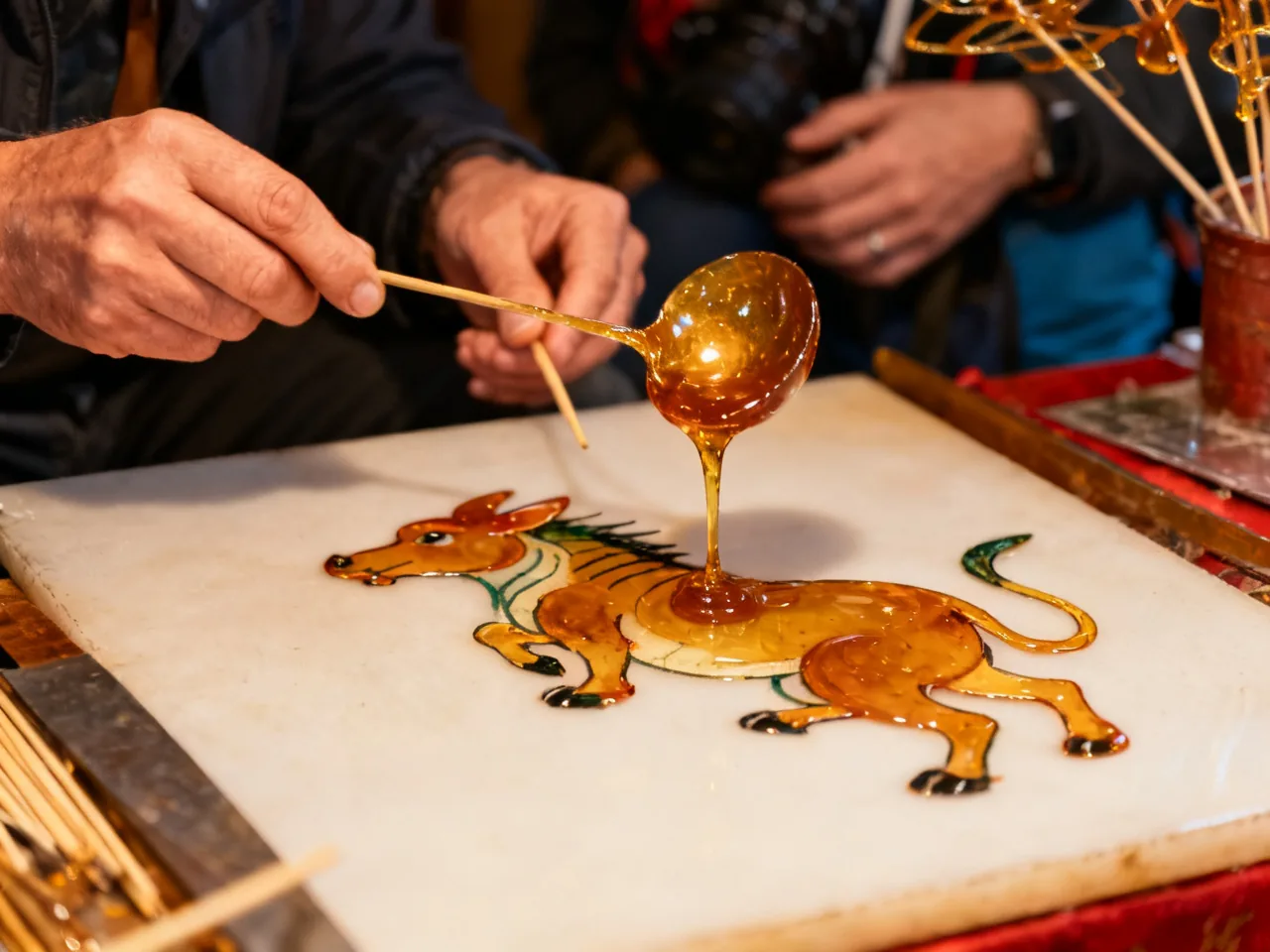
If I had to name the clearest distinction, I would say this: Turkish street sweets often amplify the atmosphere of sharing, while Chinese sugar painting intensifies the surprise of instant formation. The first feels like entering a festival together. The second feels like standing at a stall and watching an animal or legendary figure suddenly come into existence from nothing. That sudden emergence felt deeply Chinese to me, and deeply folk in the best sense. It showed me that a street craft can carry playfulness, technical mastery, and visual tradition all at once.
If you encounter sugar painting while traveling in China, I truly recommend doing more than taking a photo
If friends now ask me which Chinese folk art can win over a foreign traveler within minutes, I would definitely mention sugar painting. Its threshold is low. You do not need to know much history first, and you do not need to enter a museum. You only need to stand by the stall for a little while, and it already begins to pull you in. But I would also warn them not to treat it only as photogenic video material. What makes sugar painting wonderful is not just the finished form, but the process of watching it be drawn. In those few seconds, sugar is still liquid and then suddenly becomes image. That transformation is the soul of the craft.
If possible, try making even one small line yourself. You will immediately discover how honest this seemingly effortless folk art really is. Whether your hand is steady, whether your rhythm is smooth, whether the image exists in your mind—sugar writes the answer instantly. For me, this is one of the most valuable moments in travel. You begin as a spectator, and then, through one failed little attempt, you finally understand how skilled someone else truly is.
This sugar painting experience changed the way I understand the cultural meaning of sweetness
When I left, I was holding a small sugar painting that was not especially complicated, and its edge had already become a little brittle. It was certainly not the most refined sweet I had ever eaten, nor the most expensive souvenir. Yet it remained in my memory more easily than many other things. It made me realize for the first time that sweetness is not only gustatory satisfaction. It can also be the pleasure of street watching, the improvisational display of folk skill, and a visual language that both children and adults can understand immediately.
For me, coming from Turkey and already familiar with the atmosphere of street sweets, the most precious thing about Chinese sugar painting was not that it introduced me to an unfamiliar kind of sugar. It showed me that sugar can do another kind of work. It can do more than make people happy. Within a few minutes, it can deliver a craft, a local atmosphere, and a small burst of wonder right in front of your eyes. The feeling is light, but it lasts for a very long time.