友人の家に泊まる最初の夜、その前に私は「宿泊登記」の仕組みをちゃんと知っておいた
It was a little after seven in the evening when I came out of the metro station with my suitcase still carrying the fine dust of the airport express platform. Beijing felt warm that day, and the roadside had just been watered, leaving a damp earthy smell under the trees. My friend was waiting at the gate of his residential compound, waving an access card in one hand. He did not ask whether I was hungry first. He looked down at my passport cover and said something much more useful: don’t rush to shower tonight—figure out the accommodation registration first, and you will sleep much better.
Many first-time visitors to China put all their attention on flights, hotels, SIM cards, payments, and train tickets. Only when they actually move into a friend’s home, a short-term apartment, or a homestay do they realize that the step a hotel front desk normally handles often becomes their own responsibility in non-hotel lodging. What makes people nervous is not the process itself. It is the feeling that after planning so much, you are still unsure about one basic question: am I actually properly registered for tonight or not?
The one sentence I want readers to remember is simple: if you stay in a hotel, hand your documents to the front desk; if you stay in someone’s home or other non-hotel lodging, do not guess—confirm the registration path on the very first night. Once you move this issue to the front of your checklist, the rest of your trip, your sleep, and your mood all become much steadier.
Why I Became So Careful on the First Night

When I traveled in other countries before, I often assumed that simply having an address was enough. But in China, many things depend on whether the process is clear and whether the information matches properly. That evening, my friend led me into the building. When the elevator opened, two older women were already inside, carrying grocery bags that brushed against their trousers and released the smell of green vegetables and scallions. At that moment, I realized I was not stepping into a tourist brochure. I was moving into an ordinary residential building where people were living real, routine lives. In a setting like that, it felt even more important not to leave the paperwork vague.
I also felt uneasy for another reason: many travel guides do remind you to “register your accommodation,” but they stop there. It is like putting up a road sign without telling you whether the route becomes longer at night, whether it can be handled on a phone, or who needs to cooperate. I dislike that kind of half-information. It sounds correct, but it is not grounded enough to help. A useful guide should tell you when to ask, whom to ask, what to carry, and what your fallback is if the first attempt does not work immediately.
Don’t Memorize the Rule First—Figure Out What Kind of Place You Are Staying In
I eventually divided the problem in a very simple way, and it helped a lot. The first category is hotels, regular inns, and places with a mature front-desk process. In those cases, document handling is usually processed together with check-in. The second category is a friend’s home, a relative’s home, your own rented apartment, a short-term rental, or a homestay. In those cases, you should not make assumptions. You need to confirm proactively whether registration will be handled online, offline, or through a process that requires both the host and the guest to cooperate.
The earlier you make this distinction, the better—ideally not after midnight. At night, patience is already thinner, phone batteries are lower, luggage is half unpacked, and toiletries are spread beside the bed. Under those conditions, even a normal step starts to feel more stressful than it really is. My experience is that as long as your mind is still clear after the trip from the airport or station, ask about it early. Five minutes of confirmation can buy you a much calmer entire night.
What I Actually Did on the First Night Was Not Random Searching, but Asking Three Questions

I pulled my friend to the dining table before we even sat down with the takeout. I placed my passport, visa page, and entry information on the table and asked three direct questions. First: has this place hosted foreign guests before? Second: how is registration usually handled for this type of stay? Third: if the process cannot be completed on the phone tonight, where is the nearest in-person office that can handle it? The light above the table was slightly yellow, and on the passport cover it made the whole moment look more formal than a casual evening arrival. But that formality was exactly what made the next steps simpler.
The strength of these three questions is that they do not confuse the other person. You are not vaguely saying, “So what do I do?” You are inviting them into a clear problem-solving mode. Many Chinese friends, hosts, or homestay managers may not launch into a long explanation on their own, but once your question is precise, they often tell you quickly which step matters most. What worries me most in travel is when both sides assume, “It should probably be fine.” That kind of “probably” is harmless for scenery, but for formalities it can leave you unsettled for the whole night.
The Truly Useful Preparation Is Small, but It Needs to Be Within Reach
Now I keep a few key items together in one folder instead of hunting through chat logs and photo albums. I prepare a photo of the passport information page, the visa or entry-related pages, the address written in Chinese, the host’s or friend’s phone number, and my arrival date and time. The earlier I organize these, the less rushed I feel later. Do not underestimate the value of the Chinese address. You may know perfectly well where you are staying, but when the moment comes to state it or fill it in accurately, not having the written version in front of you slows everything down.
I also do something that looks minor but helps a great deal: I charge my phone to a comfortable level and connect it to stable internet first. Many people think these formalities mainly test their language ability, but more often they test battery life, signal strength, and patience. In a new city, what scares you is not always the lack of words. It is the moment when a page keeps spinning, a verification code arrives late, and your battery drops to six percent. Your pulse rises immediately, and even your judgment gets worse.
If You Are Staying at a Friend’s Place, These Details Are Better Discussed Early
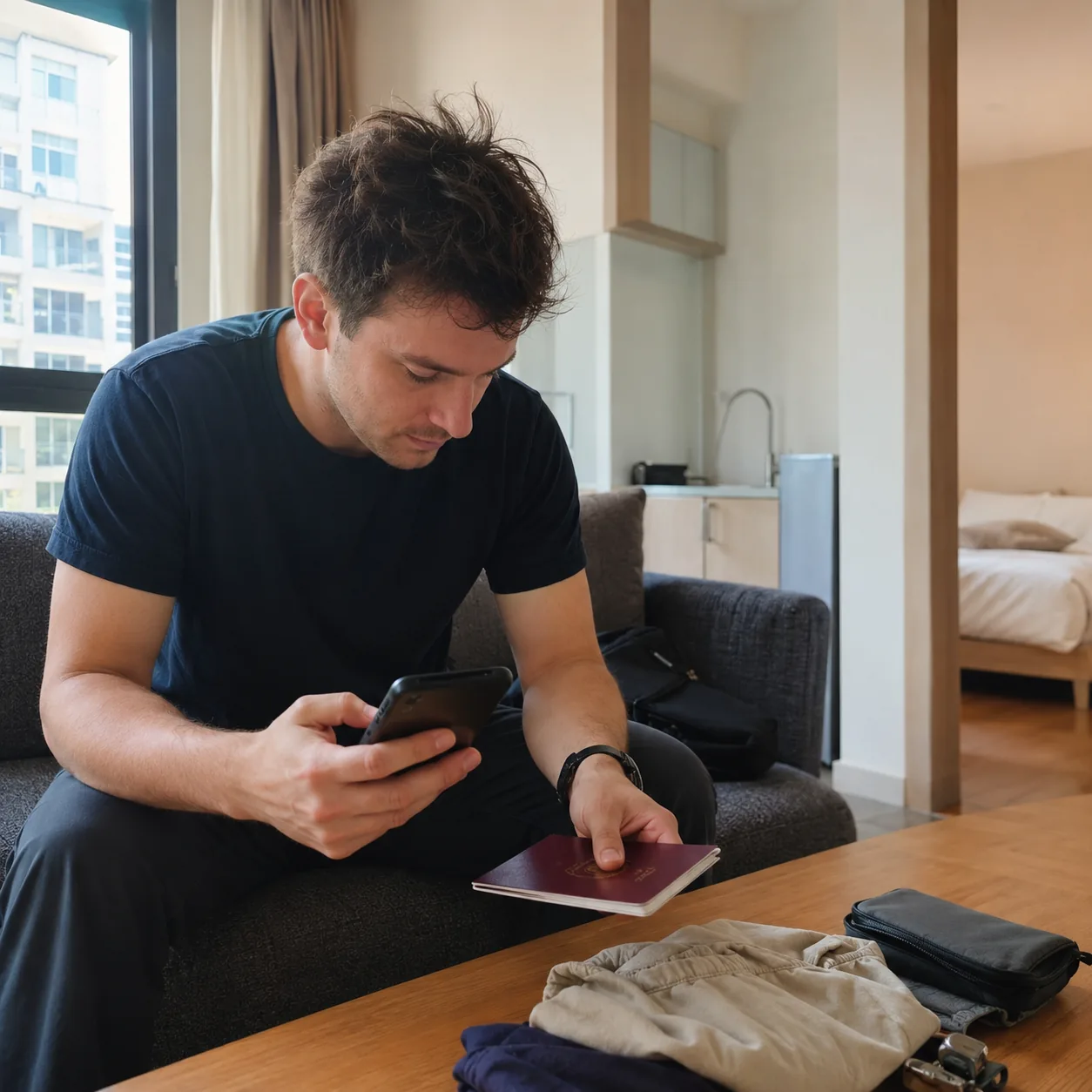
When a friend is helping you, that help is already generous, which is exactly why it is better to keep the boundaries clear. I found that the most comfortable approach is not to drop the problem on someone at the last second, but to state your needs plainly: I need to complete accommodation registration; if the online process requires your cooperation, let’s look at it together now; if it requires going somewhere in person, I am willing to head out early tomorrow. Put that way, the other person does not feel ambushed by a vague problem, and you do not end up delaying the issue just because you are afraid of bothering them.
This kind of conversation brings another advantage: it tells you immediately how familiar the arrangement really is. If your friend already understands the process, things usually move quickly. If they are unsure as well, that is not bad either. At least you are both consciously unsure, which means you can check and ask together instead of pushing forward in a haze. A surprising amount of travel confidence comes from naming uncertainty early instead of hiding it.
I Always Prepare a Fallback Plan as Well
When I plan travel now, I no longer write down only the ideal path. I prepare a fallback as well. If the online process is not finished tonight, where do I go first thing tomorrow morning? If my friend becomes busy, who else can help confirm the address details? If I am unfamiliar with the neighborhood, have I already saved the map pin, the ride-hailing pickup point, and a photo of the building entrance? What truly calms me in travel is not the guarantee that everything works perfectly on the first try. It is knowing where my foot goes next if the first step does not hold.
That is also why I do not recommend treating accommodation registration as a side task to be handled “when there is time.” Once it overlaps with unpacked luggage, an unwashed body, and an empty stomach, it becomes irritating far too quickly. But if you turn it into a checklist task with a main path and a backup path, that feeling of mental clutter fades fast. You begin to feel again that the city is not pushing you around; you are slowly learning how to catch it properly.

Beneath This Issue, It Is Really About Travel Rhythm
Over time, I have felt more and more strongly that many people get exhausted on their first trip to China not because there are too many tasks in total, but because they try to finish all of them within the same hour: arrival, payment, transfers, dinner, reassuring family, showering, replying to messages, and planning the next day. Accommodation registration often feels stressful not because it is the hardest thing, but because it appears right in the messiest window. That is why I now deliberately lower my expectations for the first night. First settle the stay, then settle the sleep; only after that do I fully have the energy to enjoy the city.
That night, we finally put the electric kettle on in the kitchen, and from the window I could still hear the soft brake sound of e-bikes downstairs. My friend sent me the address again so I could save it properly. I organized my document photos into one folder and took screenshots of the places we might need to visit the next morning. Nothing about it was dramatic, and that lack of drama was exactly what made me feel so calm. In real travel, many good experiences do not begin with “wow, how exciting.” They begin with something quieter: good, this one step is no longer hanging over me tonight.
The Practical Order I Recommend for Anyone Doing This for the First Time
If this is your first time staying in a friend’s home, a short-term apartment, or other non-hotel lodging, I recommend following this order: first confirm the address in Chinese text; then confirm who will help with the registration; next put your document photos, contact details, and arrival time together; after that, check your phone battery and internet connection; only then move on to showering, unpacking, or ordering a late-night snack. It may not sound romantic, but it works. Travel feels good not when every task is done beautifully, but when the one most likely to make you uneasy is handled first and handled steadily.
If I had to compress the lesson of that night into one final line, it would be this: do not imagine accommodation registration as something terrifying, but do not leave it blurry either. What you need is not anxiety, but order; not stubborn guessing, but confirmation; not waiting for someone else to remember it for you, but raising the issue yourself early. Once you do that, when you walk out of the compound the next morning, you do not just see an unfamiliar city. You see a city that has already begun to arrange itself into something readable for you.