Океан солнечных панелей в западной пустыне: как возобновляемая энергетика Китая преображает Северо-Запад
Look down from an airplane window over the Gobi flats of Hainan Tibetan Autonomous Prefecture in Qinghai, and you’ll see an endless ocean of deep-blue photovoltaic panels stretching to the horizon. This isn’t science fiction — this is western China in 2024, where the world’s largest clean energy bases are rising from barren land. A decade ago, there was nothing here but windblown sand and shepherds. Today, the Talatan Solar Park in Gonghe County, Hainan Prefecture, has surpassed 16GW of installed capacity, covering an area roughly the size of Singapore. Sunlight hits the panels above while herders graze sheep below — “solar sheep” has become a beloved local term.
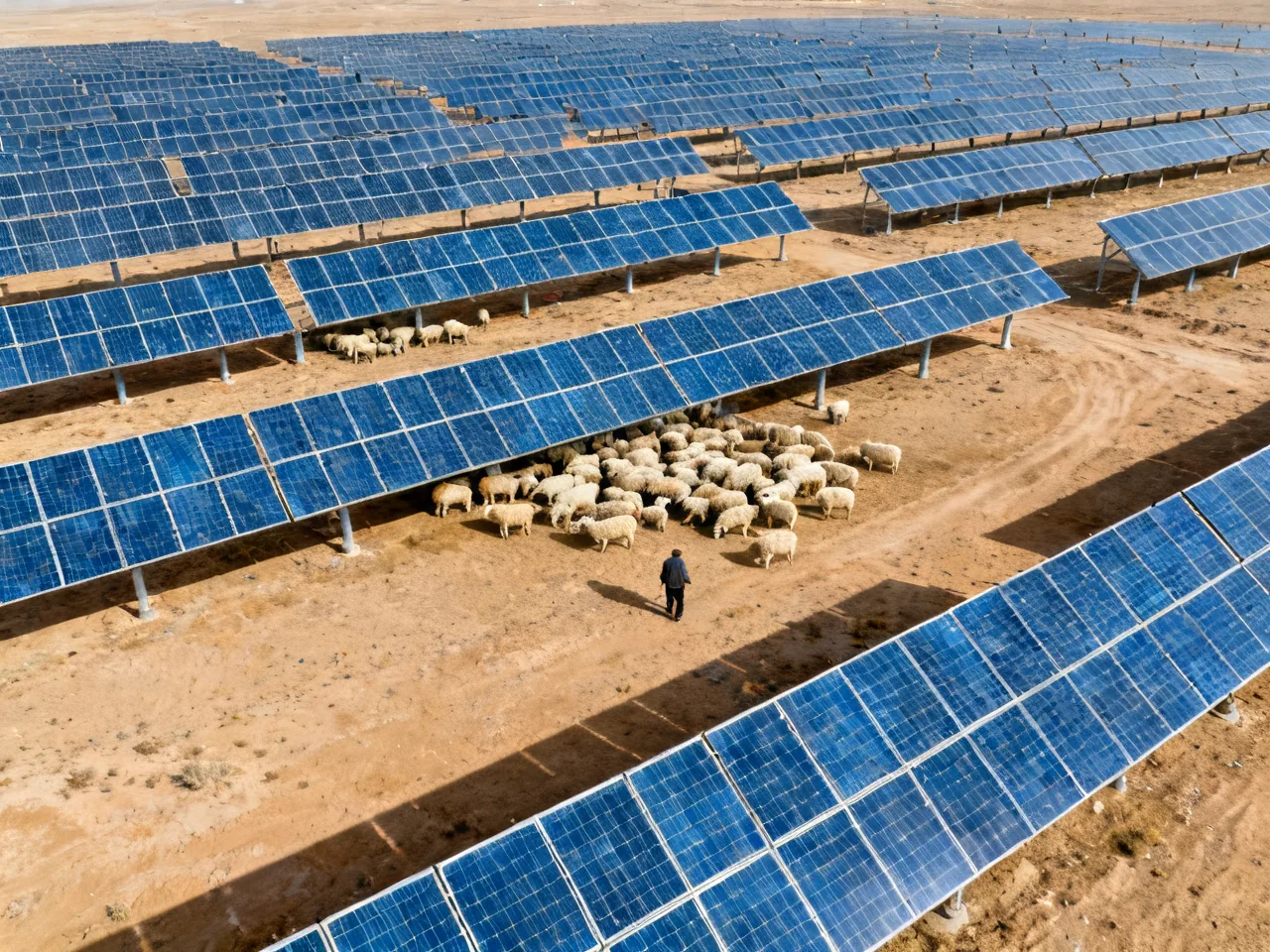
Golmud and Qaidam: Solar Pioneers on the Plateau
The story of western China’s solar journey can’t be told without Golmud, a small city on the Qinghai-Tibet Plateau. In 2011, China’s first batch of large-scale grid-connected solar plants were built on the Gobi east of Golmud — a modest 200MW that many dismissed as a vanity project. No one imagined that within a decade, the entire Qaidam Basin would transform into a colossal solar factory. Golmud enjoys over 3,200 hours of sunshine annually, among the highest in China, with solar radiation exceeding 6,800 MJ/m² per year. By the end of 2023, Golmud alone had over 7GW of installed PV capacity, while the broader Haixi Mongolian and Tibetan Autonomous Prefecture surpassed 25GW in total renewables. This electricity travels over 1,500 kilometers via the Qinghai-Henan ultra-high-voltage DC transmission line to power homes across central China’s Henan Province — delivering over 40 billion kWh of clean energy annually, equivalent to saving roughly 12 million tonnes of standard coal.
For a deeper look at how China’s UHV transmission technology is reshaping the energy map, check out this detailed overview of China’s grid engineering.
The Tengger Desert: From Barren Wasteland to a Great Wall of Solar
If Qinghai is the “cradle” of Chinese solar, the Tengger Desert is its most visually stunning showroom. At the border of Zhongwei City in Ningxia and Alxa Left Banner in Inner Mongolia, the fringes of the Tengger Desert are undergoing an unprecedented transformation. The 3GW Tengger Desert solar base, which broke ground in late 2023, is a key piece of China’s national “desert, Gobi, and wasteland” mega renewable energy plan. Spanning roughly 10,000 acres, it’s projected to generate over 5.4 billion kWh annually once complete. What’s even more remarkable is that the panels themselves fight desertification — their shadows reduce surface evaporation, and workers plant desert-adapted vegetation between the mounting structures. Over just a few years, once-barren shifting dunes have started turning green. In Zhongwei’s solar zones, vegetation coverage has jumped from under 5% to over 40%.
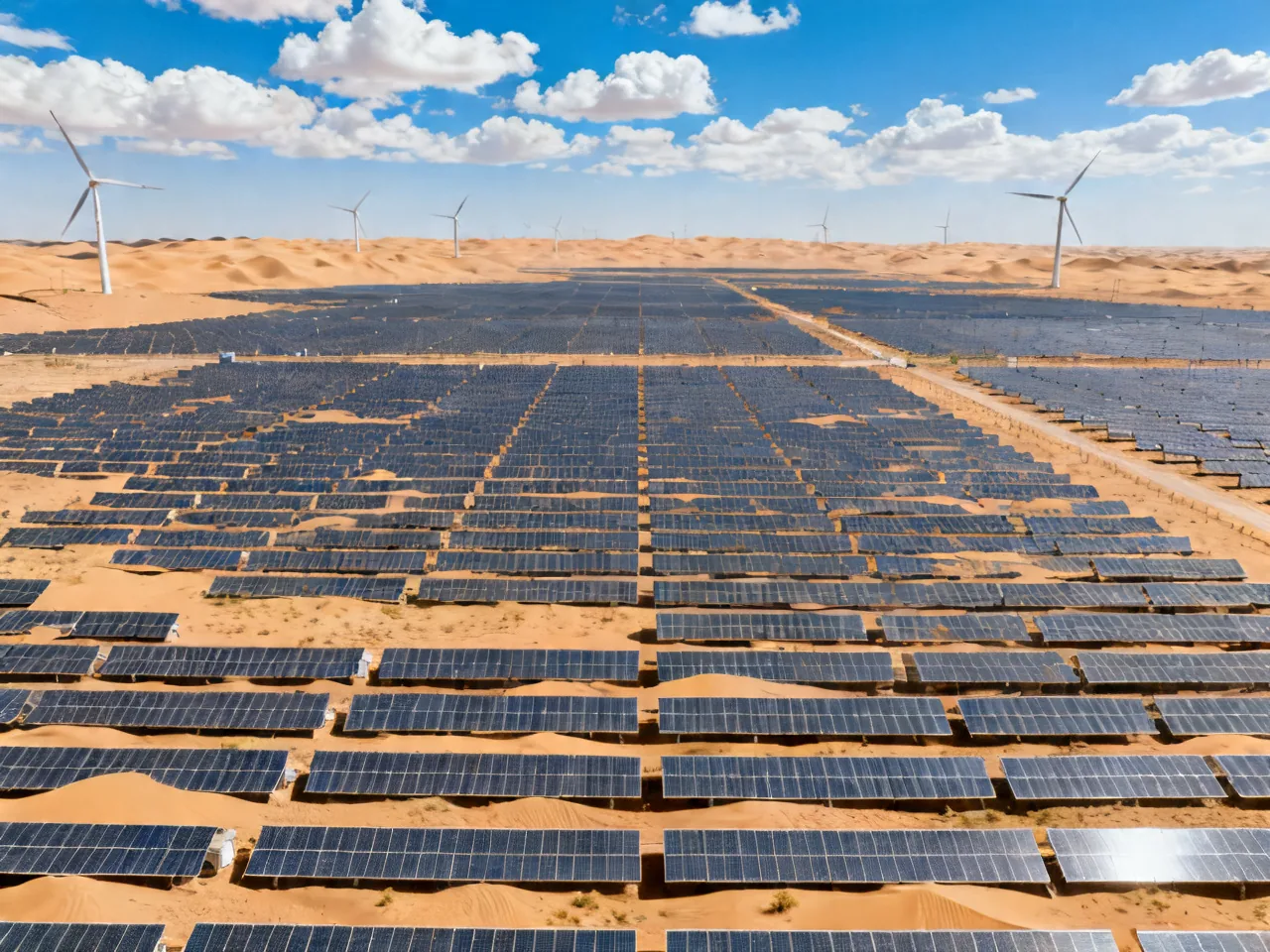
Xinjiang and Inner Mongolia: The Wind-Solar Energy Corridor
Hami in Xinjiang and Ordos in Inner Mongolia are two more shining stars on western China’s renewable energy map. Naomaohu Town in Yiwu County, Hami, boasts average wind speeds above 6 m/s and over 3,300 hours of annual sunshine — a rare zone blessed with both excellent wind and solar resources. By 2024, Hami’s total renewable capacity exceeded 30GW (roughly 20GW wind and 10GW solar), making it Xinjiang’s largest clean energy export hub. This power flows to central China via the Hami-Zhengzhou ±800kV UHV DC line. In Inner Mongolia, the Kubuqi Desert’s solar-desertification project is equally impressive — the 1GW “Top Runner” solar base in Dalad Banner features panels arranged into the shape of a galloping horse when seen from above, turning it into a viral tourist attraction. Ordos has planned an integrated wind-solar-hydrogen-storage cluster exceeding 50GW, expected to attract over 300 billion yuan in investment by 2030.
For more stories on how China combines desert restoration with renewable energy development, we recommend this feature on western ecological restoration and green development.
It’s Not Just the Landscape That Changed: The People Behind the Energy Transition
Behind the data and project names are real people and real changes in life. In Gonghe County, Qinghai, a herder named Tashi Cairang who once depended entirely on the weather now works as an inspection officer at the Talatan Solar Park, his monthly income rising from under 2,000 yuan to 5,500 yuan. He patrols between the panels on his motorcycle every day, checking equipment. “When the sandstorms were bad, we couldn’t even keep the sheep alive,” he says. “Now the panels block the wind, the grass has grown back, and the sheep are fatter than ever.” In Zhongwei, Ningxia, a young woman named Ma Xiaoyan born in the 1990s quit her factory job on the eastern coast and returned home to become a technical supervisor at a solar O&M company, leading a team of over 20 people. The western renewable energy supply chain has created more than 1.5 million direct jobs — from component manufacturing to plant operations, logistics to ecological restoration — a complete green industrial chain is growing in the desert.
The Future is Here: The Next Decade for Western Renewables
China has set a clear target of reaching over 1.2 billion kW (1,200GW) of combined wind and solar capacity by 2030, with western regions shouldering more than 60% of the growth. Since the 14th Five-Year Plan began, five of the seven planned major onshore renewable bases are in the west — Xinjiang, the upper Yellow River, the Hexi Corridor, the Yellow River’s “几” bend, and southeastern Tibet. Qinghai Province has set its own goal of becoming a national clean energy highland by 2030, targeting over 100GW of clean energy capacity province-wide. Meanwhile, breakthroughs in energy storage are tackling the west’s biggest renewable headache — grid absorption. Qinghai has already built multiple 100MW-class storage stations, and Hami in Xinjiang is constructing one of the world’s largest compressed air energy storage facilities at 300MW/1,800MWh. From Gobi to desert, from plateau to basin, western China is writing what may be this era’s most spectacular energy transition epic.
The western sun doesn’t speak, but millions of solar panels are telling its story of transformation.