В водных городках Цзяннаня не просто фотографируйте: учитесь смотреть не спеша
In Jiangnan Water Towns, Do Not Just Take Photos — Learn to Look Slowly
If this is your first visit to a Jiangnan water town, I would advise you not to rush toward the angle that looks most like a postcard. Stone arches, black-awning boats, white walls, dark tiles, and houses leaning over the water are beautiful, of course. But if you only pack them into a camera, every lane will soon begin to look similar. The truly interesting parts often wait until your pace slows before they rise out of the sound of water.
When I used to bring friends here, someone would always ask the moment we arrived: where is the best place to take photos? The question is not wrong; it is simply too early. A water town is not a stage backdrop. It has the smell of vegetables in the morning, the sound of tea cups in the afternoon, lamplight at dusk, and the patience of elders sitting on thresholds watching the day pass. Give it time first, and it will show you these things.
One autumn, I accompanied an old classmate into a narrow lane near the southern quarter. He had just bought a new camera and wiped the lens more carefully than his glasses. At the first bridge he photographed the bridge; at the second bridge he photographed another bridge; by the third bridge he frowned and asked whether everything here was the same. I did not answer. I simply took him to a tea stall below the bridge and sat there with him for half an hour.
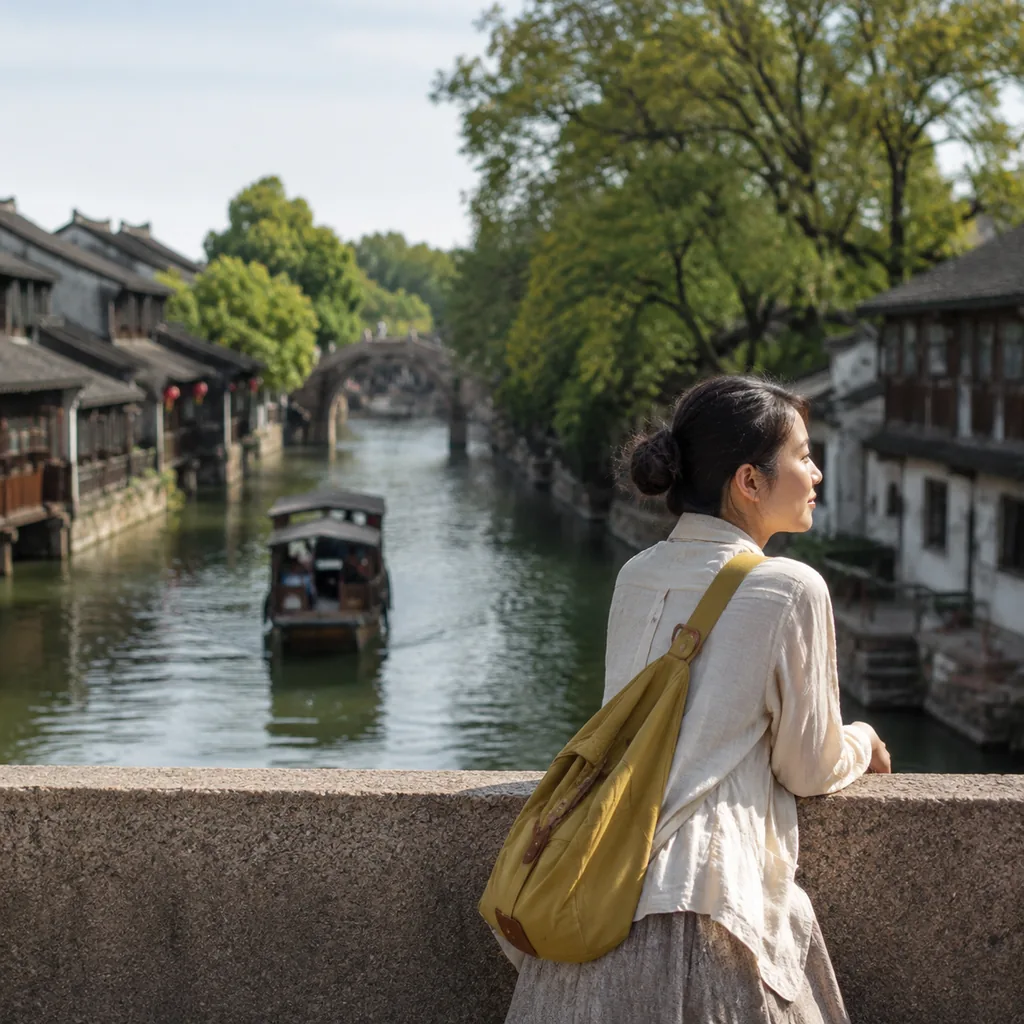
During that half hour, he was restless at first, his fingers always wanting to reach for the camera. Then an old woman selling pickled vegetables set out her small wooden tubs one by one, a cat from the tailor’s shop jumped onto the windowsill, a boatman untied a rope from its post, and the reflection on the water was slowly wrinkled by the stern. After watching for a while, he suddenly said that the bridge was not the point; what happened around it was what made it alive.
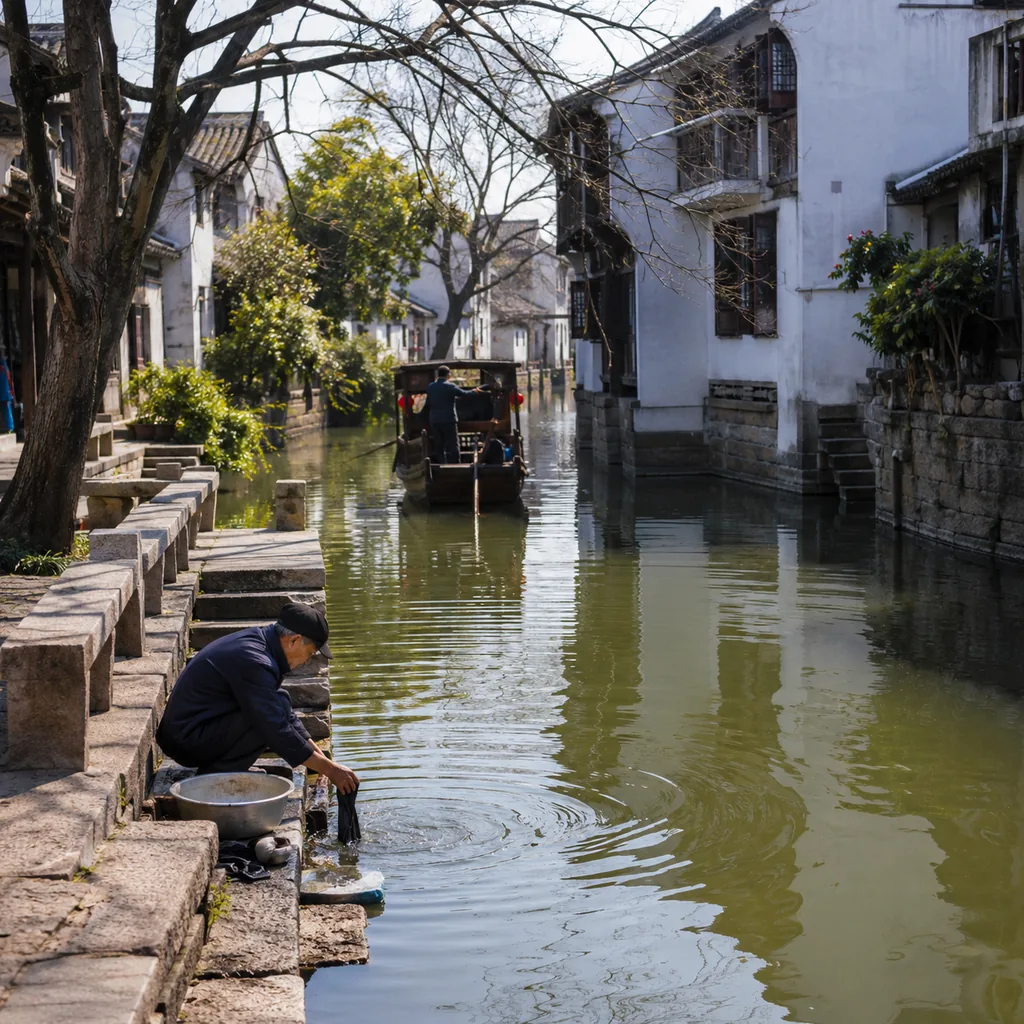
That is why I often say that in a water town one must learn to look slowly. Looking slowly is not wasting time, nor is it pretending to be profound. It means moving attention from “what did I capture” to “what is happening here.” The same white wall may hold the shadow of someone washing clothes in the morning, sun on water chestnuts in a bamboo basket in the afternoon, and the warm glow of a lamp at night. A photo gets the wall; slow looking sees the days.
You can begin by listening. The sounds of a water town are fine and subtle; they do not rush at you like mountains or the sea. Oars move close to the water, footsteps carry different weights on stone slabs, someone in a teahouse nudges a cup lid, and a spatula strikes an iron wok in a distant kitchen. If you walk while busily changing filters, these sounds will slide past you like a boat that never moors.
Then look at the doors. Doors in Jiangnan water towns are especially talkative. Some are freshly painted, meaning the house has recently been repaired. Some door rings shine from constant touch, meaning many people come and go each day. Some thresholds have been worn into shallow curves by years of crossing. If there is a pot of scallions, a pair of rain boots, or a bamboo chair by the door, you know this is not merely a scenic shell but a place where people live carefully.
Let me add an old memory. When I was a child, I went with my grandmother to buy tofu by the water, and she always took a longer route through a lane visitors rarely entered. I complained that it was slow. She said the shortcut in a water town was not always short, and the longer way was not always a loss. I did not understand then. I only remembered steam in the lane, the smell of fresh tofu, and someone hanging a wet sheet like a white sail. Years later, when I brought others through that lane, I realized she had been teaching me how to see a place.
Looking slowly also means leaving room for people. Do not press your lens against someone’s window, block a narrow bridge for an angle, or turn a quiet lane into your private studio. The water town moves us because it is still being used: people go to the morning market, take children to school, repair boats, and wash bowls. As visitors passing through, we do best to be a little lighter, as if passing a neighbor’s doorway.
If you only have half a day, I suggest this route: first walk along the main canal for the overall view, then turn into a side lane and find a teahouse by the water. Do not rush to order something elaborate; a cup of plain tea is enough. Watch how boats come alongside, how the owner greets familiar customers, how drops from the awning fall into the river. When you can sit without feeling that you are wasting time, the town’s layers begin to appear.
If it rains, do not be disappointed. Rain draws in the colors of Jiangnan: white walls no longer glare, stone paths grow gentle and glossy, and voices under the eaves come closer. Stand beneath a covered walkway and watch an umbrella cross the bridge, rain threads weave the river surface tighter, and a distant lantern sway in the water. Such scenes may not be the brightest, but they are often the easiest to remember.
Of course, you may take photographs. A good photo is no sin. The point is not to let photography complete the journey for you. After taking a picture, lower the device and confirm with your eyes: where did that boat come from, why does the tree beside the bridge lean toward the water, why does the old man always sit in the same spot? Ask a few small questions like these, and your photos will have echoes.
Before leaving, I usually take friends back to the first bridge. When they first arrived, they saw the bridge shape, the canal, and the crowd. After walking around, they recognize the pastry stall, the cat sunning itself in the afternoon, and the sound of pingtan singing from a certain doorway. The place has not changed. What has changed is that they have finally released themselves from hurry.
So when you come to a Jiangnan water town, do not only ask where the best shots are. Ask where it is good to sit for a while, which lane carries the smell of cooking, and under which bridge you can hear boats. You will find that slow looking does not mean seeing less; it means keeping what you see more deeply. Later, when you review your photos on the way home, the moments you did not photograph may return together with the pictures.