Небольшой урок по плетению из бамбука: я впервые обнаружил, что у мягкого материала тоже может быть каркас
I originally assumed the charm of bamboo weaving was mainly captured by the words “natural” and “simple.” As a foreigner from the Philippines, I am not unfamiliar with bamboo. It appears in house structures, furniture, baskets, and many of the most ordinary corners of daily life across tropical regions. So when I first saw a bamboo-weaving workshop in China, I was a little overconfident and thought I would understand the craft quickly. But once I actually sat down and held thin strips of split bamboo in my hands, I realized that what truly fascinated me in Chinese bamboo weaving was not the material alone, but the way softness, order, and structural strength could be woven into a single object.
The instructor first let us touch bamboo strips of different widths and then taught us the most basic method of building the base. It looked like nothing more than crossing one strip over another, yet the moment I tried it myself, my hands immediately understood that it was not so simple. If the strips were too loose, the whole surface lost coherence. If they were too tight, they bent into unnatural hard creases. Even harder was the rhythm: I had to follow the pattern, maintain even pressure, and constantly check whether the edge was drifting out of line. In that moment I understood that bamboo weaving is nothing like the casual “just make something by hand” image many outsiders might have. Its difficulty lies not in one dramatic gesture, but in a long sequence of small decisions.
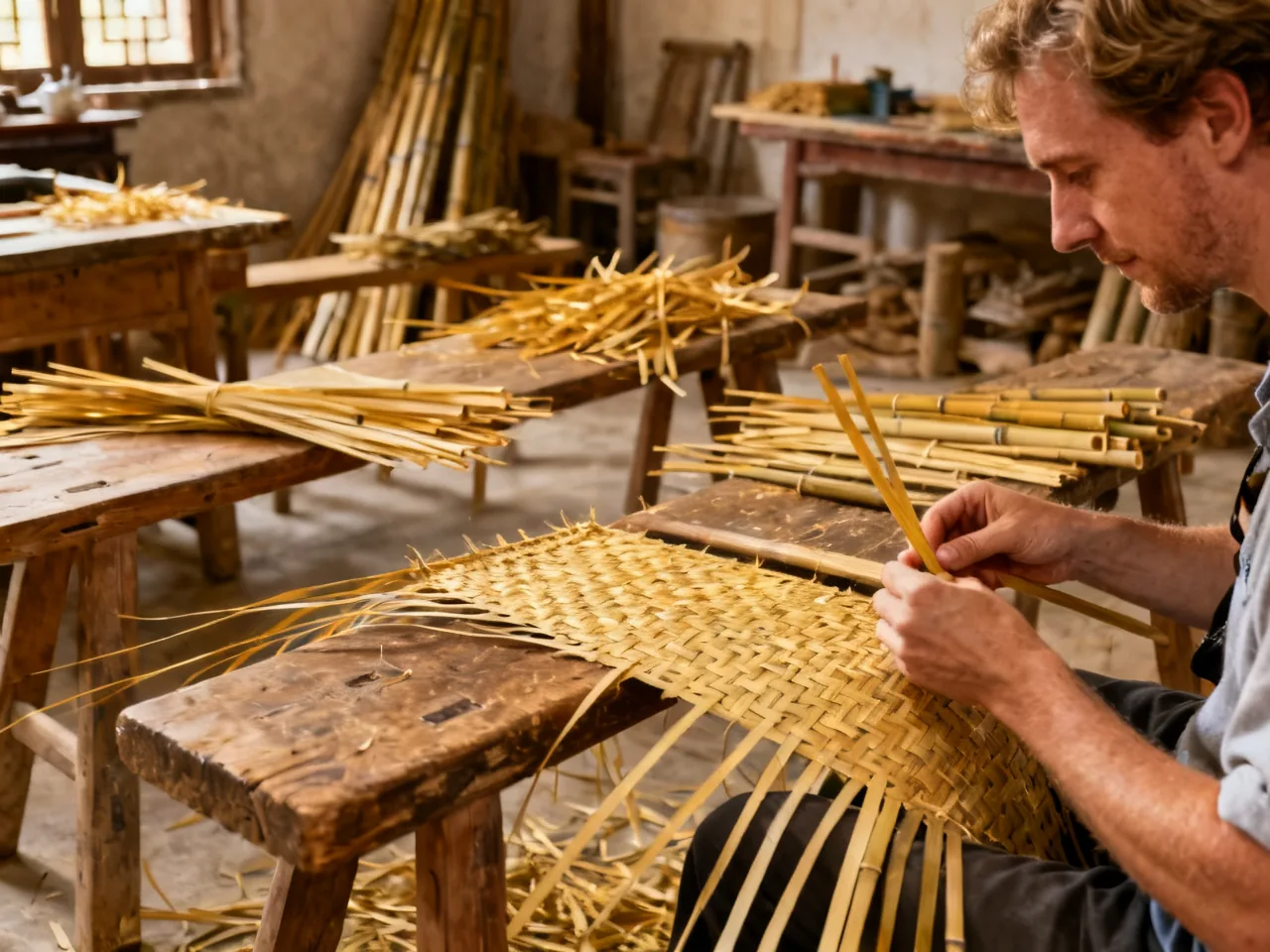
What impressed me most was how quiet the instructor’s movements were during her demonstration. She used almost no wasted force. Her fingers simply moved through the strips, yet the woven surface grew steadier and flatter. She said that good bamboo weaving does not “subdue” the material, but arranges it according to its nature. Bamboo has its own grain direction and its own temperament. Knowing when it can bend and when it should not be forced depends on experience. I felt an immediate connection to that idea, because it is one of the most beautiful qualities of traditional craft: you are not controlling the material by yourself; you are learning how to cooperate with it.
As I continued, I began noticing the geometric beauty inside woven patterns. Even the most basic plain weave already looked elegant, and slightly more complex variations created diagonals, diamonds, and repeating rhythms that felt part mathematics and part textile. Yet bamboo weaving is not cloth, because it often becomes a three-dimensional object: a basket, box, lampshade, tray, screen, or larger household item. That means the craft is not only concerned with surface beauty. From the beginning, it thinks about weight, opening, framing, and practical use. For a traveler, that is especially humbling. You realize that what you are seeing is not just decorative technique, but a whole structural intelligence refined through long everyday use.
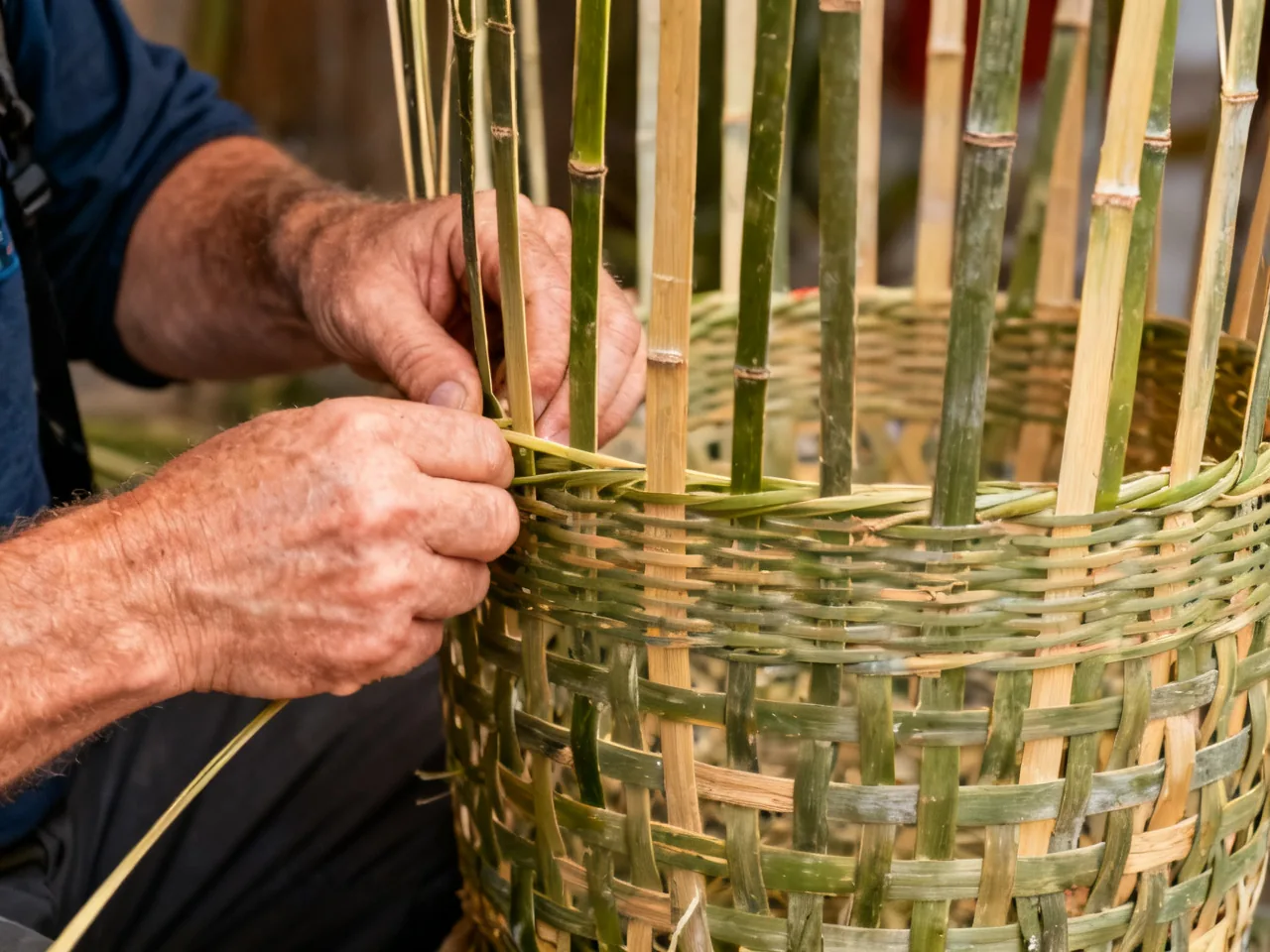
This naturally made me think of bamboo craft in the Philippines. We also use bamboo in baskets, mats, furniture, and architectural details, and many regions preserve strong handcraft traditions. But the emphasis I felt in China was somewhat different. Philippine bamboo objects often make me think first of tropical living—ventilation, lightness, practicality. Chinese bamboo weaving, at least in this workshop and in the finished works I saw, presented more strongly an aesthetic of refined order. It does not only ask whether an object works; it also asks whether the pattern, edge finish, closure, and overall proportion are carefully resolved. Both traditions are intelligent and close to everyday life, but Chinese bamboo weaving gave me a deeper feeling of restraint and composure.
In the end, I finished only a small woven square, about the size of a coaster. It was not especially beautiful, and the edges were still a little uneven. But when I placed it on the table, I felt a very solid satisfaction. This small piece made me truly understand for the first time why bamboo weaving matters so much in many parts of China. What it represents is not merely a rustic atmosphere, but an ability to turn natural material into stable order. You begin with flexible bamboo strips and end with an object that has structure, rhythm, and purpose.
If foreign friends asked me which Chinese folk craft most easily carries a person from material contact into cultural understanding, I would gladly recommend bamboo weaving. It looks simple, yet its layers run deep. You can begin with the tactile feeling of bamboo and then gradually understand the relationship among weaving methods, structure, vessel form, and local aesthetics. For me, that is what made this experience so valuable. It did not impress me through dramatic spectacle. It quietly made me rethink what strength can mean in craft.