После опыта с лаковыми веерами я впервые обнаружил, что у «текущего цвета» тоже может быть порядок
- Folk Art
If I had not made a lacquer fan with my own hands, I probably would have kept thinking of it as simply a beautiful tourist craft. A fan already carries associations of elegance, lightness, and summer, while the word “lacquer” naturally suggests refinement and tradition. So before entering the workshop, I did not fully understand that the most fascinating part of this craft lies not only in the finished object, but in the moment when colors flow across water, meet one another, and are captured. As a foreigner from Japan, I had assumed I was not unfamiliar with either fans or lacquerwork. But once I began making a Chinese lacquer fan, I quickly realized that what moves me most here is not decoration alone. It is the way chance is slowly turned into aesthetics.
Only when I stood before the basin did I realize that color choice is not the hardest part
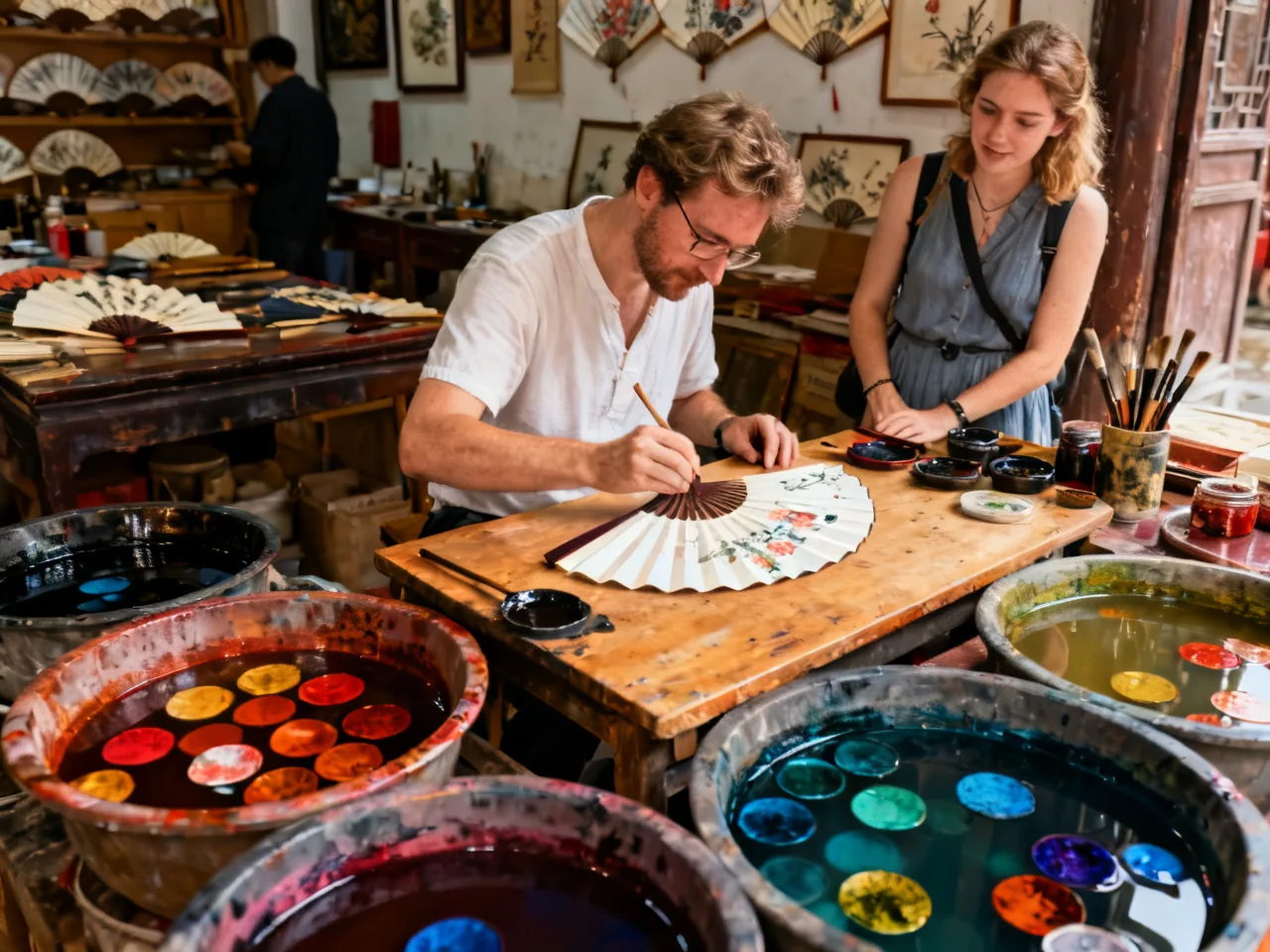
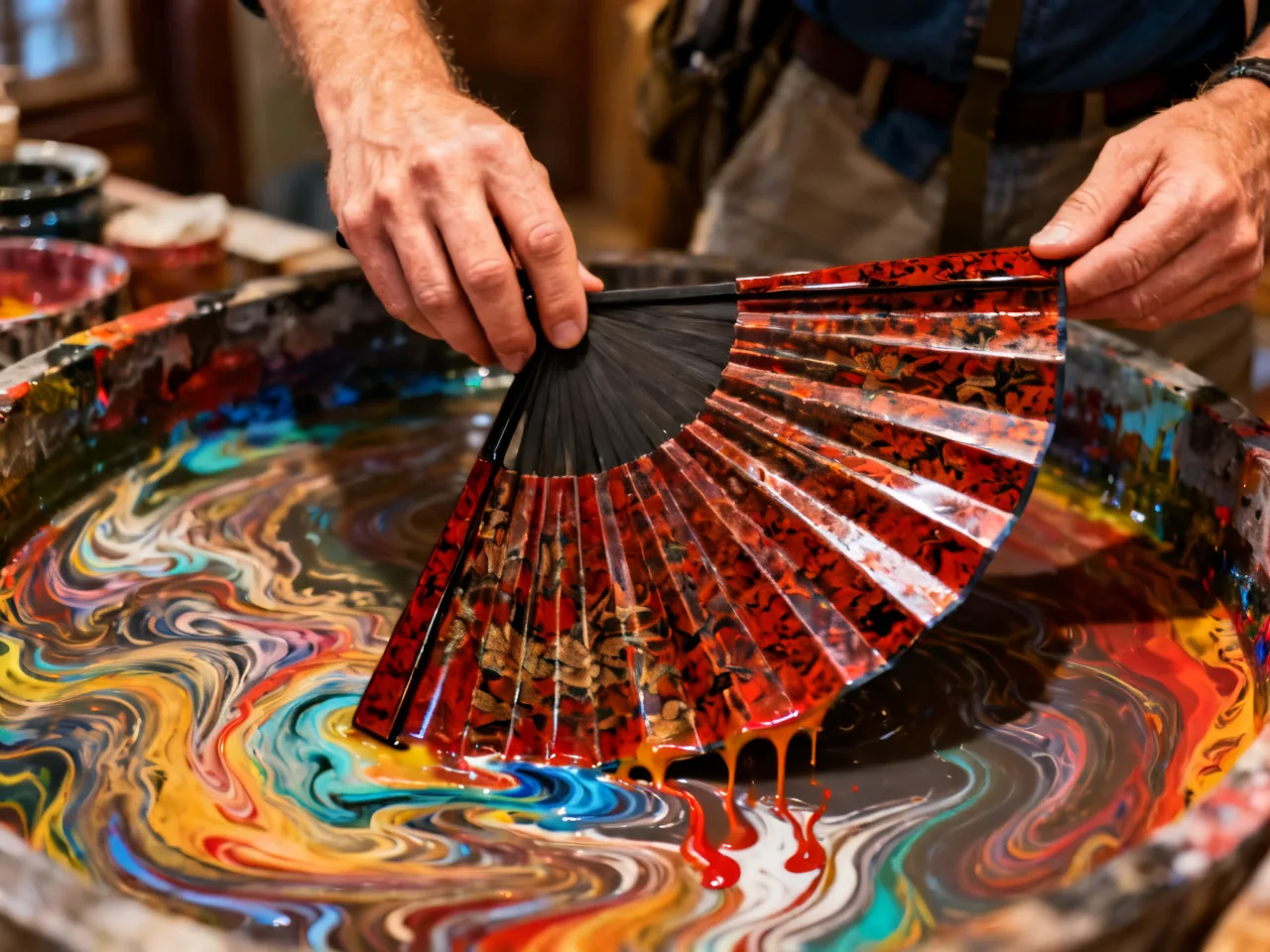
The instructor first demonstrated the process for us. She dropped several lacquer colors into a basin of water one after another. The pigments did not sink immediately, but slowly spread across the surface like clouds, smoke, or petals pushed by a breeze. Then she used a small tool to guide them lightly, and the colors at once began to chase one another, giving the water pattern and direction. Finally, she pressed a white fan surface down in one steady motion and lifted it again, and a complete flowing design had attached itself to the fan. The whole process took only a short time, yet I never felt it was simple. Every step carried the tension of something that cannot be repeated in exactly the same way.
When it was my turn, I thought my biggest problem would be whether I could choose colors well. But the real difficulty had nothing to do with selecting colors. It was whether, once the colors began to move, I could resist the urge to control all of them. At first I instinctively wanted to drag the pattern around a few extra times, thinking that might make it richer. But the instructor immediately reminded me that lacquer fans suffer most from greed. Once the colors are disturbed too much, their original breathing space disappears, and what remains is only muddiness and crowding. I remember that sentence vividly because it revealed the heart of the craft almost at once: the point is not to fill everything, but to know when to stop.
What attracted me most was that it combines chance with discipline
I have always been drawn to crafts that contain some element of unpredictability, because they make the material itself feel like an active participant. Lacquer fans are exactly like that. Of course you can decide the general palette, direction, and rhythm, but the final pattern that lands on the fan still preserves something of the water’s temperament, the lacquer’s temperament, and the difference in pressure created by each gesture. In other words, you are not commanding an image to appear. You are negotiating a result together with moving material. For a traveler like me, that felt especially fresh. It made me realize that the real value of some folk crafts does not lie in reproducing a single standard answer perfectly, but in the honesty of each result belonging to one unrepeatable moment.
When I made a second fan, I was clearly more restrained than with the first. With the first one, I kept wanting to add just a little more. With the second, I began to accept empty space and asymmetry. The result was interesting: the second fan looked looser and was much more pleasant to keep looking at. At that moment I suddenly understood why lacquer fans can become addictive. On the surface, it seems like a craft about playing with color. In reality, it trains judgment. You have to learn when to continue, when to wait, and when to admit that enough is enough. It is a gentle lesson, but also a very direct one.
It reminded me of Japanese lacquerware and fan culture, yet the mode of expression is completely different
Because I come from Japan, it was almost impossible for me not to think of the lacquerware and fan traditions I know from home while making a lacquer fan. Japan, of course, also places great importance on lacquer. Whether on bowls, boxes, trays, or more elaborate craft pieces, lacquer in Japan often gives an impression of depth, steadiness, and restraint. We also have our own fan culture. Folding fans, round fans, and fan use connected to Noh performance or tea practice make the fan not merely an everyday object, but something tied to etiquette and aesthetic meaning. So before coming to China, I assumed that the combination of lacquer and fan would not feel especially unfamiliar to me.
But after truly experiencing it, I still felt a clear difference. Japanese lacquer art often makes me think first of layered accumulation, surface gloss, careful finishing, and a rather quiet sense of completeness. What moved me first in this Chinese lacquer fan workshop, by contrast, was the feeling of formation within movement. It does not place all beauty in the final stage of smoothness and polishing. Instead, it allows water patterns, diffusion, and naturally unfolding trajectories to become the main actors. The beauty of many Japanese lacquer objects feels as if time has been pressed slowly into the surface. Chinese lacquer fans, to me, feel more like preserving a passing transformation upon the fan. One leans toward composed concentration; the other toward airy unfolding. I love both, but their characters are undeniably different.
What touched me most was the way it turns irreproducibility into a gift
When we travel, we often instinctively want souvenirs that look reliably beautiful in the same way for everyone, as if standardization were safer. Lacquer fans are the opposite. Even with the same colors, the same motions, and the same fan surface, it is impossible to create two completely identical pieces. At first that worried me. I was afraid the pattern I made would not look “standard” enough. But once I held the finished fan in my hand, I felt that this was exactly what made it precious. What I was seeing was not a perfectly replicated style, but the trace left by that day’s water, that day’s gestures, and that day’s hesitation and judgment all together.
The fan itself is also a special kind of object. It is not merely a decoration to hang on a wall. It can be opened, closed, held in the hand, and used together with air and movement. That means the pattern on a lacquer fan is not presented in a fixed way. It changes with the opening angle, with the light, and with the movement of the wrist. This made it feel more alive to me than many flat crafts. It is not a static picture, but a small object that enters into relationship with the body.
If you come across lacquer fan making while traveling in China, I strongly recommend trying it yourself
If friends now ask me which Chinese folk craft best helps a foreigner understand both the freedom of color and the necessity of restraint, I would probably recommend lacquer fans. At first, the threshold looks low. It even seems a bit like a relaxed game of color. But once you actually lower the fan into the water and lift it back up, you immediately understand that this craft is far more than simply making something pretty. What it teaches is not how to chase complexity, but how to recognize order within change and learn restraint within chance.
For me, as someone from Japan who had assumed I already knew fans and lacquer fairly well, the most precious part of Chinese lacquer fans was not that they introduced me to a completely unfamiliar material. It was that they made me understand again how lightness and elegance can be joined in a different way. This craft does not display tradition with heavy solemnity. Instead, through a fan that can be held in the hand, it shows how color flows, how aesthetics knows when to stop, and how craft can turn chance into something memorable within only a few minutes. When I left, holding the lacquer fan I had made, I felt that it was physically very light, and yet somehow it had carefully preserved the water patterns and mood of that entire afternoon.