Впервые покупая лекарство от простуды в китайской аптеке, я понял: сначала опиши симптомы, а потом смотри на бренд
It had rained that evening, and when I came out of the subway station, the soles of my shoes still lifted a little damp dust from the ground. The convenience store on the corner was bright, the fruit shop was closing, and the pharmacy by the residential gate looked especially calm behind its cool white lights and glass door. My nose was badly stuffed up and my throat felt tight, but my mind still followed the habit I had learned elsewhere: walk into a pharmacy, look for familiar packaging, find something labeled “cold medicine,” and leave. As a foreigner living in China, I assumed this would be simple. I even entered with the quiet confidence of someone who thought, I already know how this works. But inside that small neighborhood pharmacy, still and quiet after the rain, I understood for the first time that buying cold medicine in China is not really about recognizing a brand first. It is about explaining clearly what exactly feels wrong.
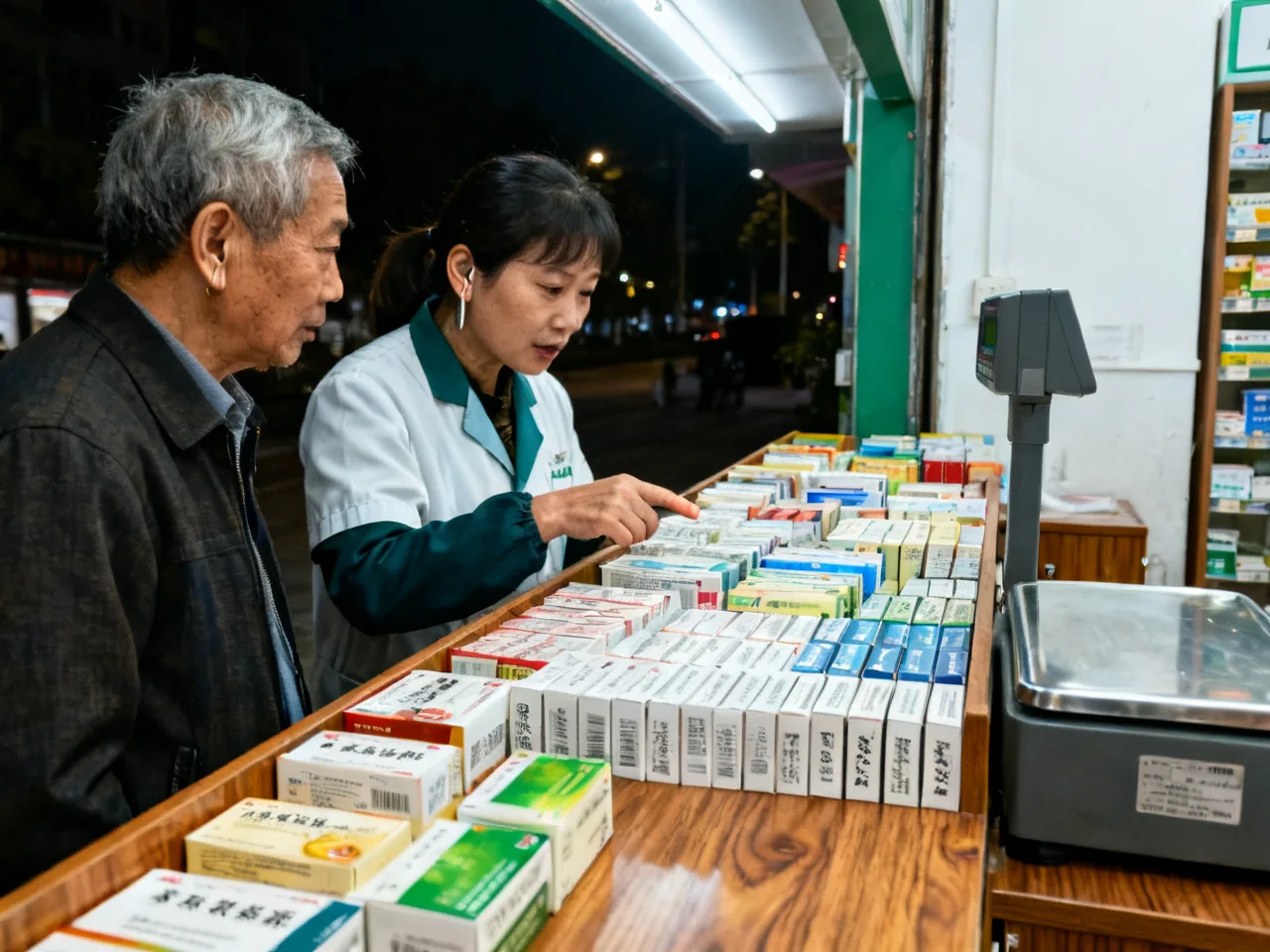
The pharmacy was not large. Near the entrance stood a row of promotional masks and vitamins, and farther inside were neat shelves divided with surprising precision: fever relief, cough medicine, throat remedies, rhinitis, stomach problems, external use. The clerk behind the counter looked up at me without rushing or immediately recommending anything. She simply waited for me to speak. I first stood in front of the cold-medicine section and stared at the boxes, trying to find an answer through color and familiarity. The problem was that the longer I looked, the less certain I felt. Many boxes carried one or two words I recognized, but I could not tell from the packaging alone whether they were mainly for fever, cough suppression, phlegm, or nasal congestion. My assumption at that moment was very typical: a cold is just a cold, so some broad all-purpose medicine should be enough. But standing there in front of those shelves, I suddenly realized that my idea of “knowing how to buy medicine” depended heavily on already knowing a specific market and its brands.
I picked up a box of cough medicine and was about to walk toward the counter when the clerk asked first, “Is it mostly coughing, or nasal congestion? Does your throat hurt? Do you have a fever?” She asked quickly, but not carelessly. It felt as if she was pulling me out of the lazy logic of just grabbing something. I hesitated, because I had not planned to break my symptoms down at all. In my old habit, I often chose the medicine myself and the clerk might ask only whether I wanted anything else. Here, though, the first thing happening at the counter was not brand confirmation. It was symptom clarification. I answered in Chinese that was not elegant but good enough: no obvious fever, mainly a blocked nose, a little runny nose, a dry throat at night, and only occasional coughing. After hearing that, she immediately put the box back and explained that it leaned more toward cough relief, while what I was describing sounded closer to nasal congestion and upper-respiratory discomfort.

Then she showed me two other medicines and pointed to the functional descriptions on the boxes while continuing to confirm details: “Do you need something that won’t make you sleepy in the daytime? Is the nasal blockage especially bad at night? Are you taking any other medicine?” That was the moment I realized pharmacy conversation is also a very fine-grained form of everyday translation. For a foreigner, the real difficulty is not whether you know the Chinese word for “cold.” It is whether you can describe your discomfort specifically enough. Nasal congestion and coughing may come from the same cold, but they do not automatically call for the same solution. A dry throat and a painful throat can also lead a clerk in different directions. She did not turn the interaction into some superior medical interrogation. Instead, she seemed to be helping me organize the mixed signals my body was sending. Because of that, I felt for the first time that buying medicine in a Chinese pharmacy is not a simple vocabulary exercise. It is the ability to turn vague discomfort into something clearer.
Looking back, what stayed with me most from that evening was not the exact box I bought, but the few seconds in which I almost bought the wrong cough medicine. If the clerk had not asked follow-up questions, I probably would have taken it home under the logic that the packaging looked close enough and the purpose was probably close enough too. But the real experience of a Chinese pharmacy taught me that common discomforts are often sorted more carefully at the counter: is your problem more about the nose or the throat; do you need to stay alert in the daytime or sleep more comfortably at night; do you have a fever; is the cough dry or productive. These questions seem small, but they are much closer to useful information than brand recognition alone. I used to think looking at brands was efficient. After that night, I understood that describing symptoms first is actually the more reliable form of efficiency.
That symptom-first approach also gradually taught me another very practical habit of expression in China. In many everyday interactions, Chinese does not require you to sound perfectly polished from the beginning, but it does help enormously if you can state the key points clearly. “The congestion is pretty bad, especially at night.” “My throat feels dry, but not really painful.” “No fever, but my head feels heavy.” None of these sentences are advanced, yet they are extremely useful. They do not only help you buy medicine; they help the other person decide how to respond. For people who have not been in China very long, there is often a tendency to speak less because we are afraid of speaking incorrectly. The result is that we trap ourselves inside broad words like cold, unwell, uncomfortable. But everyday life usually becomes smoother precisely when you break the broadness apart and make the vagueness more specific.
I also noticed that the bright, orderly, slightly functional atmosphere of a Chinese pharmacy can easily make you assume that everything is just a standardized procedure: pick medicine, scan, pay, leave. Yet what really makes the process work is those few spoken checks in the middle. When the clerk finally handed me the medicine, she also reminded me that if it did not improve in two or three days, or if I started developing a fever, I should not just keep enduring it on my own and should go to a hospital. The sentence was ordinary, but it made me feel that the place was not merely a retail shelf for medicine. It was also a small node in an urban system of everyday care. You may walk in because your nose is blocked, your head feels heavy, and you want to go home and sleep, but the short exchange at the counter often pulls you back from “I’ll just buy something” to “let me first figure out what is actually wrong.”
Now, if another foreign friend asks me what mistake is easiest to make when buying cold medicine in China, I would say it is not failing to read the box and not failing to know the famous brands. It is treating “a cold” too quickly as a word that requires no further explanation. What Chinese pharmacies taught me is: do not rush to recognize packaging first. First explain where you feel bad, when it feels worse, whether you have a fever, whether the problem is congestion or throat pain, whether you are coughing or your throat is simply dry. Once those details are spoken aloud, the later choices often become much easier. What I truly remember is not the name of a box of medicine, but the feeling of becoming more reassured precisely because the clerk asked follow-up questions. It taught me that describing discomfort clearly is itself a form of self-care. For a foreigner slowly building real life experience in China, that matters more than memorizing any single brand.