Guilin Without Rushing: Li River to Yangshuo, an Experiment in Slowness
The Li River doesn’t hurry.
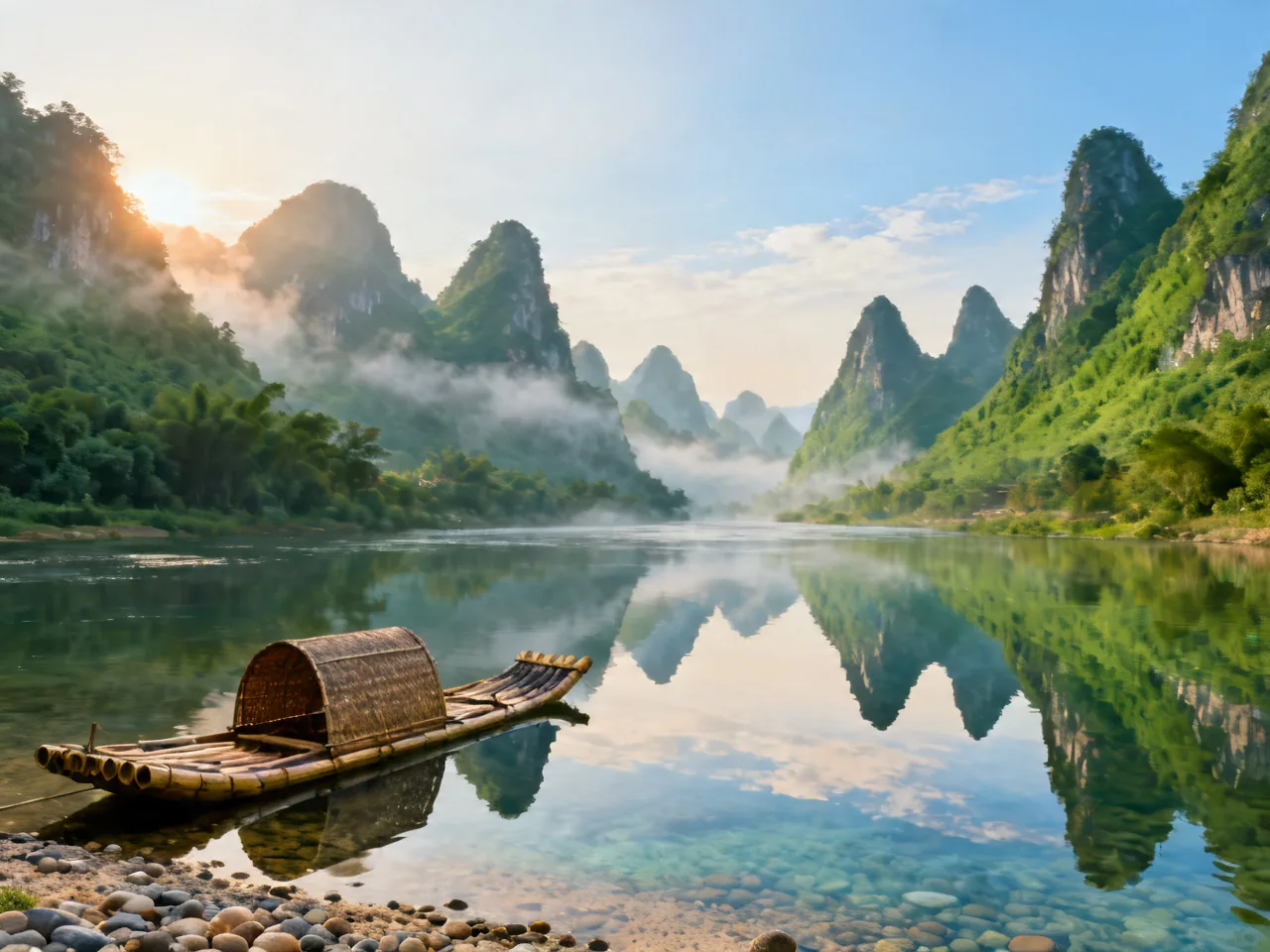
From Guilin to Yangshuo, eighty-three kilometers of waterway, a bamboo raft takes over four hours. No rapids, no dangerous shoals — the surface is flat as a moving sheet of glass. Karst peaks appear one after another on both banks, then recede one after another behind you, like a scroll painting being slowly unrolled. People on the raft soon give up taking photos — because every frame is roughly equally beautiful, yet every frame is different.
There are no “must-visit checkpoints” along this waterway. Or rather, the entire route is the checkpoint. The scenery on the back of the 20 RMB note is in the Xingping section, but without someone pointing it out, most people would miss it — because the mountains and water before and after look equally worthy of being printed on currency.
Why Guilin’s Mountains Look Like This
Three hundred million years ago, this was an ocean.
Thick limestone deposited on the seabed. Then the crust lifted, the sea retreated, and limestone was exposed to subtropical heat and heavy rainfall. Rainwater absorbed carbon dioxide and became a weak acid, dissolving the limestone bit by bit — soft parts washed away, hard parts remained, forming these steep, isolated, uniquely shaped peaks.
Geologists call it “tower karst,” and the world’s most textbook example is in Guilin. These peaks average 200 to 300 meters in height, with flat alluvial plains and winding rivers between them. From above, it looks like someone casually placed a few hundred irregularly shaped chess pieces on a green tablecloth.
This terrain has a byproduct: caves. The dissolution process doesn’t just happen on the surface — it happens underground too. There are over a thousand caves around Guilin. The most famous, Reed Flute Cave and Silver Cave, contain stalactites, stalagmites, and columns, some growing for hundreds of thousands of years. They look genuinely beautiful under lighting, but honestly, after seeing one cave, the wow factor of the second drops significantly.
Li River Bamboo Raft: Choosing Your Section Matters
The Li River bamboo raft has several sections, and not all are worth riding.
The classic stretch is Yangdi to Xingping, about eighteen kilometers, roughly an hour and a half on the raft. This section concentrates the Li River’s finest scenery: Nine Horse Fresco Hill, Yellow Cloth Reflection, and the 20 RMB backdrop. The rafts are electric (hand-poling ended long ago), four passengers per raft, tickets around 200+ RMB per person.
During peak season (April to October), book online a day ahead — walk-up tickets are often sold out. Departing at 8-9 AM is ideal: soft light, mist not yet fully cleared, peaks looking like ink wash paintings. Midday light is too harsh, making photos look washed out.
There’s also a shorter raft from Xingping to Nine Horse Fresco Hill, cheaper and suitable for those short on time. But if you can only choose one section, Yangdi to Xingping, no contest.
One thing to know in advance: bamboo rafts don’t allow children under 7 or adults over 70 — safety regulations. Families with young children or elderly members can only take four-star cruise ships, more expensive, larger boats, a completely different experience — cruise ships feel like tourism, bamboo rafts feel like travel.
Yangshuo: The Real Yangshuo Is Beyond West Street
West Street in Yangshuo is a 600-meter pedestrian street lined with bars, restaurants, and souvenir shops. At night it’s neon-lit and loud, with beer fish restaurant signs packed side by side. If this is your entire impression of Yangshuo, you’ve probably seen about 5%.
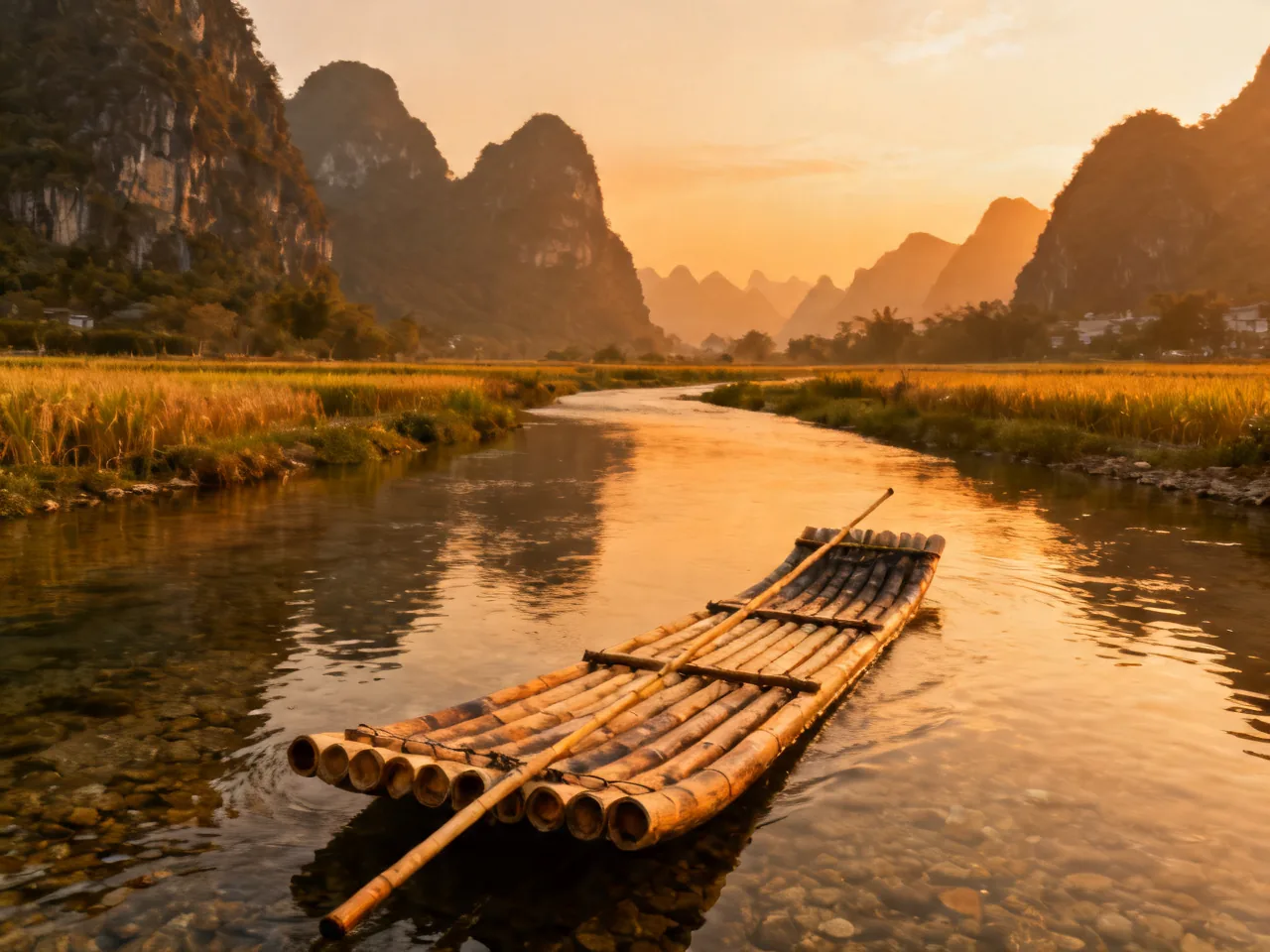
Rent an e-bike (or bicycle, if you have the stamina) and ride along the Ten-Mile Gallery. This road extends south from Yangshuo town, flanked by rice paddies and karst peaks, well-paved, almost flat. Ride to the Yulong River and take another bamboo raft — the Yulong is much narrower than the Li River, shallower and clearer, with villages and farmland on both banks, quiet enough to hear waterbirds calling.
The Yulong River rafts are genuinely hand-poled, slower, more primitive in feel. Some sections pass over small weirs — the raft splashing down is the only “thrill” of the entire journey.
Three Places Not in the Guidebooks
Xingping’s morning market. Xingping is the endpoint of the Li River raft; most tourists get off and leave by bus. But if you stay overnight and visit the old town’s morning market at 6-7 AM, you’ll find locals selling freshly picked vegetables, live fish, and rice noodles. A bowl of Xingping rice noodles costs 6 RMB — pork bone broth topped with pickled long beans and fried soybeans. This bowl beats anything on Yangshuo’s West Street.
Xianggong Mountain sunrise. Xianggong Mountain sits on the east bank of the Li River, not high — twenty minutes to the summit viewing platform. At dawn, the Li River makes a grand bend below, mist rises from the water, and distant peaks fade layer by layer into white. This is Guilin’s best sunrise photography spot, known to virtually every photographer, but few regular tourists visit — because you need to leave at 4-5 AM. Tickets 60 RMB. Worth it.
Laozhai Mountain. Next to Xingping old town, free, but the path is steep — thirty minutes of scrambling using hands and feet. The summit view is even more expansive than Xianggong Mountain, showing the complete bend of the Li River at Xingping and the karst peaks across the river. No railings — those with a fear of heights should think twice.
When to Go, How Long to Stay
Guilin’s rainy season is April to June. Many people think rainy season is bad — actually it’s the opposite. The Li River’s water level is highest during rainy season, making the raft experience best; peaks appearing and disappearing in rain and mist are more atmospheric than clear skies. The only issue is that continuous heavy rain suspends raft operations — check the weather forecast before departing.
September to November is another good window — crisp autumn air, rice paddies turning gold, the color layers of the peaks at their richest.
Plan at least three days: Day 1 in Guilin city (Elephant Trunk Hill, Two Rivers Four Lakes, East-West Lane), Day 2 Li River raft to Yangshuo, Day 3 Yulong River and Ten-Mile Gallery. If there’s a Day 4, give it to Xingping — stay overnight, watch the sunrise, browse the morning market, then leave slowly.
About “Guilin’s Scenery Is the Finest Under Heaven”
This line comes from the Southern Song Dynasty poet Wang Zhenggong, carved into the cliff face of Solitary Beauty Peak in Guilin, over 800 years ago. For over 800 centuries, countless people have come to Guilin to verify this claim, and most conclude: it wasn’t an exaggeration.
But “finest under heaven” itself may not be the point. The point is that Guilin’s landscape has a rare quality of “just right” — mountains not too tall, so they don’t feel oppressive; water not too fast, so it doesn’t feel tense; mist not too thick, so it doesn’t obscure the view. Everything is precisely, gently, effortlessly moderate.
In an era where everything accelerates, this quality of “just right” is itself a luxury. The Li River doesn’t rush, and the people sitting on bamboo rafts don’t need to rush either. That’s probably the best part of Guilin.
Related Reads
- 10-Day East China Five-City Loop
- Lijiang Old Town: Naxi Culture & Snow Mountain Views
- Zhangjiajie Glass Bridge & Tianmen Mountain Guide
- Guilin Li River Scenic Tour Complete Guide
- Spring Bloom Map: China’s Most Beautiful Flower Fields