In a Hangzhou Wet Market I Learned Not to Pretend: Real Cultural Integration Often Starts by Admitting You Don't Know
Opening
At nine in the morning in Hangzhou, the air was no longer cold, but the wet market still held the dampness of early day. Water glimmered and splashed at the fish stalls. White steam rose in soft threads above the tofu counter. Freshly cut oranges smelled sweet enough to almost overpower the earthiness of leafy greens. I stood in front of a stall in the third row to the right of the entrance, staring at several piles of vegetables that looked almost identical to me, and one ungraceful thought crossed my mind: maybe I should just pretend I understand.
Many foreigners who live in China for a while eventually feel a subtle pressure. You already know how to order coffee, call a car, scan a code, say “thank you,” say “sorry to bother you,” and ask simple questions. So you begin to hope you can pass as someone who “basically gets it.” But the places closest to local life are usually not malls, metros, or hotel front desks. They are wet markets, neighborhood stores, shoe-repair corners by residential gates, breakfast stalls, and prepared-food counters. These places are not designed to explain themselves to outsiders. They do not slow down for your understanding. The moment you step inside, you find out whether you actually understand a city or not.
That morning in Hangzhou, in exactly such a place, my urge to pretend was exposed almost immediately.
Part One: I Stared at the Greens, and the Vegetable Auntie Saw Through Me Instantly
I was staying temporarily at a friend’s apartment. The night before, we had agreed to cook lunch at home the next day. My friend would not be free until around 9:30, but jet lag woke me too early, so I decided to go buy some ingredients first, partly to feel useful. My friend sent me a short message: “Get some green vegetables, tofu, and maybe fresh mushrooms if they look good.” In a supermarket, this would have been easy. In a neighborhood market in Hangzhou, it was practically an essay question.
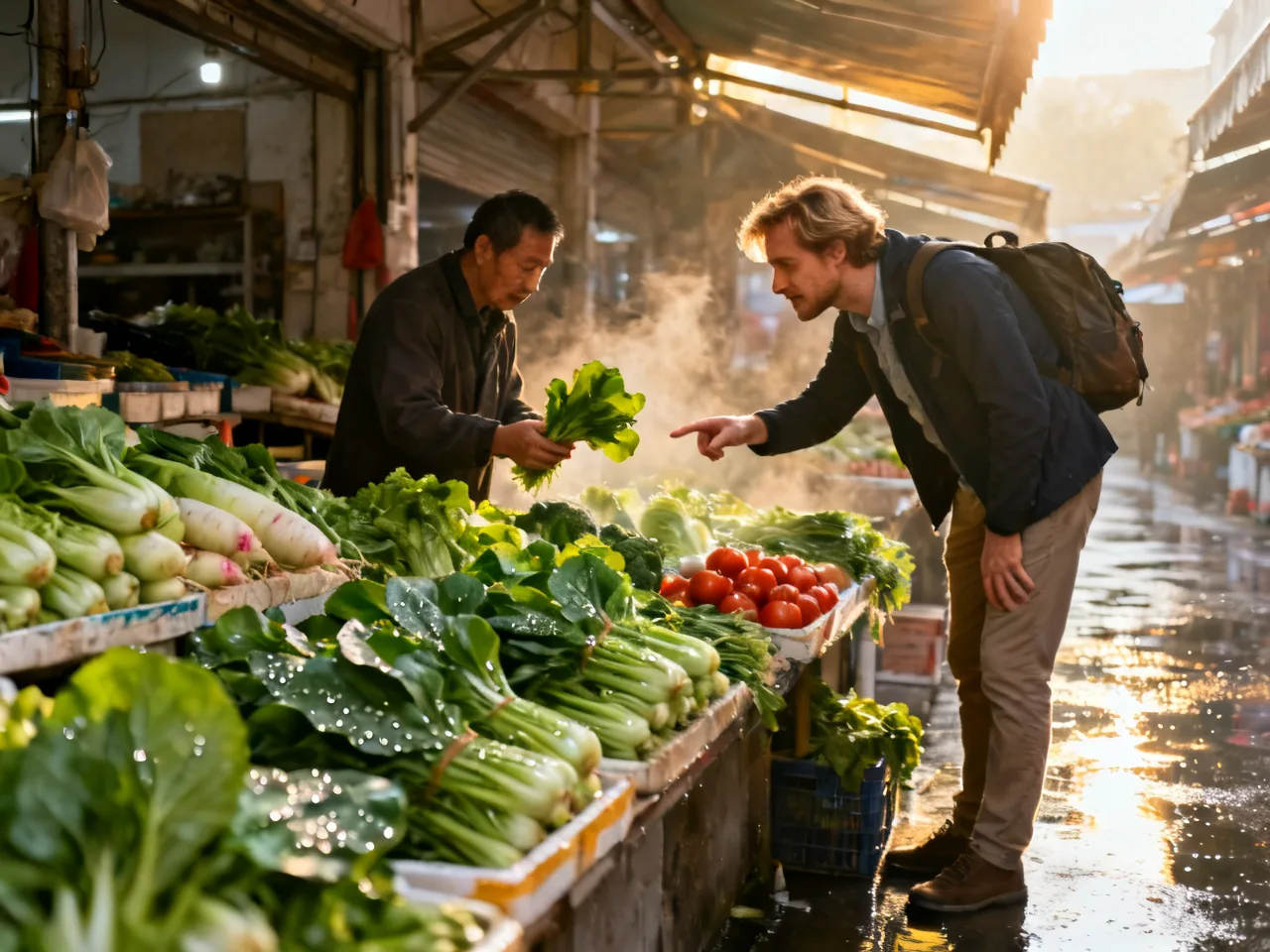
I stood before a stall where there was spinach, romaine-like greens, water spinach, baby bok choy, chrysanthemum greens, and several local leafy vegetables I could not identify at all. Every bundle was tied neatly. Tiny beads of water still clung to the leaves from the morning rinse. I was about to choose two bundles at random and rely on confidence, but the vegetable auntie was already smiling at me. She wore blue sleeve covers, an apron with small marks of soil on it, and moved quickly—bagging, weighing, and making change for the customer before me. Then she turned and asked, “First time buying?”
For one brief second, I almost kept pretending. I nearly said, “No, no, I’m just looking.” But something about the morning light in Hangzhou, and the natural closeness between people in that market—informal, unceremonious, but not cold—made me tell the truth instead. I smiled and admitted, “Yes, I’m not very good at telling them apart. My friend asked me to buy some greens.”
The moment I said that, the whole interaction relaxed. She did not laugh at me, and she was not impatient. She immediately shifted into an efficient teaching mode, pointing as she spoke: “This one stays crisp when stir-fried. This one is good for soup. This one needs a quick fry. This one has a slightly bitter fragrance. Are you eating at home by yourself or cooking for friends?”
I told her I was cooking with friends, and she nodded. “Then get this baby bok choy. Safer choice. Almost everyone likes it. And take some mushrooms—they match well.” When she said “safer choice,” I understood something instantly. She was not making decisions according to a recipe. She was using the logic of daily life. Not “what is the most special,” but “what is least likely to go wrong.”
In that moment, I felt that cultural integration is not about performing like a local from the beginning. It is about allowing yourself to act like a beginner and making your questions specific enough to be answerable. You do not have to understand everything at once. You just have to place your not-knowing honestly on the table.
Part Two: I Realized Market Politeness Is Less About Formal Courtesy and More About Rhythm
If most of your interactions happen in restaurants, hotels, or tourist sites, it is easy to think politeness is mainly verbal: say hello, say thank you, say sorry to trouble someone. Those things matter, of course. But in a wet market, there is another, more hidden form of politeness: do not drag the rhythm, observe carefully, and when your turn comes, make your question clear.
I stayed there for more than twenty minutes, almost like auditing a class in practical life. One person would arrive and immediately state the quantity: “Two jin of tomatoes, the softer ones.” Someone else would scan the stall first, then ask, “This one is fresh today, right?” Another would not ask price first, but cooking use: “I’m making soup tonight—which kind works better?” These conversations were brief, but information-dense. Everyone seemed to understand that the market is not a social lounge. It is a high-frequency, fast-moving public space that still leaves room for mutual care.
So I adjusted myself. I stopped holding up my phone while hesitating endlessly. Instead, I first watched how other people bought, how they asked, and when it was natural to speak. When my turn came, I tried to deliver the key information all at once: “I’m cooking lunch with a friend. We don’t eat very spicy food. I want greens that are easy to stir-fry, and one block of soft tofu.” The vendors could almost always respond immediately.
This reminded me of the Chinese rhythm of politeness hidden inside an ordinary meal. Many everyday situations in China do not require fancy wording. They require timing, awareness of the setting, and the ability to stay concise when others are busy too. Politeness is a language, but it is also a way of participating in public rhythm.
I felt this even more clearly at the tofu stall. The owner was a middle-aged man with glasses, and there were always three or four people waiting beside his board. He cut tofu with the speed of a fixed rhythm: left hand steady, right hand slicing, plastic bag flicked open, tofu sliding in, digital scale set down, next customer already moving forward. I had originally wanted to ask many things: What is the difference between soft tofu and firmer tofu? Which one is better for soup? How long does it keep? But after watching just three customers, I suddenly knew how to ask.
I said, “For a home-style dish, and I want a softer texture—which one is best?”
He barely needed to look up. His hands were already moving. “This one. Best if you eat it at lunch today. Don’t leave it too long.”
One second, full answer, smooth transaction. Not because my Chinese was advanced, but because I had finally learned to compress the question into market language.
Part Three: After Admitting I Didn’t Know, I Was Invited More Deeply Into Everyday China
The most interesting part was that once I stopped pretending, people often became more willing to tell me a little extra. The mushroom auntie would remind me, “Wash enoki quickly—don’t soak it.” The shrimp seller would say, “This batch isn’t as fresh for drunken shrimp; that one is better.” Even at a tiny stall near the market entrance selling scallions, ginger, and garlic, a neighborhood auntie with a cloth bag stepped in to explain, “He means this one is sweeter, not spicier.”
At one point I felt unexpectedly moved. Not because they were treating me as some special foreigner, but because for the first time I really felt how much everyday kindness in China is often not dramatic at all. It hides in the tiny act of “adding one useful sentence for you.” If you present yourself as someone who already understands everything, people often do not know how to approach you. But once you honestly reveal a little blank space, many people naturally hand you one piece of information, one warning, one lived detail.
The feeling was similar to what I had experienced in other cities when I learned to ask about routes, transfers, or safer night paths. Asking for help does not always create distance; sometimes it creates trust. It reminded me of the sense of safety that grew once I learned to speak up for help in China: I no longer felt like a person being tested by the environment. I began to feel like someone who could participate in it and form a relationship with it.
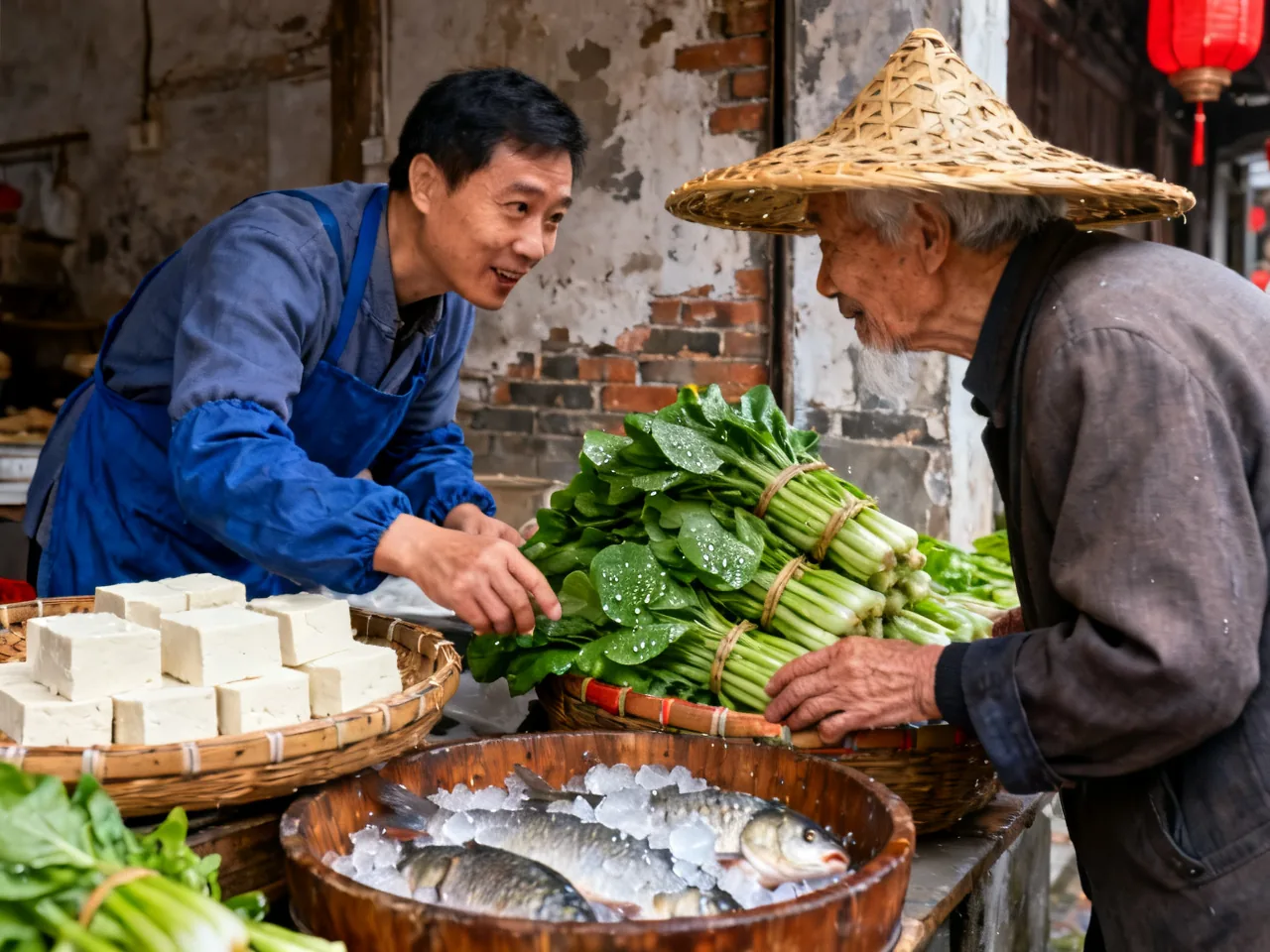
The best little moment happened just before I left. I was already carrying greens, tofu, and mushrooms, ready to head back, when I noticed a pile of small purple-red radishes near the entrance. They looked beautiful, so I paused for a few extra seconds. The vendor smiled and asked, “Do you know this one?” I honestly shook my head. An older man buying vegetables beside me joined in: “You can eat it raw or make a cold dish. If you don’t know it, just buy a little and try.”
“If you don’t know it, just buy a little and try.” That sentence felt deeply Chinese and deeply practical. It did not demand total understanding immediately, and it did not suggest avoiding the unknown. It simply said: start small, then build experience gradually. That may be the best summary of cultural integration I have learned since.
What the Hangzhou Market Taught Me About Real Integration
Admitting You Don’t Know Is the Starting Point for Real Help
Many people think integration means reducing every visible sign of unfamiliarity. But in everyday Chinese spaces, what is actually useful is often not disguise, but clarity: “I’m not very familiar with this. Could you tell me how to choose?”
Watch How Others Do It Before Deciding How to Ask
Wet markets, breakfast stalls, neighborhood counters—these places all have their own rhythm. Watching for one minute is often more effective, and more polite, than speaking immediately.
Ask Situation Questions, Not Academic Questions
Do not start with “What vegetable is this?” if your real problem is lunch. Better questions are: “Is this good for stir-frying?” “Is it bitter?” “How much is right for two people?”
In China, Much Kindness Arrives in the Form of Practical Advice
When people help you, they may not wrap it in warm speeches, but they may directly tell you what is safer, quicker, or more suitable. That is a precious form of practical kindness.
Not Pretending Makes Real Judgment Develop Faster
Only when you admit the blank spaces do you begin to observe, compare, remember, and learn by trial. After a few rounds, the vegetables, tofu types, and seasoning habits that once felt impossible to distinguish slowly become familiar.
Integration Is Not Performing Localness, but Building Functional Confidence
This matters especially for foreigners. You do not need to pretend you became a Hangzhou resident overnight. You only need to gradually learn how to buy ingredients, ask questions, judge freshness, and speak naturally when you do not know. Functional confidence matters more than performance.
Closing Reflection: Carrying a Bag of Vegetables Home, I Felt Less Like a Tourist and More Like Someone Living a Day
When I left the market, the morning had fully brightened. A repair stall near the residential gate had just unfolded its chair. The breakfast shop was still steaming fresh buns. A few electric scooters stood by the road with scallions and celery sticking out of basket tops. I carried a plastic bag in one hand. The tofu inside was still faintly warm. The green leaves pressed softly against the sides of the bag, and the mushrooms bumped lightly with each step. The weight was physically small, but emotionally it felt surprisingly substantial—not like a souvenir, not like a check-in photo, not like a ticket from a scenic site. It felt like a concrete piece of daily life.
I used to think cultural integration required big events: long residence, fluent language, deep friendships, major turning points. Now I increasingly believe that much of the real integration happens in modest places like this. You stand before a pile of greens and admit you do not know. Someone does not treat you as a burden, but casually teaches you one thing. You learn to ask, choose, pay, and leave according to the rhythm of that place. By the time you step out of the market, the city has not merely been visited by you. It has started to be used by you, understood by you, little by little.
So if someone asks me now how to get closer to everyday life in China, my answer may not be grand at all. I would say: go to a wet market once. Do not rush to photograph everything. Do not rush to pretend. Do not rush to perform familiarity. Smell the air first. Watch how other people choose vegetables. Listen to how vendors describe things like “fresh,” “tender,” and “safe choice.” Then, in one moment when you truly do not know, ask honestly.
Most likely, what you bring home will be more than ingredients for lunch.