More Than a Dish: Peking Duck as Beijing's Letter to the World
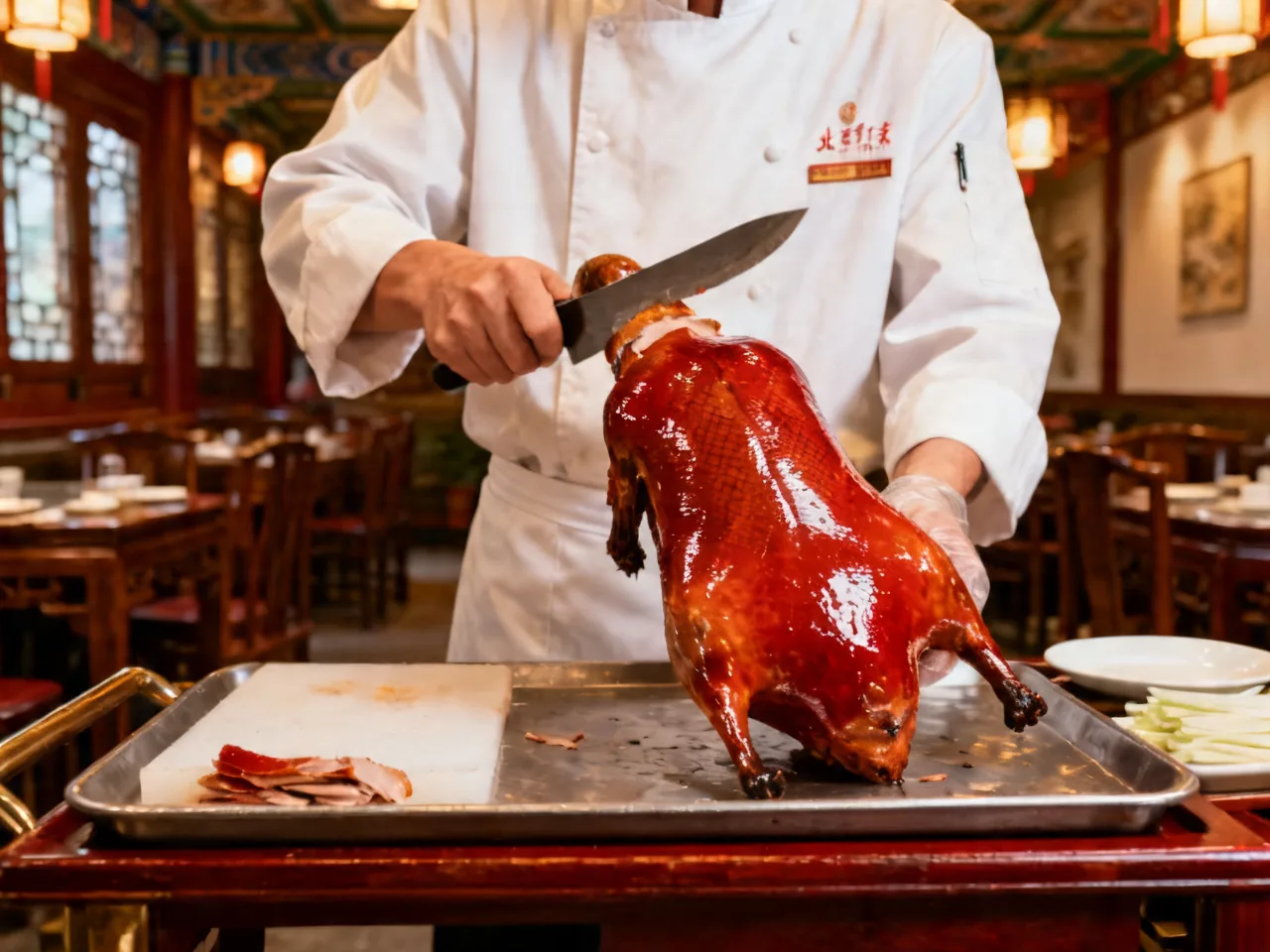
Welcome, everyone, to Quanjude. Before I take you through the process of making Peking duck, I’d like to ask a question: do you know how many days it takes from the time a Peking duck is born to the moment it arrives at your table?
Sixty-five days. During those sixty-five days, the duck undergoes a strict rearing program: forty-five days of free movement, then twenty days of force-feeding on a precise schedule, allowing the duck to accumulate sufficient subcutaneous fat in a short time. That fat is the key to the crispy skin. Without it, no oven — however fine — can produce that amber-colored skin that shatters at the bite.
I’ve been a guide at Quanjude for eighteen years, taking visitors from around the world through the making of Peking duck every day. I’ve seen French chefs go slack-jawed watching the carving master work. I’ve seen a Japanese grandmother insist on taking the duck carcass home for soup stock. I’ve seen an American diner eat an entire duck and then ask to pack up the rendered fat. Peking duck means something completely different to each person.
But one thing is always the same: when the carving master presses that thin blade against the skin and lifts the first slice, everyone goes quiet. There’s a ritual quality to that motion that makes you hold your breath without thinking.
The history of Peking duck traces back to the Ming Dynasty. The original method was “closed-oven roasting” — the duck placed in a sealed chamber, cooked by the residual heat of the oven walls, never exposed to open flame. Later came “hanging-oven roasting,” with the duck suspended in an open-fronted oven and roasted directly over fruitwood fire. Both methods have devoted partisans, and the debate continues to this day.
Quanjude uses the hanging oven, with jujube wood and pear wood as the primary fuel. Jujube wood burns steadily; pear wood carries a faint fruity fragrance. Together they give the skin a subtle smoky sweetness. The oven temperature is maintained around 270 degrees Celsius, roasting time approximately forty minutes. The master rotates the duck every few minutes to ensure even heat. The timing and angle of those rotations is a skill that takes years to master.
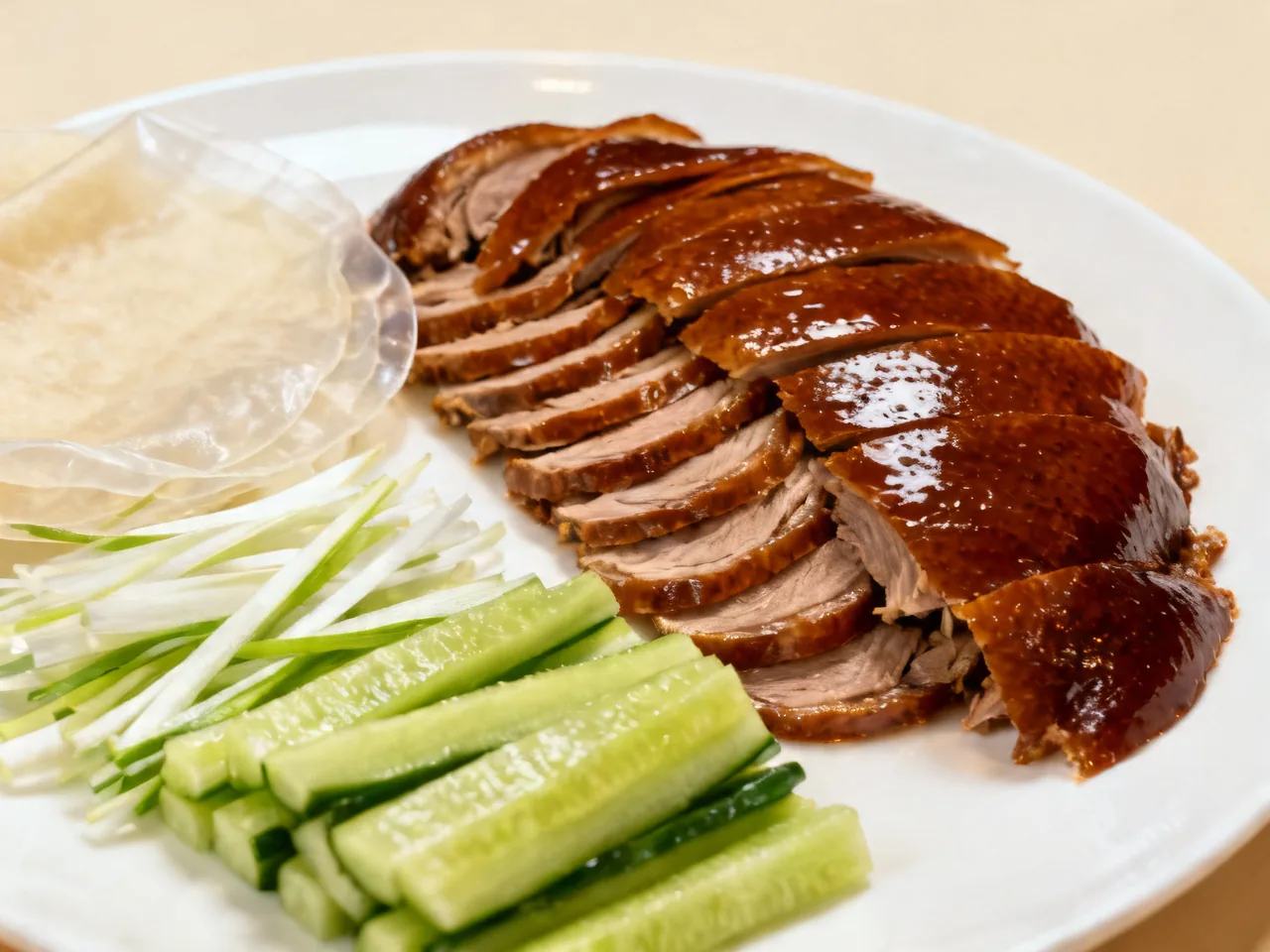
The carving is the climax of the whole ritual. A standard Peking duck should be sliced into 108 pieces, each carrying both skin and meat, uniform in thickness. This number isn’t arbitrary — 108 carries special significance in Chinese culture — but more practically, 108 pieces means every bite contains crispy skin, tender meat, and that thin layer of fat beneath the skin simultaneously.
The eating method matters too. The orthodox approach: take a lotus-leaf pancake, lay it flat, place two or three slices of duck on it, add a few strips of scallion, spread a little sweet bean sauce, roll it up, and bite through in one go. The savory sweetness of the sauce, the sharpness of the scallion, the fragrant crunch of the skin, the silky tenderness of the meat — all unfold in the mouth simultaneously, in distinct layers. Some guests like to add cucumber strips, some prefer more sauce. All fine. But one thing cannot change: it must be eaten in a single bite. You cannot bite halfway and put it down.
A significant portion of the visitors who come to Quanjude each year are here to “check in” — photograph, post to WeChat Moments, prove they’ve been to Beijing. I understand the impulse, but I always add one thing: the best moment to eat Peking duck is the instant after carving, while it’s still steaming. If you spend too long on photos, the steam softens that crispy skin, and the best moment is gone.
Once, an Italian chef heard me say this, immediately put down his phone, and picked up his chopsticks. He took the first bite, paused, then said something in Italian. I don’t speak Italian, but the interpreter beside me said he’d said: “This is the most honest food I have ever eaten.”
I think that might be the finest thing anyone has ever said about Peking duck. Not the most complex. Not the most refined. The most honest. Six hundred years of craft, one duck, one knife, one fire of fruitwood. Nothing to hide.
Related Reads
- The 8 Great Cuisines of China
- Spellbound at First Bite: A Stranger’s Descent into Chengdu’s Heat
- Street Steam: The Real Pulse of Chinese Cities
- The Peppercorn Dossier: Sichuan’s Flavor Map Through a Botanist’s Eyes
- 10-Day East China Five-City Loop