10 Chinese Phrases the Writer Learned to Actually Use While Traveling in China
At 7:40 in the morning, the writer stood beside a ticket machine at Shanghai Hongqiao Railway Station with a suitcase in hand. The glass doors had just opened, cool air flowed out into the hall, and the floor still held a trace of dampness from cleaning. Announcements kept switching between Mandarin and English, while people around moved quickly toward the gates, their luggage wheels clicking over the tiles. That morning made one thing clear: the most useful Chinese phrases for travel are not the longest textbook sentences, but the short, practical lines that get you understood immediately in stations, restaurants, taxis, shops, and pharmacies.
The writer is from Japan and originally assumed that Chinese characters would solve most problems. In China, it quickly became obvious that recognizing a few characters and actually speaking up are two different skills. In Japan, many situations can be handled by quietly observing and matching the rhythm around you. In China, especially at high-speed rail stations or breakfast shops, the pace is faster. People move like a current. If you hesitate for three seconds, the person behind you has already gone around you. So this article does not present ten phrases as cold flashcards. It puts them back into real scenes, so a Japanese visitor can understand when to use them and why they matter.
Starting at the Station
The first moment the writer got stuck in a Chinese rail station was not while buying a ticket, but while failing to catch which gate the staff member had mentioned. She pointed at the screen, then at the ticket in her own hand, and the first truly useful Chinese phrase that came out was: “请问,这个怎么走?” The pinyin is Qǐngwèn, zhège zěnme zǒu? It simply means, “Excuse me, how do I get there?” The power of this sentence is not whether “this” is perfectly specific. The power is that the listener instantly knows you are asking for directions, not complaining and not standing in the wrong line on purpose.
The second phrase usually follows the first one: “我听不太懂。” The pinyin is Wǒ tīng bu tài dǒng. This is more useful than saying “I don’t speak Chinese,” because it leaves room for the other person to keep helping. Back in Japan, the writer used to feel slightly embarrassed admitting she had not understood. After a few days in China, she noticed that this sentence often made station staff slow down immediately, point with their hands, or even write down a key word. Saying you know nothing can shut a conversation down. Saying “I don’t quite understand” often keeps it alive.
The third phrase became something the writer used almost every day: “请说慢一点。” The pinyin is Qǐng shuō màn yìdiǎn. It works at railway stations, hotel counters, and scenic ticket windows alike. Service in many Chinese cities is efficient, and people often speak fast, especially when others are waiting behind you. Once, in a waiting area, the writer asked where the restroom was. An older woman answered in one breath with two floors, two corners, and one escalator. The writer only caught “left” and “go up.” After saying “Please speak a little slower,” the woman broke the explanation into smaller pieces and used her hands while talking. The situation became easy immediately.

In Restaurants, the Bigger Problem Is Often Ordering Too Much
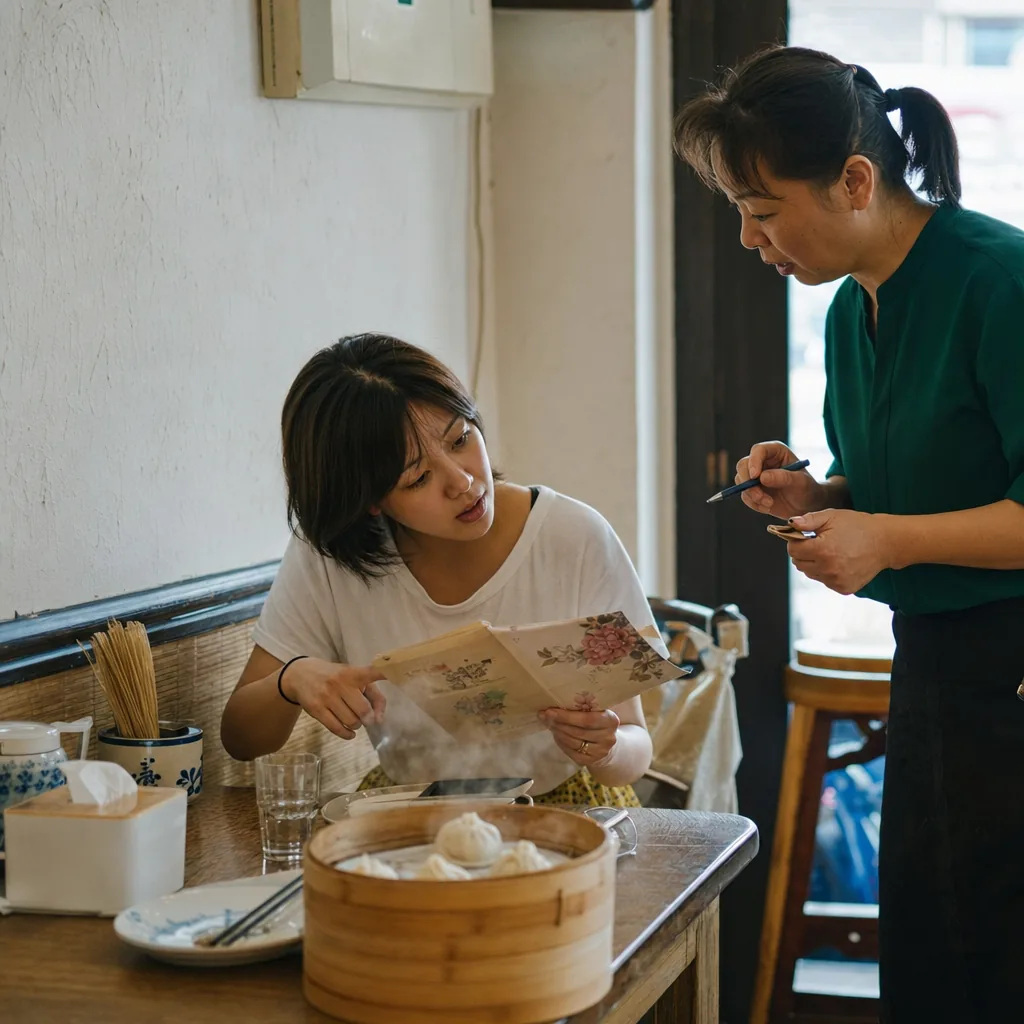
At noon in a small restaurant in Hangzhou, the writer sat at a wall-side table marked with faint water rings left by hot cups. At the next table, an older woman was dividing a basket of soup dumplings for her child. When the server handed over the menu, the first thing the writer needed was not a dish name, but the fourth phrase: “这个怎么点?” The pinyin is Zhège zěnme diǎn? It looks basic, but it is especially useful for foreign travelers because the ordering logic in Chinese restaurants can differ from Japan. Some dishes are by portion, some by weight, some require a minimum order for two people, and some come with a default spice level. If you do not know the rule, asking how to order is much safer than guessing.
The fifth phrase is directly tied to how enjoyable your meal will be: “不要辣。” The pinyin is Bú yào là. The writer is not completely unable to eat spicy food, but the first time she ordered “mild spice” in China, sweat appeared on her forehead almost immediately, and even cold soy milk could not rescue the situation. Later, she learned that if she wanted to play it safe, she should simply say “No spicy.” If she wanted a small compromise, she could say “Less spicy.” The strength of this phrase is that even imperfect pronunciation is often enough, because “spicy” is a very clear keyword. For Japanese visitors, stating your taste clearly matters more than delivering a long, polished sentence.
The sixth phrase seems small, but it prevents a surprising amount of awkwardness: “我不要香菜。” The pinyin is Wǒ bú yào xiāngcài. Quite a few Japanese travelers are not comfortable with coriander, and the writer is one of them. Once in Xi’an, she ordered noodles. Steam rose from the bowl, the garlic aroma and vinegar smelled wonderful, but the first taste still hit coriander before anything else. That was the day she realized many noodles, soups, and cold dishes in China may come with coriander automatically, and the staff may not ask first. If you dislike it, saying so in advance makes the entire meal much more pleasant.
In a Taxi, Short Phrases Beat Formal Niceties
After rain in the evening, the writer slipped into a taxi from the entrance of a shopping mall, her shoe soles still damp. Small drops covered the windows, and the navigation voice kept breaking in from the front seat. In this setting, the seventh useful Chinese phrase is: “到这里,谢谢。” The pinyin is Dào zhèlǐ, xièxie. You can show the driver the address on your map and finish with this phrase. Its purpose is simple: it confirms the destination. At first, the writer always tried to produce full sentences. Later, she realized that in taxi situations, shorter information is safer and easier for the driver to catch immediately.
The eighth phrase is a rescue line many foreign travelers will eventually need: “可以停这里吗?” The pinyin is Kěyǐ tíng zhèlǐ ma? Road layouts in Chinese cities can be complicated. A mall entrance, subway exit, or hotel side door may not sit exactly on the map pin. Once, in Chengdu, the writer was heading to a cafe inside an alley when the driver was about to pass it. The moment she spotted the small sign by the roadside, she said this sentence almost instinctively. The driver pulled over, and the moment she stepped out, she could smell coffee beans and bread mixing with the damp air. That moment made her feel that one timely Chinese sentence can be more useful than ten extra minutes of route study on a phone.
Convenience Stores and Pharmacies Reveal Whether You Can Really Use Chinese
A little after 9 p.m., the writer entered a convenience store in Beijing looking for a charging cable. The shelves were full of accessories in nearly identical packaging, and the white lights made the plastic cases shine. Near the cashier there was also a hot-food counter with oden. The ninth useful phrase here is: “有这个吗?” The pinyin is Yǒu zhège ma? If you show the clerk your phone port while asking this, communication becomes very efficient. It also works for toothbrushes, tissues, bandages, umbrellas, and power banks, almost any travel item you suddenly need. Later, the writer realized that the easiest way to travel in China is not memorizing every product name, but learning how to ask a clear question with “this” plus a gesture.
The last phrase is the one the writer hopes every traveler to China memorizes first, because it can help in pharmacies, clinics, and hotel front desks alike: “我不舒服。” The pinyin is Wǒ bù shūfu. It is not as precise as naming a symptom, but it is fast, and it immediately signals that you need help. One evening, after spending too long in air conditioning, the writer woke the next day with a tight throat. At the pharmacy door, this was the first thing she said. The clerk asked her to sit down, handed her warm water, and only then slowly asked whether it was a sore throat, a cough, or a fever. When you feel unwell while traveling, you are usually more anxious than usual. In that moment, what matters most is not stating every detail perfectly, but making sure the other person understands that you need assistance.

Why These Ten Matter More Than Perfect Chinese
The writer later saved these ten phrases in a phone note, not because they sound advanced, but because they cover the moments in travel when people are most likely to panic: finding the way, not understanding, asking for slower speech, ordering food, avoiding certain flavors, confirming taxi stops, buying emergency items, and dealing with discomfort. They are: 请问,这个怎么走? 我听不太懂。 请说慢一点。 这个怎么点? 不要辣。 我不要香菜。 到这里,谢谢。 可以停这里吗? 有这个吗? 我不舒服。 What these sentences share is that they are all short. Even if your pronunciation is imperfect, people often understand through context.
For Japanese visitors, one of the most interesting things about traveling in China is that Chinese characters can create the illusion that you should already be able to manage everything. In reality, what makes the trip move smoothly is not recognition, but whether you speak up at the right moment. During the first few days, the writer would build full sentences in her head before approaching a counter. A few days later, she had changed strategy: say the shortest useful half-sentence first, then finish the meaning with gestures, maps, expressions, and a few extra words. Many ordinary people in China do not become impatient just because your Chinese is incomplete. Quite often, they take your half-finished sentence and help lay the rest of the road out for you.
If the writer had to close this article with one concrete image, it would not be the giant departure board in the station or the steaming dishes in a restaurant. It would be the cup of warm water quietly pushed within reach at the pharmacy. Language during travel is not always about sounding elegant. Sometimes it is simply about making it easier for another person to step one pace closer to you in an unfamiliar place. Once you can say one simple line in Chinese, many of the things that come after no longer feel so difficult.