What Dali Taught Me First Was Not the View, but How to Steady My Steps Outside the Old Town
01
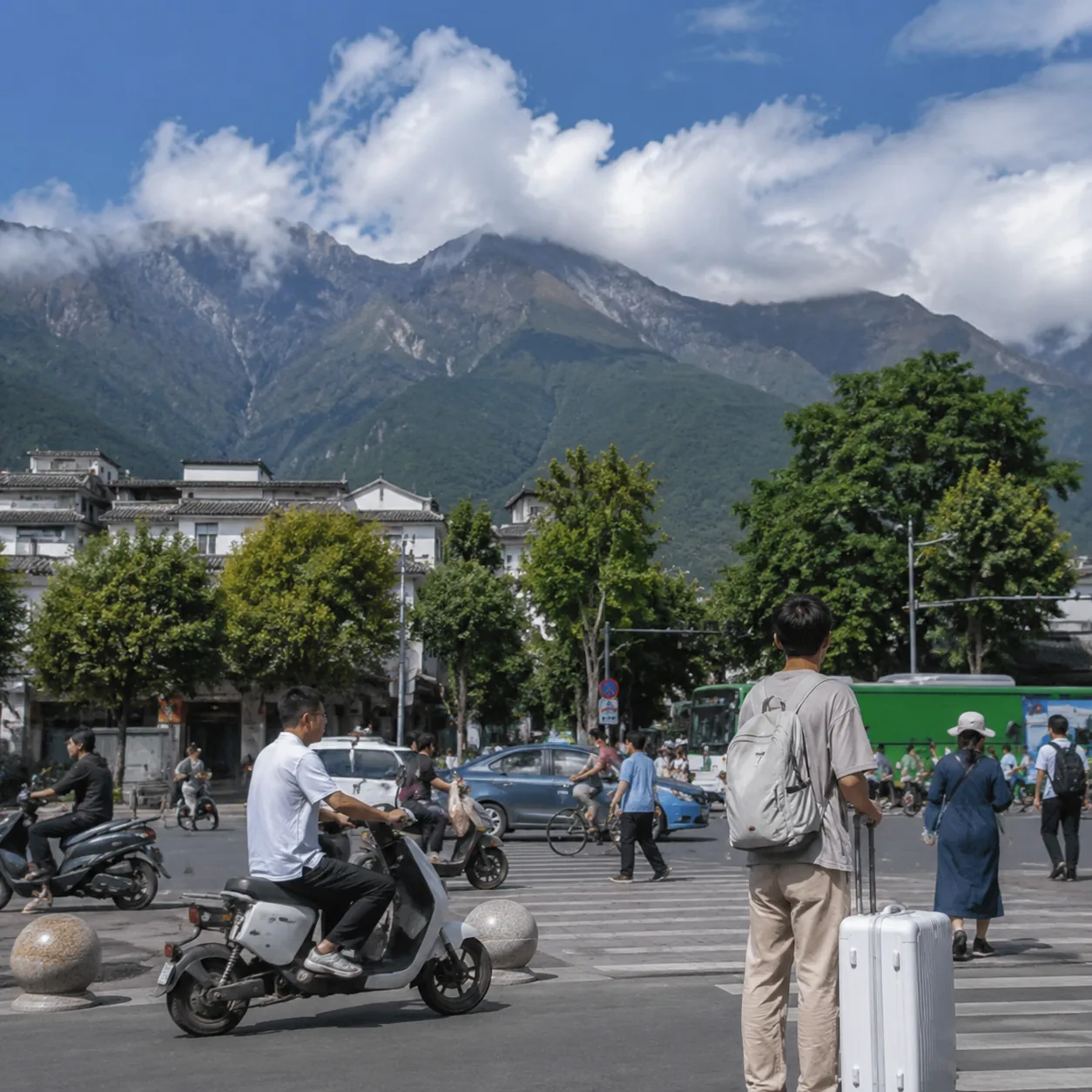
On my first day in Dali, I did not rush to judge it with words like “relaxed,” “romantic,” or “healing.” Those words too easily leap out of short videos and guesthouse copywriting, introducing the city before the city can introduce itself. What actually began to teach me Dali was several intersections outside the old town. They were not beautiful or quiet; they were even a little chaotic: electric scooters brushed past the edges of crosswalks, taxis paused briefly at corners, backpackers dragged suitcases while checking phones under road signs, rental shops pushed small e-bikes one by one to the door, and buses slowly squeezed into the flow. Cangshan stood steadily in the distance, and Erhai glimmered on the other side, but the first real entrance was not mountain or lake. It was the intersection. You have to learn to read direction, speed, and people’s hesitation there before you can truly enter Dali.
02
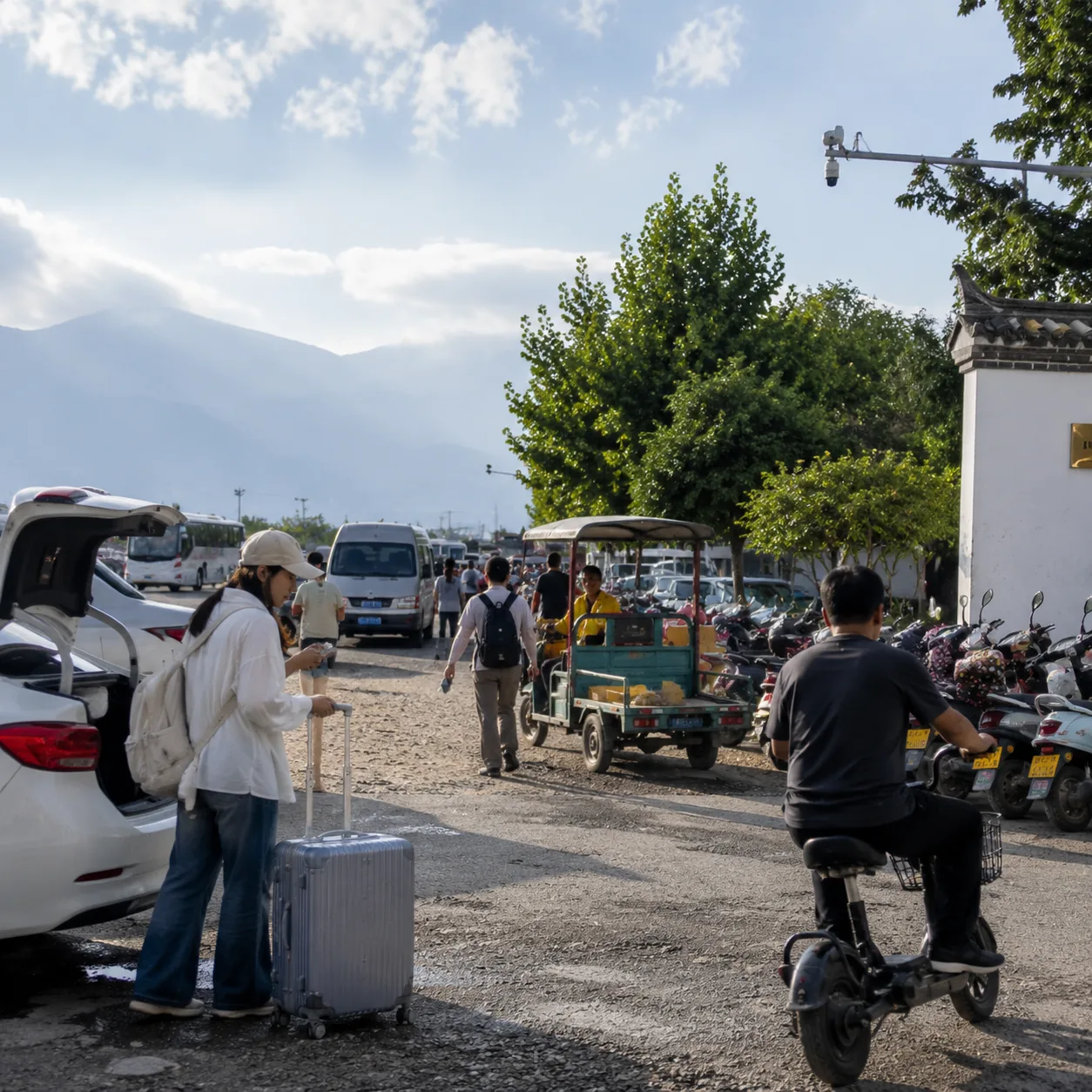
The roads outside the old town are like a buffer zone separating imagined Dali from Dali as it actually operates. Inside the gates are stone paths, shop signs, silver jewelry, flower cakes, shawls, and people taking photos. Outside the gates are parking lots, passenger vans, shared e-bikes, delivery riders, three-wheelers, tour group meeting points, and navigation routes that keep changing. Many visitors step out of vehicles with the relaxed expression of “finally arrived,” but their bodies are already pushed into motion by traffic: first dodging an electric scooter, then crossing an uneven patch of pavement, then searching for the location sent by a guesthouse owner. The old town is not an island. Around its outer side lies a very real edge. That edge decides whether you drag your suitcase for ten minutes or take a shuttle; whether you rent a vehicle to circle the lake or store luggage first; whether you enter the scenery immediately or receive a lesson from the road conditions.
03
I stood at one intersection for a long time. The traffic light had its own rhythm, but the flow of people did not completely obey it. Locals judged gaps quickly. Electric scooters found a thin line through traffic and slipped across, the front wheel tilting slightly, the rider’s weight shifting with it, like an instinct shaped by long practice. Visitors were half a beat slower. They often looked first at the light, then at the cars, then at whether anyone beside them was crossing. Two speeds met at the intersection, forming the clearest difference of my first day in Dali: one belonged to people familiar with the road moving through daily life, the other to people newly arrived, calibrating themselves before the scenery. Neither was absolutely right. The locals’ speed came from life’s inability to stop; the visitors’ slowness came from the need to confirm every step. The intersection exposed this difference clearly and tested the city’s patience.
04
Rental shops outside the old town explain Dali’s travel style better than many scenic spots. At their doors stand rows of e-bikes, small motorcycles, open-top jeeps, and Beetle-like cars in bright colors, like a line of freedom available for purchase. The staff introduce routes skillfully: clockwise or counterclockwise today, how long it takes to reach Xizhou, whether Shuanglang can be done in one day, which section of the western lakeside road is good for photos, where the wind is strong, and where traffic checks are strict. As visitors listen, the blue of Erhai and the version of themselves in road-trip photos often already appear in their eyes. But renting a vehicle also lays out boundaries. Can you ride? Do you dare to enter traffic? Can you accept sun, wind, congestion, parking difficulty? Can you judge direction quickly at an unfamiliar intersection? These questions are more concrete than “Do you want freedom?” Freedom in Dali is not abstract. It must be cashed out through deposit, helmet, battery level, speed limits, and right of way.
05
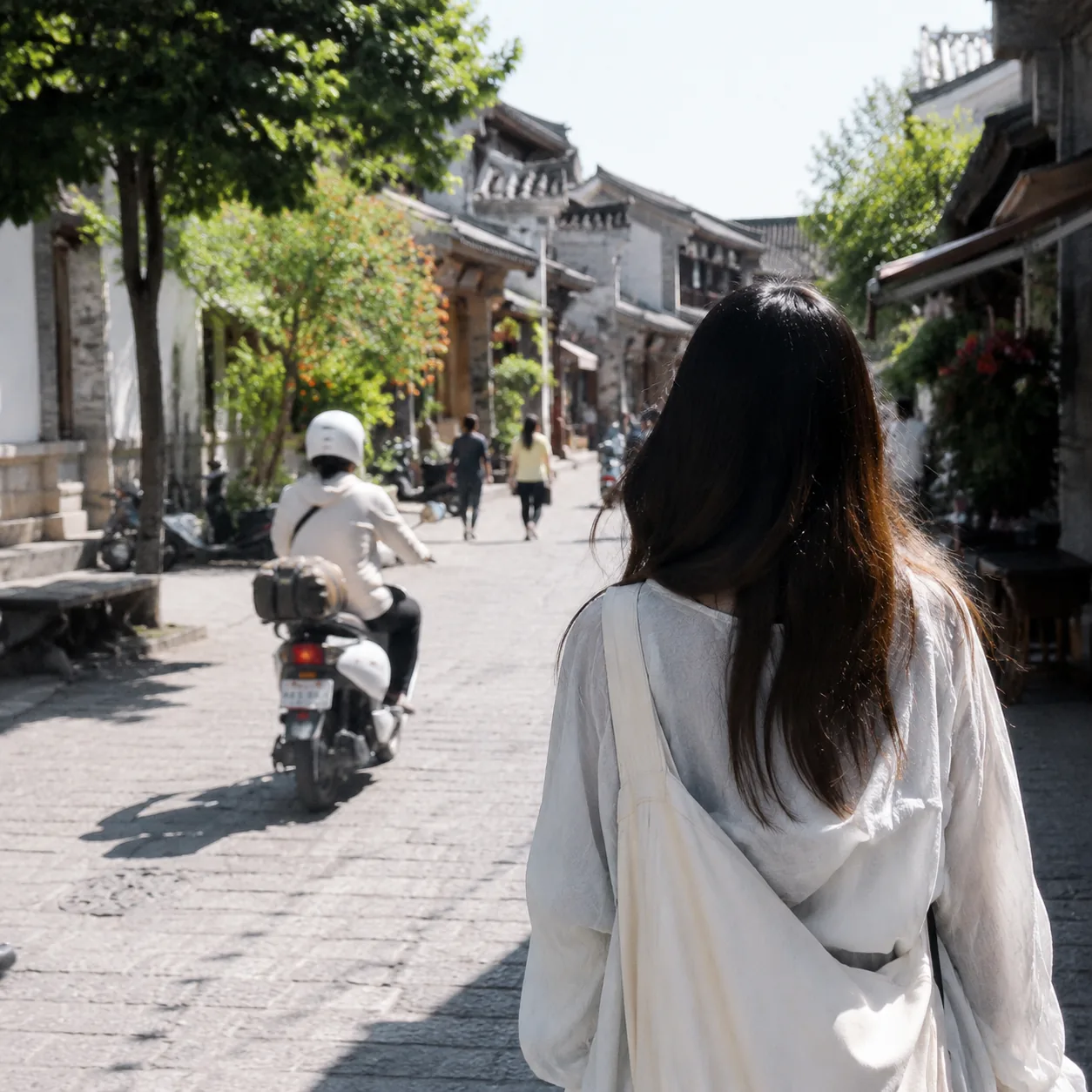
The boundary of walking is also obvious. Inside the old town, walking slowly feels right. You can be drawn from shop to shop by smells, music, and signs, stopping anytime to photograph a door, a pot of flowers, or a dog asleep on a step. But once you reach the outside, walking begins to feel clumsy. Sidewalks are sometimes occupied by e-bikes, sometimes cut off by temporarily parked vehicles, sometimes suddenly narrowed so that people dragging suitcases have to step down near the roadway. Distances that look short on the map grow longer under sun, wind, and traffic. The same is true by Erhai. The lake surface seems to invite you to keep walking, but the sections comfortable for walking are not continuous. Some places suit strolling, some suit cycling better, and in some places you are simply searching for a position between traffic and scenery that does not feel awkward. Dali’s slowness does not mean every road is suitable for slow walking.
06
In the afternoon I went toward Erhai, and the flow of people on the road changed shape. Outside the old town, the flow was scattered and direction-seeking, carrying luggage and the questions of new arrival. By the lake, the flow seemed drawn by the same picture. Bodies turned toward the same direction, and phones lifted at similar angles. Someone rode past on an e-bike, a shawl blown backward by the wind; someone parked a rented vehicle at the roadside, eager to find an angle that could hold the sea-like lake, the trees, and themselves together; someone simply sat on stone steps, staring as the sun cut the water into broken silver. Traffic did not disappear here. It merely retreated temporarily to the edge of the view. Wheel sounds, horns, tourist laughter, and photographers telling people where to stand were diluted by the lake’s great light. But step back a few paces and reality immediately returns: parking, passing, turning around, yielding, waiting for someone.
07
The most interesting thing by Erhai is not the scenery itself, but how people arrange their distance from it. Some insist on getting close to the water even if that short section is not easy to walk. Some prefer standing across the road, putting the lake, vehicles, and roadside trees into one photo. Some keep riding, as if using speed to prove the completeness of circling the lake. Some walk and stop, breaking an afternoon into many small pauses. Renting and walking are not only modes of transportation here; they are also two modes of seeing. Renting gives you a larger range, allowing you to chase light, clouds, or a less crowded corner. Walking gives you a finer touch, allowing you to hear leaves, vendors calling, and shoe soles crossing gravel. But both have costs. Renting can make you miss details; walking can confine you by distance. The first day in Dali is a repeated choice between these two costs.
08
I later realized that the outside of the old town and the edge of Erhai form two reading systems. Outside the old town, you read intersections: where you can cross, where you must wait, which road leads to lodging, which road leads to parking, which road looks close but is hard with a suitcase. By Erhai, you read people flows: where crowds stop, where photos begin, where wind is too strong for people to stay long, where good tree shadows create temporary lines. The former trains you to understand the city’s practical order; the latter trains you to understand the movement of travel desire. Dali does not exist only through natural scenery. It also exists through routes that are constantly used, misread, adjusted, and chosen again. If on the first day you look only at mountains and lake, Dali may seem too simple. But if you look at intersections and people flows, you will find it complex.
09
At dusk, returning to the outside of the old town, the intersections became harder to read than in the daytime. The sky lowered, headlights came on, stalls began to occupy the roadside, and people going to dinner mixed with people returning to lodging. Directions that had seemed clear by day were disrupted by smells and lights. The sweetness of grilled rushan cheese, the steam of mushroom soup, barbecue smoke, and the fragrance from flower cake shops drifted together, making people forget which way they had meant to go. Traffic also became more emotional: someone hurried to return a rental, someone could not find a parking space, someone had just rented a scooter and was not yet familiar with the brake, someone stood by the road waiting for companions. The intersection became a temporary theater, each person entering with a small task. Dali’s evening is not simply gentle. It is a kind of density: the density of scenery, appetite, movement, and choice.
10
At the end of the day, I did not feel that I had “finished seeing” Dali. Instead, I felt I had just learned to see its edges. Many cities place their most photogenic parts at the center and ask you to arrive, photograph, and leave. Dali’s center is certainly beautiful, but the places that truly make one pause and think are often between center and edge: the parking points outside the old town gate, the helmet racks at rental shop doors, the places where the road by Erhai suddenly narrows, the intersections where visitors stop and wonder whether to continue, the unexaggerated skill with which residents ride through crowds. Understanding these on the first day does not make travel easier, but it makes it more real. You learn that so-called relaxation is not the absence of order, but a movable position constantly negotiated among mountain, lake, people, and vehicles.
11
If Dali’s first impression is often color, what I remembered on my first day was flow. People moved continuously from stations, parking lots, old town gates, rental shops, inns, and the lakeside, like streams of different temperatures meeting on the same ground. Some moved inward, wanting to enter the old town; some moved outward, wanting to approach Erhai; some jumped repeatedly between the two, unwilling to give up the bustle of shops yet eager to chase a stretch of lakeside sunset. Transportation changed the speed of these flows and also changed people’s tempers. Riders believed more in distance; walkers depended more on nearby places. Drivers thought first about parking; taxi passengers thought first about congestion. People dragging suitcases were the most realistic: they only wanted to know whether the road was flat. All these small judgments formed the underlying map of my first day in Dali.
12
So I prefer to write my first day in Dali as a moving sketch rather than a postcard. A postcard chooses the cleanest angle and places Cangshan, Erhai, blue sky, and white walls together. A sketch keeps the hesitation at intersections, the noise of traffic, bargaining at rental shops, regret halfway through a walk, crowds taking photos by the lake, and residents passing through as usual. A postcard makes you believe Dali is responsible only for beauty; a sketch reminds you that beauty also needs roads, rules, stamina, and patience to support it. On the first day I had not yet entered very deep alleys or reached distant villages, but I already knew Dali was not a place meant only to be viewed from afar. It needs to be approached, detoured around, waited through, yielded to, and chosen again. To read the intersections and people flows is to read how it turns scenery into life, and how it keeps life within scenery.