A Convenience Store at Night in Shenzhen Showed Me Another Kind of Urban Safety
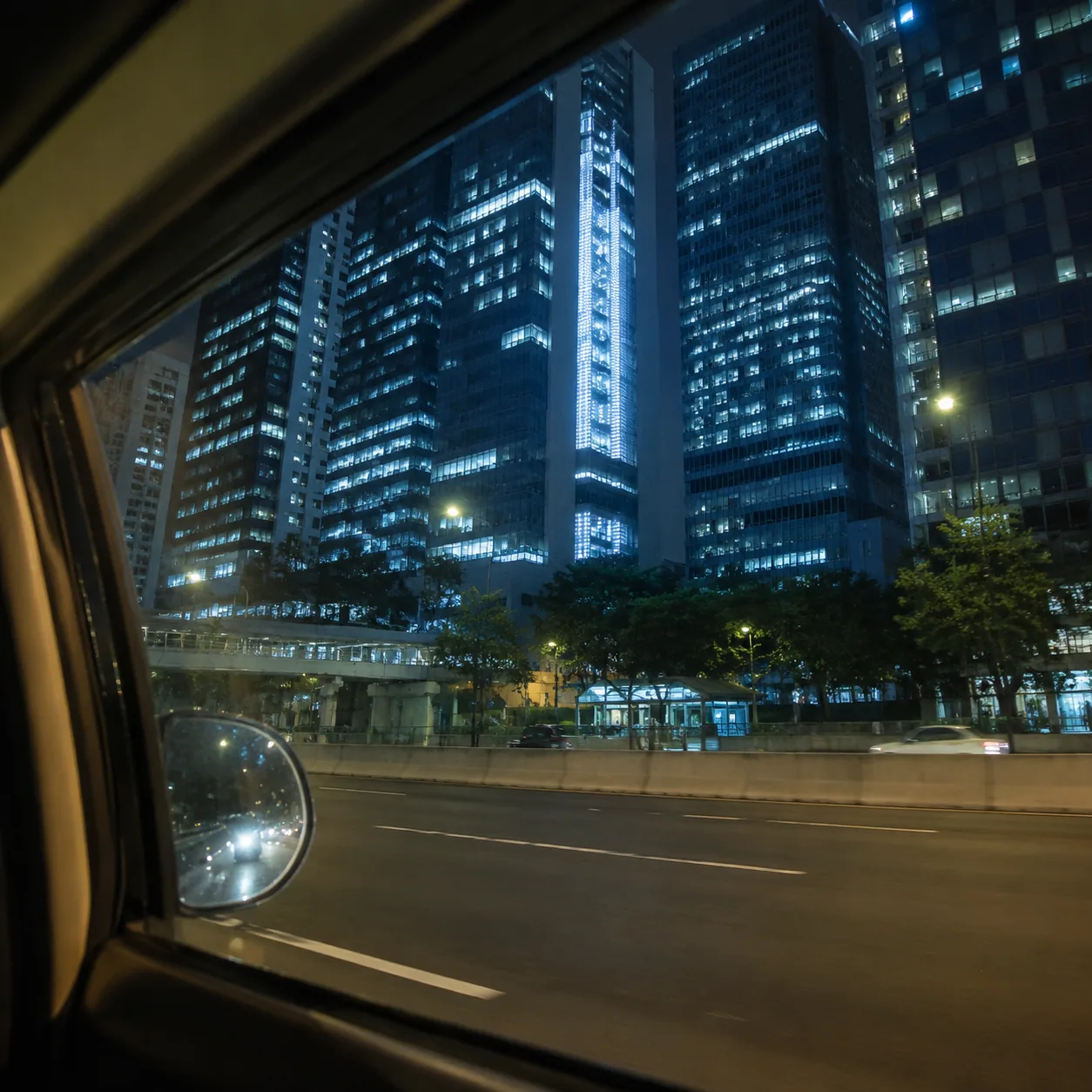
I landed in Shenzhen close to midnight, when the city should have been folding itself into sleep. Instead, the taxi window showed towers still lit like vertical screens, reflecting street lamps, billboards, and the red tails of passing cars. I had assumed that a new city at that hour would send me straight into the hotel: shower, curtain, bed. But when my suitcase stopped at the lobby door, I realized I was wide awake and hungry. The receptionist said there was a convenience store around the corner, open twenty-four hours, only three minutes away on foot.
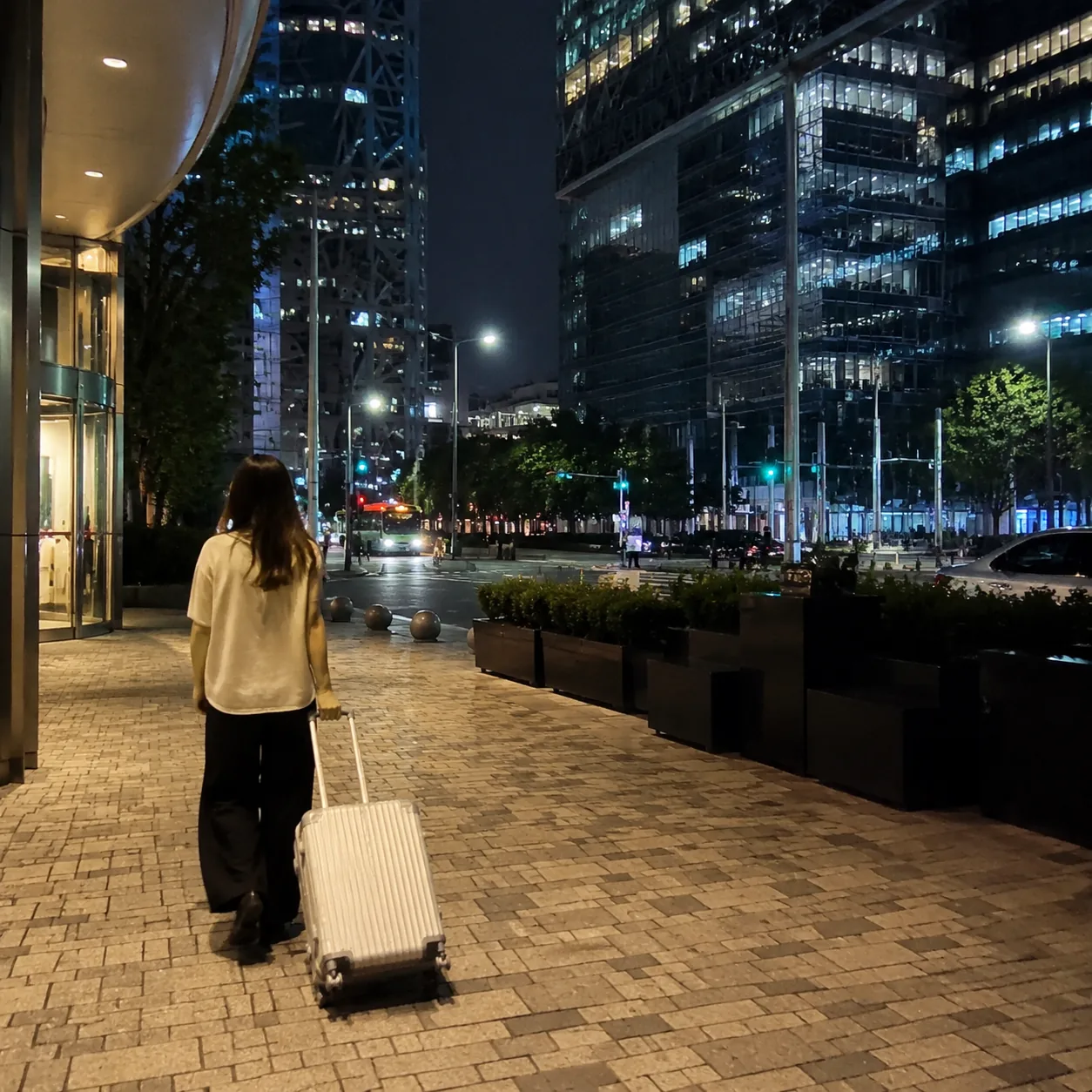
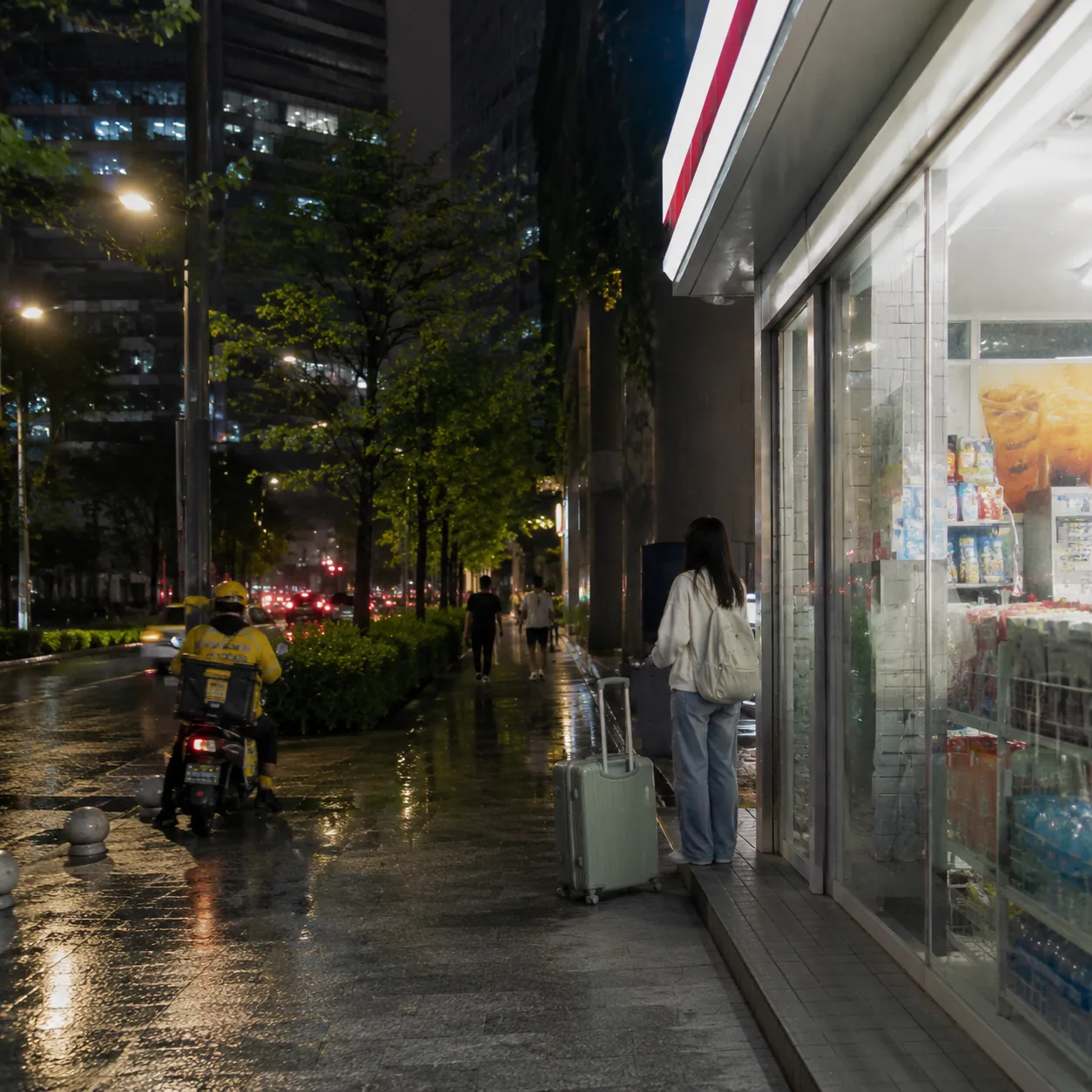
Those three minutes became my first real memory of Shenzhen at night. The road was not wide. Office buildings stood along it, their turnstiles quiet, their security guards sitting with phones in hand. Delivery riders passed me with warm food containers in their baskets. The sidewalk shone after rain, leaves held small drops of water, and the streetlights pressed every shadow close to the ground. I walked slowly with my suitcase, yet I did not feel the usual tension of a late-night street. It was not because the place was as crowded as daytime. It was because the city seemed awake in an orderly way: some people working, some going home, some waiting for rides, and no corner abandoned entirely.
When I pushed open the door, cool air from the air conditioner met the steam of oden at the entrance. The sensor chimed, and the clerk looked up with a quiet welcome, as if confirming that I had stepped into a small bright zone. Nothing on the shelves was extraordinary: rice balls, bottled water, yogurt, tissues, charging cables. Every city has these things. Yet under the fluorescent lights they looked unusually dependable. A man in a shirt waited for his boxed meal at the microwave. A young woman with a laptop bag chose gum. Two riders stood by the cashier checking order numbers. Nobody bothered anyone, but everyone added presence to the room.
I took a bottle of water first, then hesitated in front of the hot-food counter. Fish balls, radish, and knots of kelp floated slowly in broth. Beside them were warm soy milk and tea eggs. The smell was not fancy, but it was deeply calming, as if it understood that people traveling at night did not need to be impressed; they needed to be cared for. I bought a rice ball, a skewer of fish balls, and a cup of hot soy milk. The clerk handed me the receipt and pointed to the microwave on the left in case I wanted to heat anything. She said it so naturally that it sounded as though the night had always kept a light on for strangers.
I sat on a high stool by the window and ate while Shenzhen kept moving outside. Ride-hailing cars stopped and left. Delivery riders fastened helmets. Someone came out of an office building while speaking quickly into a phone. The convenience store glass framed these scenes like a city documentary without dramatic conflict. Safety is not an easy word for travel writing; it can become abstract or slogan-like too quickly. Yet that night I understood that some forms of safety do not come from grand explanations. They come from precise things: a transparent door, a row of lights, a microwave that can warm your food, and a clerk who answers when you speak.
In many travel stories, night is used as a stage for adventure. People praise alleys for atmosphere, bars for secrecy, and streets after midnight for excitement. Shenzhen’s first lesson to me was not excitement but predictability. Predictability may not sound romantic, but it matters. You know there is a store around the corner. You know it has hot water and outlets. You know you can buy a cable if your phone is dying. You know hunger does not have to wait until morning. When a city can offer these ordinary certainties after dark, your body relaxes first, and only then do you have room to like the place.
I noticed that people entered and left quickly, yet most kept a small courtesy. Someone bought cigarettes and left after paying. Someone charged a phone in the corner while answering messages. Someone carried two sports drinks, looking as if overtime or training had just ended. The clerk restocked shelves, flattened empty cartons, and moved with practiced quietness. Nobody treated this place as an attraction. Nobody tried to make it into a memory with a photo. That was why it revealed something travel often misses: the moment a city truly catches you is often not in front of a landmark, but when you are tired, hungry, and less sure of your direction.
The next day I visited Futian and Nanshan and saw the Shenzhen that appears more easily in travel articles: towers, checkpoints, malls, metro lines, and seaside parks. Everything suggested a fast city. Yet I kept thinking about the convenience store from the previous night. Daytime Shenzhen displayed capability; the nighttime store displayed the base layer. Under the dazzling buildings and industrial narratives was a dense everyday network: convenience stores, metro stations, security booths, shared bikes, delivery systems, night-shift workers. They do not compete for attention, but they keep the city usable outside standard hours.
This usability is especially precious to travelers. When you arrive somewhere new, the first fear is not always missing the best sights. It is not knowing what to do when something small goes wrong. The suitcase is too heavy, the stomach too empty, the phone nearly dead, the hotel address confusing, the rain sudden. These problems rarely appear in brochures, but they shape your first judgment of a city. The Shenzhen convenience store did not solve a grand problem for me. It simply allowed me not to pretend to be tougher than I was. It reduced a complex city into a room I could understand: where the door was, where the water was, where the food was, where the people were.
I also realized that the store’s sense of safety did not appear from nowhere. Behind it were supply routes, night shifts, street lighting, mobile payment, and enough foot traffic and commercial demand. The traveler sees a cup of warm soy milk; the city’s operators support the system that makes the cup available at midnight. Shenzhen is often described with words such as young, efficient, and innovative. Those words are not wrong. But that night I preferred another description: connected. Not merely connected to the internet, but connected in the sense that urban service had not gone offline.
After sitting for a while, I began to hear more details. The refrigerator hummed softly. The door chime sounded every few minutes. The microwave gave a short beep when heating was done. The clerk and riders discussed order numbers quickly but without irritation. Someone asked for bandages, and the clerk took them from under the counter. Someone asked when the nearby metro opened, and another customer answered casually. This kind of help was too light to become a sentimental story, yet it formed a low-intensity reliability. It did not require people to know one another. It only required public space to keep basic kindness and function intact.
I used to think about urban safety in broad terms: public order, cameras, institutions, rules. Those are important, of course. But a traveler’s body is also shaped by smaller scenes. You enter a shop: is the light harsh but steady? You ask a question: does someone answer? You sit down to eat: do you feel in the way? You pass an intersection late at night: can you still see ordinary people doing ordinary things? Safety is not always a promise that risk is absent. Sometimes it means risk is not enlarged by loneliness. That Shenzhen night gave me exactly that: a night road not magnified by being alone.
Over the next few days, I entered several convenience stores at different hours. In the morning people bought coffee and buns. At noon they bought boxed lunches. In the evening students bought ice cream. Late at night the customers became travelers, overtime workers, riders, and outsiders like me. Each hour gave the store a different expression, but all of them filled the gaps of the city. If you missed mealtime, there was an alternative. If rain grew heavy, there were umbrellas. If the hotel room felt too quiet, there was a bright place to pause. These stores did not promise surprise. They promised to remain open.
This made me rethink the word convenience. It is not only speed, proximity, and easy payment; it is also an emotional buffer. In an unfamiliar city, small matters can grow large because every choice is tied to unfamiliar roads, uncertain prices, and the worry of bothering someone. A convenience store reduces the scale of choice. With minimal social cost, you get basic supplies. You do not have to explain why you are outside at this hour. You do not have to prove that you understand local rules. You do not have to turn a simple purchase into a negotiation. You push the door open, choose something, pay, and sit for a while.
Of course, I do not want to romanticize a convenience store into something unreal. Night shifts are hard, and the stability of urban service often rests on many people’s fatigue. A clerk’s patience, a rider’s rush, a cleaner’s work, a guard’s watchfulness—none of these exist so that visitors can write beautiful feelings. That is why this sense of safety deserves serious attention. It is not an accessory to scenery; it is infrastructure for urban life. When travelers benefit from it, we should recognize that it comes from concrete labor, not from a city’s atmosphere playing automatically in the background.
On my last night in Shenzhen, I passed the first convenience store again. This time I did not go in. I only stopped outside for a moment. The glass door opened and closed. Light spilled onto the sidewalk. A rider tucked a drink into his basket. The clerk lowered her head to arrange the counter. Nothing happened at that corner that deserved a photo, yet I suddenly felt that a night with nothing dramatic happening was itself an urban capability. Letting someone buy water smoothly, return to the hotel smoothly, and end the day smoothly sounds too ordinary. After enough travel, you learn that ordinary smoothness is not ordinary at all.
If someone asks what I remember most about Shenzhen at night, I may not begin with the skyline or a famous mall. I will remember that convenience store: the high stool by the window, the paper cup of warm soy milk, the microwave beep, and the wet sidewalk shining after rain. They did not turn Shenzhen into an unrealistically gentle city. They made me believe that in a city running at high speed, a stranger could still find a brief, bright, dependable place to stop. For me, that is another kind of urban safety: not being welcomed with ceremony, but being treated normally even late at night.