Miao Embroidery and Batik: In Guizhou, I Saw Mountains and Rivers Written on Cloth
If I had to recall the quietest yet most powerful day from my trip in Guizhou, I would immediately think of the first day I truly paid attention to Miao embroidery and batik. As a foreign traveler who has spent a long time moving around Asia, I had assumed I already understood what “tradition on cloth” meant. After all, in Indonesia I had watched Javanese batik artisans draw patterns little by little with wax tools, and I had seen how different islands treat textiles as part of identity, ritual, and memory. But the moment I entered a Miao village in Guizhou and saw Miao embroidery and wax-resist dyeing up close, I realized at once that what I had known before was only the surface of the word “craft.”
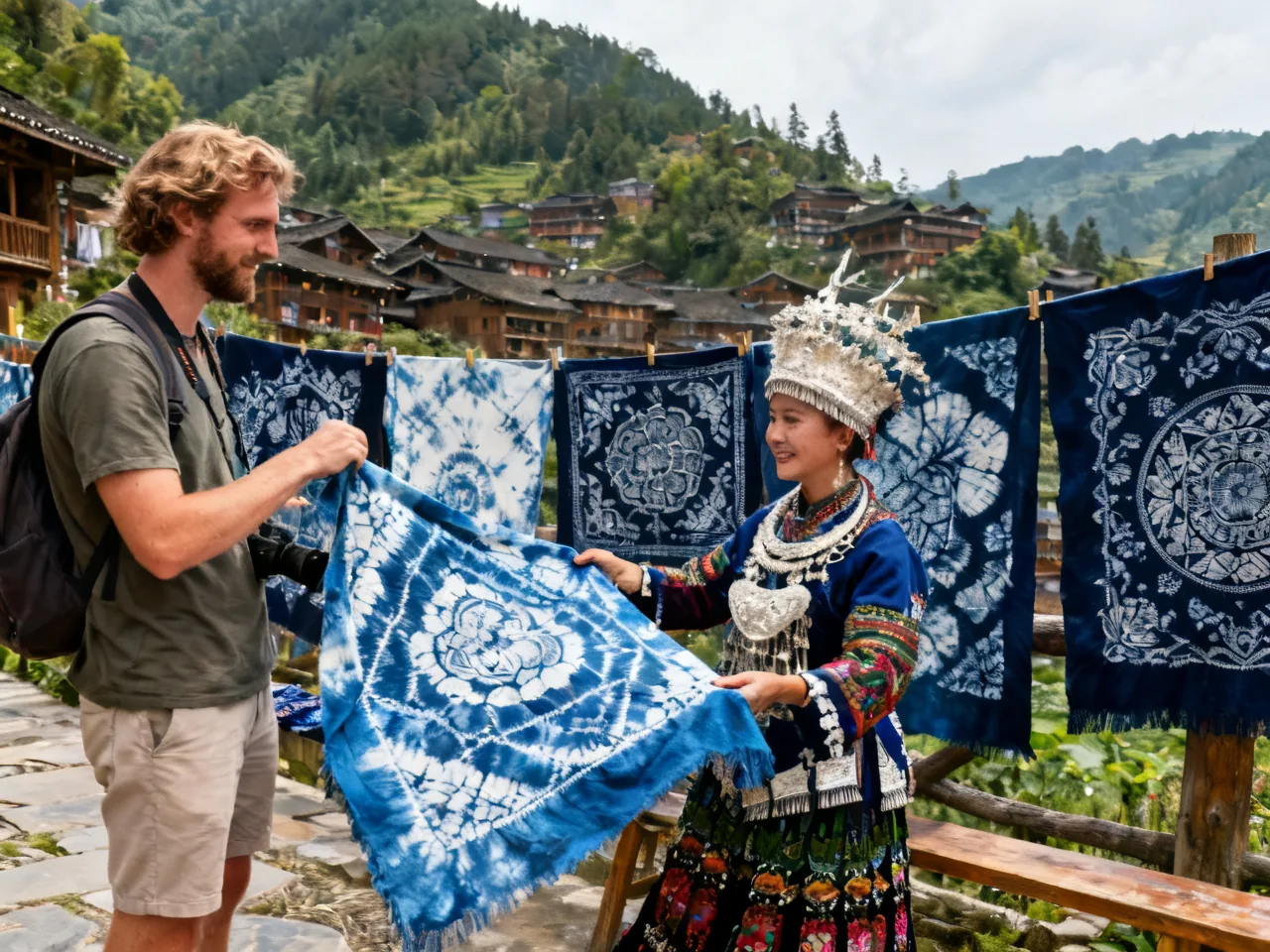
The mountain air that day was damp, and the stone path reflected a little light from recent rain. As I slowly walked deeper into the village, what first captured my attention was not the architecture but the clothing and textiles. Dark blue skirts, densely layered patterns, and stitching that seemed to overflow from collars and cuffs kept making me stop and look again. These were not the kind of “ethnic-style decorations” displayed in shop windows for tourists to photograph. They were naturally worn on people’s bodies and appeared on baby carriers, aprons, bags, and household cloths. At that moment, I suddenly understood that a tradition that is truly alive enters daily life without effort.
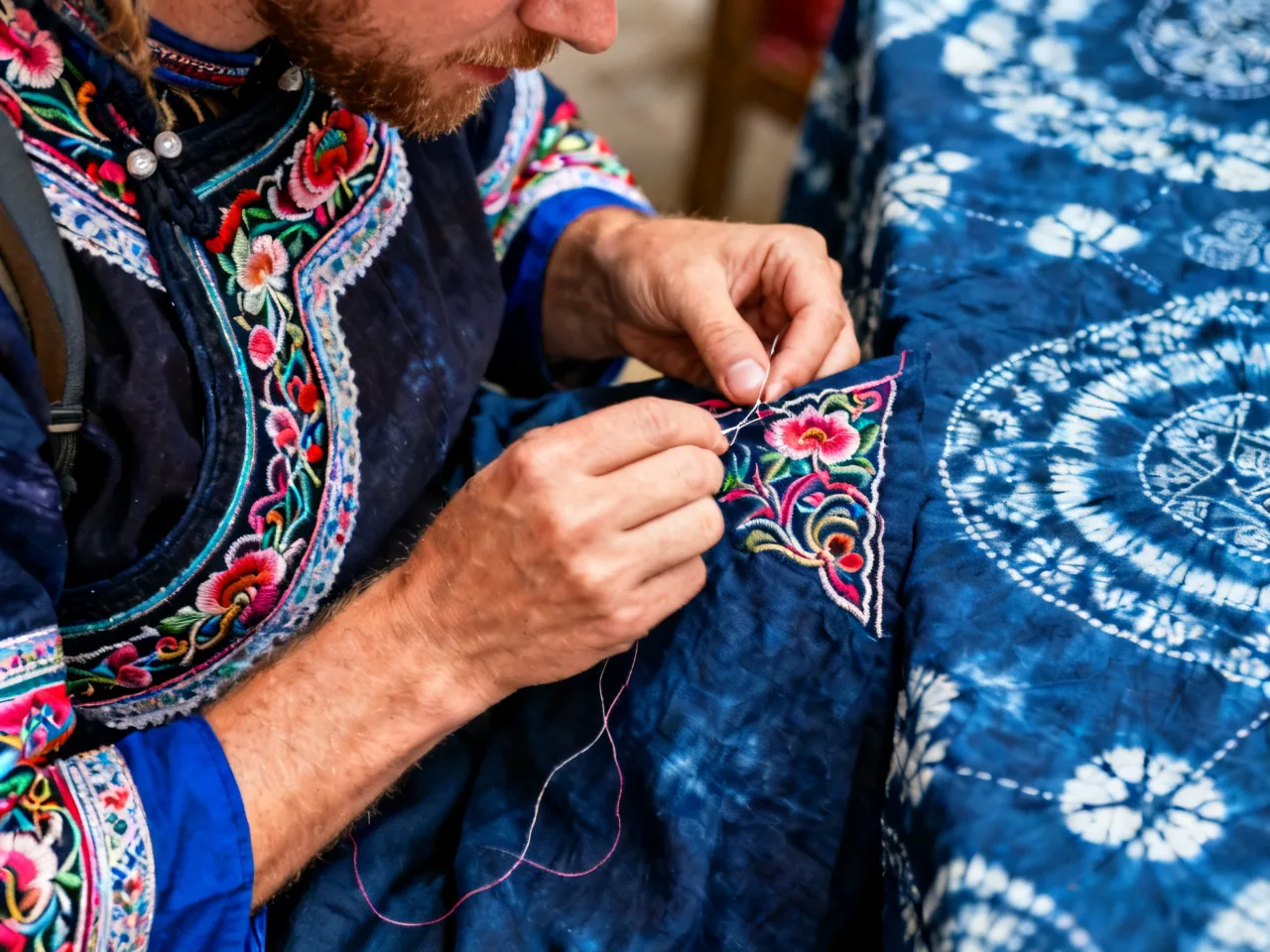
Later, I sat beside a Miao auntie and watched her continue her embroidery. She did not slow down for effect, nor did she turn the act into a performance for outsiders. She simply lowered her head, threaded the needle, and drew the thread through the cloth as naturally as breathing. Precisely because of that, I was even more moved. Her stitches were astonishingly fine, and the patterns on the fabric pressed layer upon layer with almost no careless space anywhere. From far away, I saw flowers, butterflies, birds, and fish; from close up, they began to resemble topography, waterways, or some code remembered across generations. As an outsider, I could not possibly understand every motif at once, but I could clearly feel that these designs did not exist merely to look beautiful.
The answers I received when I asked about these motifs were also fascinating. No one handed me a standardized explanation. Instead, it felt as if a story archive had been opened: butterflies could point toward old origin legends, fish toward vitality and fertility, while birds, flowers, water patterns, and terraced-field motifs connected to the natural environment, memories of migration, and family hopes. Listening to these interpretations, I did not think of museum labels. I thought of language. Miao embroidery felt to me like a complete writing system without an alphabet. When someone wears clothing like this, they are not simply wearing decoration. They are wearing collective memory.
This naturally made me think of Indonesian textile and batik traditions. In Java, certain batik patterns were historically associated with royalty, rank, or region, and could not simply be worn in any setting. In Sumatra or Bali, some textiles are still closely tied to weddings, rituals, and stages of life. Miao embroidery gave me a feeling very close to that experience: patterns are never neutral, and behind them there are always social relationships and cultural grammar. But the temperament of the two is not identical. Indonesian batik often gives me a stronger sense of order, repetition, and rhythm, while Miao embroidery feels more like myth, nature, and emotion being stitched into one piece of cloth all at once. It is denser, and more eager to tell stories.
What I felt most strongly while watching the embroidery was actually slowness. In travel today, we are too easily trained to consume everything quickly: photograph quickly, judge quickly, buy quickly, and leave quickly. But Miao embroidery belongs to a completely different time. If you sit beside it for even a few minutes, you immediately understand how much patience a complex embroidered piece requires. Every stitch demands steadiness, every color choice depends on experience, and every local detail must obey the rhythm of the whole. Its beauty exists precisely because it cannot be rushed. At that moment I even felt a little ashamed, because I too often evaluate traditional crafts through the lens of modern efficiency: Is it worth it? Is it too expensive? Is there any need for it to be this slow? But once I sat there, those questions suddenly felt too impatient.
If Miao embroidery felt like an intense and complicated song, then batik appeared to me more like a quiet poem. Because I had already seen Indonesian batik before, the idea of using wax as a resist in dyeing was not unfamiliar to me. In fact, I was almost a little too confident, assuming I could probably predict what Guizhou batik would feel like. But the moment I saw the finished pieces and the process up close, I realized I was wrong. What moved me most in Miao batik from Guizhou was the breathing space between blue and white. The white motifs did not seem harshly placed on top of a dark blue ground; they seemed to rise slowly out of the blue itself. Combined with the naturally formed crackles and ice-like lines, the cloth looked like stream water, wind, light frost, or moonlight suddenly appearing in a mountain night.
I stood there looking at those blue-and-white cloths until I was almost spellbound. Their patterns included butterflies, flowers, spirals, water motifs, and also some very geometric arrangements. But whatever the exact motif was, the overall character kept reminding me of mountain mist and moving water. Compared with some Indonesian batik styles that are warmer in color and more layered in visual complexity, Miao batik felt clearer, more restrained, and closer to the rhythm of nature itself. In Indonesian batik, one often sees the decorative density created through long histories of courts, trade, religion, and the tropical world. In the Miao batik I saw here, it felt instead as though mountain life had slowly left the landscape on cloth.
I especially loved what this comparison taught me. What the two share is the proof that a piece of cloth can exceed the definition of mere utility and carry identity, beauty, blessing, and memory. What differs is that they grow out of completely different geographies and cultural temperaments, so the languages they finally present are also different. Indonesian batik feels more like a pattern system shaped through a long historical sedimentation, often emphasizing continuity, symmetry, and repetitive rhythm. Miao batik, by contrast, made me feel a mountain people’s sensitivity to natural textures. It allows accidental crackles, the breathing of blank space, and the contrast between blue and white to participate directly in expression. One feels like order woven from tropical history; the other like poetry left behind by mountain air and water.
As I kept looking longer, I slowly realized that the most precious thing about Miao embroidery and batik was not simply that they are beautiful, but that they have never existed as isolated artworks. They are tied to marriage, festivals, family, intergenerational transmission, women’s labor, and regional identity. In other words, these crafts were not first invented to be admired and only later brought into life. On the contrary, they grew inside life from the beginning, which is exactly why they have the beauty we see today. This is very similar to what I have felt around certain traditional textiles in rural Indonesia. Cloth traditions with real vitality usually do not survive through display boards. They survive by being worn, used, gifted, and remembered.
As a foreign tourist, I also had to remind myself not to remain in the safe position of mere admiration. It is easy to say, “How beautiful,” and easy to take a few photos or buy a few souvenirs. But if that is all I do, then my respect for these crafts is still shallow. Miao embroidery and batik kept making me ask more: Who is making these things? How are these skills being passed on today? Do younger people still want to learn them? When the market fills with machine-made copies and cheap imitations, how can genuine handwork still be valued fairly? These are not easy questions, but they determine whether a tradition is merely consumed or actually understood.
Before leaving, I bought a small piece of batik cloth and a handmade bag decorated with Miao embroidery. They were not cheap, but as I held them in my hands, I knew very clearly that I was not merely buying objects. I was buying the time that had gone into making them, the cultural judgment behind the patterns, and also a reminder I had received that day in the village: the forms of beauty that remain in memory are often not the newest, fastest, or loudest ones, but the things quietly repeated and carefully guarded across generations. Back at my lodging, I spread the batik cloth on the table and looked at it for a long time. Under the lamp, the blue became deeper and the white looked like moonlight floating on water. Suddenly I felt that cloth may be especially suited to preserving culture precisely because it stays close to the body, accompanies people in life, and slowly grows old with them.
If someone asked me what stayed with me most after seeing Miao embroidery and batik, I would probably say this: they made me confirm once again that many traditional Asian crafts, though born in different lands, share a deep spirit—respect for materials, respect for the labor of the hand, and respect for the slow and lasting ties between people and community, and between people and nature. Miao embroidery and batik in Guizhou reminded me of Indonesian batik, but they are by no means copies of one another. On the contrary, it is precisely because both their similarities and their differences are so clear that I can better see the unique beauty of each tradition. As a passing foreign traveler, I am grateful that on that day I did not see only colors and patterns. I also saw, just a little, mountains and rivers on cloth, and the time hidden inside stitches and blue-and-white dye.