China Knowledge
In Kashgar, It Was Not a Landmark but a Fresh Naan Beside the Crossing That Made Me Stop
- A crossroads in Kashgar is like an eye that never fully sleeps, watching people from every direction gather slowly and disperse again. I stood at an intersection near the old city as the sun had not yet set completely, and the walls were warmed into an earthen yellow. Electric scooters slid gently past me, a child on the back seat gripping a piece of naan. An elder in a doppa cap waited for the green light with a cane. A young man carrying plastic bags full of fruit crossed quickly from one side of the zebra crossing to the other. The flow here is not mere crowding; it is a river with rhythm. It carries language, scent, color, and the weight of everyday life from every alley to the crossroads, then back into life again.
- At one corner stood a naan stall, fresh round breads piled beside the oven, sesame and wheat fragrance spreading through the heat. The vendor moved quickly, taking money with one hand and slipping bread into bags with the other, occasionally lifting his eyes to the signal light and crowd. On the other side was a fruit stand, pomegranates cut open so their red seeds shone like small lamps in the evening light. Some people stopped to ask prices; others only glanced while passing, their steps never fully pausing. The Kashgar crossroads therefore has a special layering: traffic flows, trade continues, neighbors greet one another, travelers look around. Each movement is different, yet the same traffic light temporarily arranges them together.
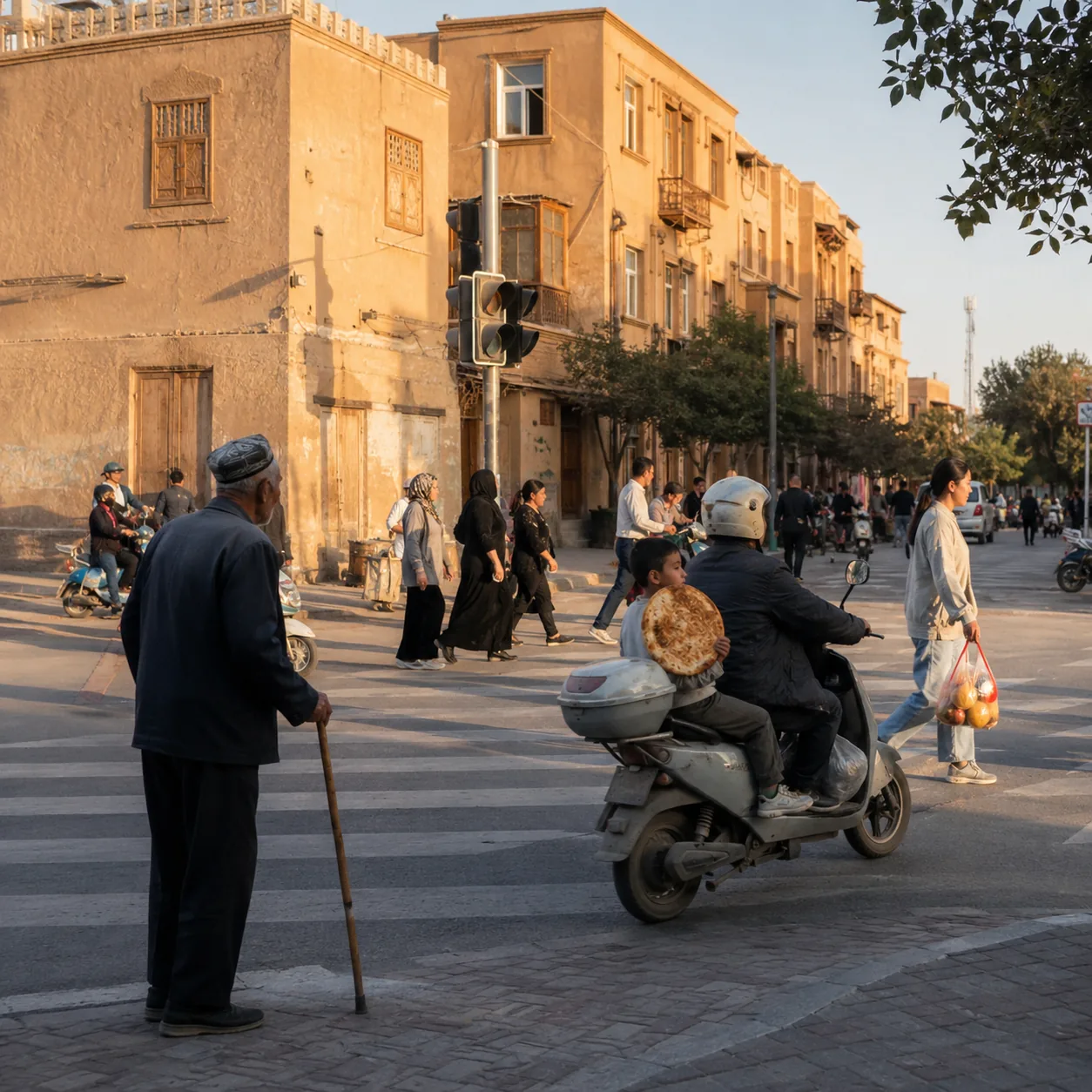
- While waiting for the light, I heard several kinds of sound overlapping. Cars hummed low, scooter bells rang briefly, vendors called with rising endings, and children’s laughter jumped out from gaps in the crowd. Uyghur, Mandarin, and occasional English crossed in the air. Some I understood and some I did not, but all felt as if they belonged to this place. The truest part of the crossroads lies in these rhythms that do not need translation. People watch the lights, yield to vehicles, wave, turn sideways, speed up or slow down; bodies communicate before language does. When one stranger pauses slightly, another passes naturally, and order forms inside this tiny tacit understanding.
- The buildings of Kashgar’s old city spread around the intersection: earthen walls, wooden lattice windows, arched doorways, and new shop signs standing beside one another. In slanting sunlight, the textures on the walls were as clear as palm lines. The passing crowd kept changing the center of the scene: a group of schoolchildren suddenly brightened the corner, a man pushing a cart of melons made the intersection feel grounded, and several women in vivid dresses seemed to ignite the whole zebra crossing with color. Standing still, I realized a crossroads explains Kashgar better than any viewing platform. A platform lets you overlook a city; a crossroads surrounds you with it and lets you hear its breathing.
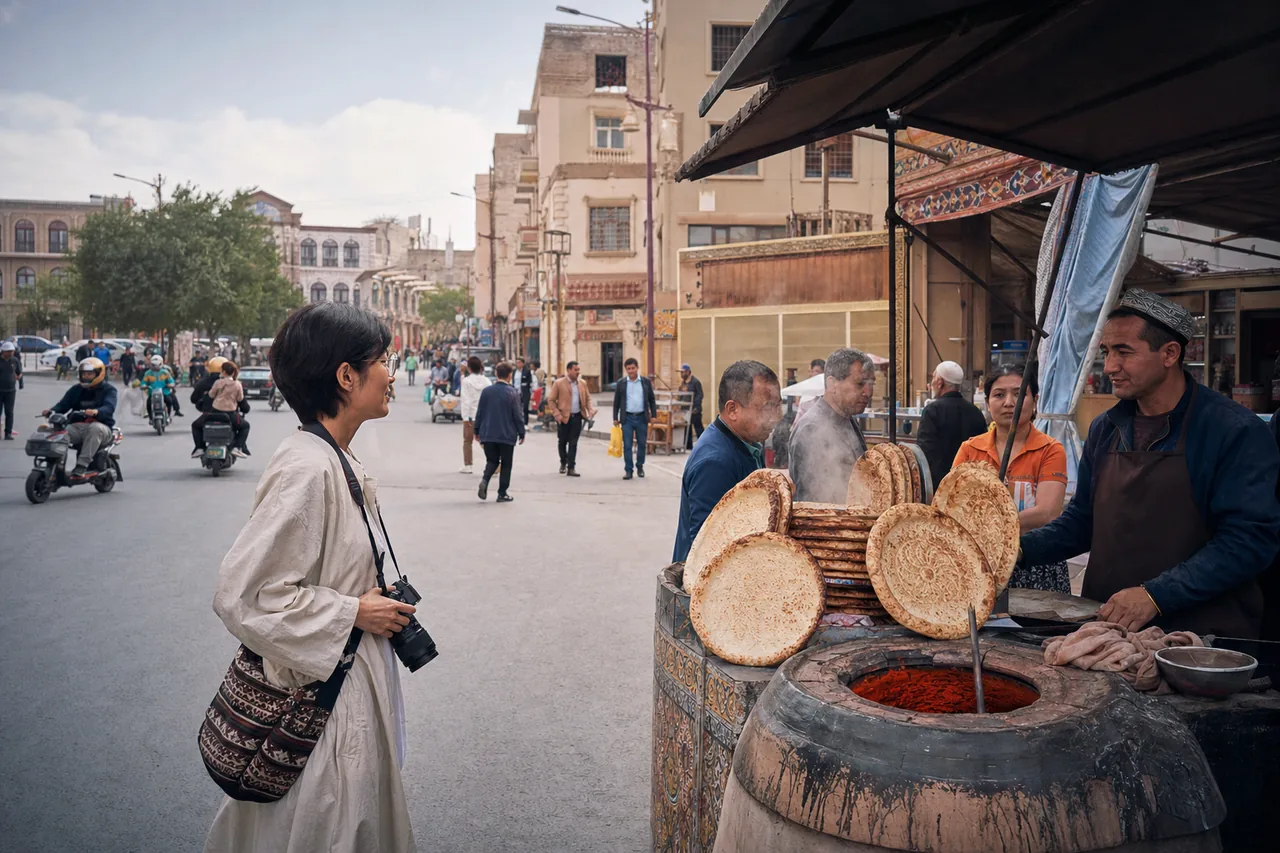
- When the red light came on, the crowd gathered in a curve at the roadside. Some looked down at phones, some pulled children closer, and some used the pause to adjust headscarves. A few seconds of waiting reset everyone’s speed to zero and made observation possible. I saw an elder break off a small piece of naan and hand it to the grandson beside him, who immediately took a bite. I saw two young people wave across the traffic and laugh loudly. I saw a delivery rider brace one foot on the ground, eyes fixed ahead, ready to leave as soon as the light turned green. Waiting at a crossroads is not empty; it is filled with moments in which life adjusts its posture.
- When the light turned green, the crowd moved forward as if gently pushed. No one truly ran, yet everyone knew the direction they should take. Elders moved more slowly, and people naturally circled around them. Children stepped with little jumps while mothers held their hands steadily. Cyclists lowered their speed and passed behind pedestrians. At that moment I thought that a city’s character often hides at its intersections. Broad avenues can display planning, grand buildings can display ambition, but crossroads show how people make room for one another. A Kashgar crossroads has warmth and patience. Many directions cross here, yet they do not hurry to push one another away.
- A teahouse beside the crossroads kept its door open, the light inside yellower than the sunset outside. Several men sat by the window drinking tea from small cups, their movements slow while their eyes remained on the street. The teahouse was like a bank, the crowd at the intersection like a river, and the people inside were both within life and slightly apart from it. As I passed the door, the scent of tea mixed with dust, forming a balance particular to Kashgar: dry yet warm, rough yet close. People say that in Kashgar one should see old city architecture, bazaars, and mosques. I think one should also watch an ordinary crossroads and see how people, without noticing, live the city into their own shape.
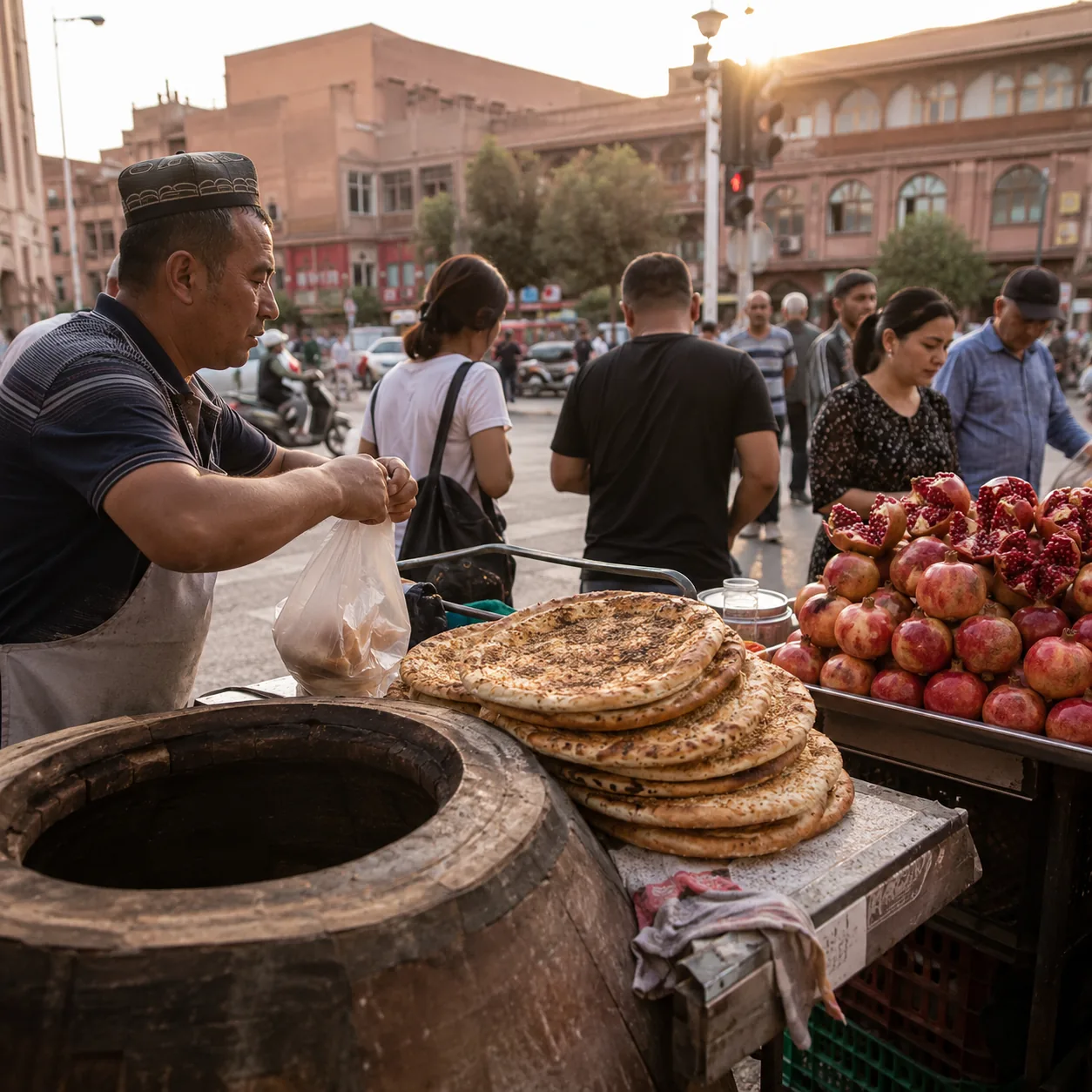
- After the sky darkened, streetlights and shop lights took over the pavement. The clear earthen yellow of daytime softened, characters on signs began to glow, and vehicle headlights cut the zebra crossing into segments. The flow of people did not decrease; it simply changed speed. People carrying groceries started home, those heading toward the night market increased, and children were more excited than adults, circling around their parents. Kashgar’s night does not become lively all at once; it is gradually lit by many crossroads. Each intersection has a small cluster of voices, a small patch of light, and a little food aroma. Connected together, they give the whole city its nighttime outline.
- I crossed the zebra crossing with the flow once, then returned from the other side. The first time I only looked ahead; the second time I noticed details underfoot: the edges of the white lines had been grayed by tires, the road surface held shallow cracks, and a few pomegranate seeds had been crushed, leaving tiny red marks. In travel we often chase distant landmarks and overlook evidence beneath our feet. The crossroads gathers such evidence: a dropped glove, a paper slip with prices written on it, a row of bicycle tire marks, a few sesame seeds fallen from naan. They are small, but they prove the city is not an abstract name. It is a scene continuously written by countless footsteps.
- An elder selling doppa caps had set up not far away, the patterns on the caps fine and bright under the light. I stopped to look, and he picked up several to show me. Although language did not fully connect us, smiles and gestures were clear enough. Local customers were choosing beside me; the elder greeted them first, then turned back to me, the order natural and without distance. Trade near a crossroads often carries this temporary intimacy: you may stop for only three minutes, yet you are treated seriously; you may buy nothing, yet receive a nod. The crowd in Kashgar does not swallow strangers. Instead, in a certain glance or gesture, it often makes a place for them.
- At night, wind rose and dust moved lightly along the ground, turned by headlights into a thin mist. The sounds of the crossroads did not disappear with the deeper night; they shifted from daytime brightness into nighttime depth. Music came from far away, bargaining from nearby, and a motorcycle gave a brief shudder as it started before quickly joining traffic. After standing for a long time, I began to distinguish directions within the crowd: some people were going to eat, some returning home, some heading to work, some simply walking. Different directions did not prevent them from sharing the same crossroads. A city is built from such sharing, even if what is shared is only a few seconds of green light and a patch of pavement under a lamp.
- I thought of how Kashgar often feels distant in many people’s imagination, as if it lies at the edge of the map and the edge of narrative. But standing at this crossroads, distance was gradually diluted by the flow of people. There was no loneliness of an edge here, only the busyness of a center; no abstract exoticism, only concrete life. A child handed leftover naan to the mother, a driver rolled down the window to ask directions, a vendor pressed change beneath a fruit bag so the wind would not carry it away. Such actions could happen in any city, yet because they happened in Kashgar’s light and dust, they carried an irreplaceable texture. The crossroads turns faraway into present and brings imagination down to the ground.
- Before leaving, I stopped for one more cycle beside the red light. The crowd gathered, the green light came on, the crowd dispersed. The process was as ordinary as breathing, yet I could not look away. Perhaps the best moment in travel is not standing before a famous site to confirm that you have been there, but suddenly realizing at an ordinary crossroads that people here are also rushing, waiting for someone, buying dinner, looking after children, and preparing for tomorrow. Kashgar therefore stops being only a distant name and becomes a warm current passing beside you. It surges from the crossroads and spreads into deep alleys, leaving bicycle bells, naan fragrance, lamplight, and human voices lingering in memory.
…