The Moment I Properly Parked a Shared Bike Outside the Metro, I Understood That Locking It Is Not the End
The first time I rode a shared bike to a metro station during Hangzhou’s morning rush, I had only one thought in my head: do not be late. The morning air still carried a trace of coolness left over from the night, but outside the station everything was already fully awake. Steam rose from breakfast stalls. Soy milk cups and plastic bags swung in people’s hands. Electric scooters slid past one after another on the side road, while warning chimes, brake sounds, and the distant voice of buses announcing stops layered over each other. What stood out most was the huge patch of shared bikes by the metro entrance. Yellow, blue, and green frames were crammed together. Some sat neatly along the parking lines. Others leaned diagonally across neighboring handlebars. A few were simply dumped sideways at the edge as if someone had abandoned them in a rush. At that time, as a foreigner still learning the tempo of Chinese city life, I naturally assumed that once I reached the station, locked the bike, and saw the charge stop on my phone, the task was finished.
I almost parked in the worst possible place. That morning I followed the crowd to the station entrance, saw that there seemed to be little room left, and turned my handlebars as if I could just wedge the bike diagonally against a row of others and hurry into the station. Just as I was about to lock it, a parking assistant in a reflective vest raised a hand to stop me. He was not harsh. He only said, “Don’t leave it here. The tactile path has to stay clear.” I looked down and realized that the yellow tactile paving with raised dots was running straight through the middle of the sidewalk beneath me. If I had left the bike there at an angle, the back wheel would have blocked it exactly. In that instant I felt a sharp flush of embarrassment. In my own mind, I had only seen a gap where one more bike could probably fit. In other people’s daily routes, it was a line that absolutely had to remain open.
I pushed the bike away and walked a few meters before noticing that the parking boxes on the ground were actually quite clear, only less visible beneath the rush-hour crowd and the tangle of bike frames. More importantly, I began to notice that people who really knew how to park did not just “find a spot and leave.” In a matter of seconds, they ran through a whole set of judgments: whether the handlebar direction would block someone trying to pull out the next bike, whether the frame crossed the tactile path, whether the back wheel jammed the narrowest corner of the sidewalk, and whether a fallen bike there could knock down a whole row. Some people, after parking their own bike, even straightened the one beside it if it had been nudged crooked, restoring the row to the painted line. Those few seconds may look tiny, but they determine whether that station entrance will feel smooth or chaotic for the next half hour.
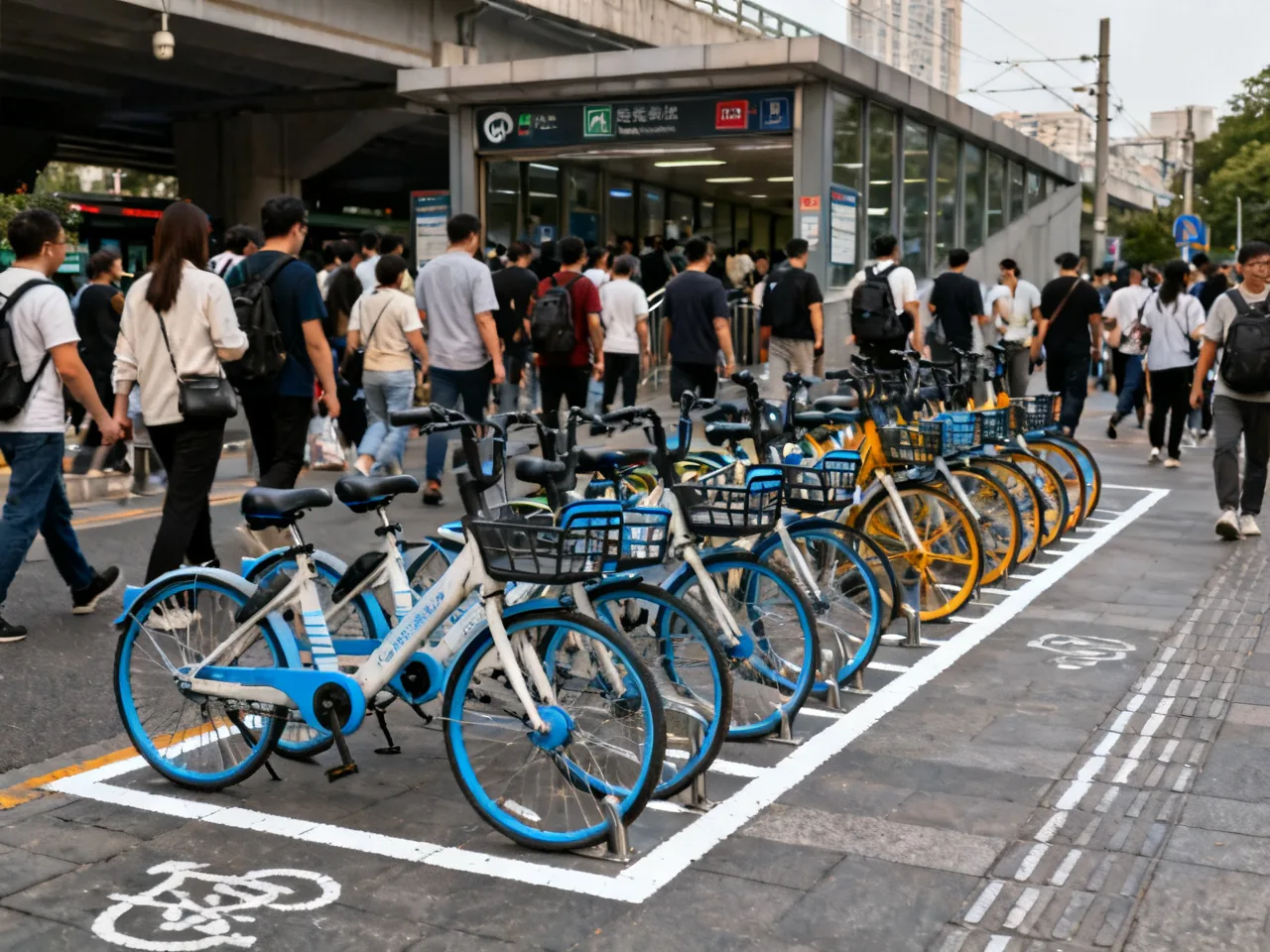
Over the next few days, I deliberately lingered nearby and watched more closely. That was when I realized that a shared-bike parking zone is an excellent example of a practical public understanding in Chinese cities. Everyone is in a hurry. That much is obvious. Some people are checking their metro QR codes while walking. Some are jogging toward the station with laptop bags bouncing on their shoulders. Some lock their bike with one hand while holding breakfast buns in the other, moving as if the sequence were rehearsed. Yet even in that rushed state, many people still instinctively leave the next step open for others. One rider pushes the bike into the painted box and then lifts the back wheel slightly so it aligns better with the row ahead. An office worker notices their handlebar has hooked another bike’s brake cable and immediately steps back to fix it. Some people even scan out and then return a few steps to raise a bike that has fallen over. Nobody stands there making speeches about civic behavior, but whether a row of bikes stays orderly often depends on exactly those unpraised movements.
I used to think the most important thing about shared bikes was that they should be easy to unlock, easy to ride, and easy to return. Later I understood that “easy to return” is not as simple as a successful screen on the app. Especially around metro entrances, where space is dense, returning a bike is not only a transaction with a platform. It is also a handoff to a crowd of strangers on the ground. If you park carelessly, an older person may have to detour around you. If you jam your bike in at an angle, the next person trying to pull one out may have to yank twice. If you save yourself two seconds by pressing a bike into the edge of the tactile paving, the person who really pays is the one who cannot see your small laziness. For foreigners, this is especially easy to miss, because it is tempting to understand bike sharing as a purely personal convenience tool. In a place where usage density is this high, though, it behaves more like a public interface passed from one person to the next.
One evening during the commute home, I saw a row of bikes parked in complete disorder, with the outermost one almost lying across the space between the tactile path and a short step. A mother pushing a stroller got stuck there and had to lift the front wheels slightly to squeeze through. She did not get angry. She only frowned and adjusted the stroller’s angle. That scene stayed with me because it showed how the consequence of parking badly often does not fall on the person who did it. It falls on whoever arrives next. That is why, the more I thought about it, the more that assistant’s reminder—“the tactile path has to stay clear”—felt less like a scolding directed at me and more like someone speaking in advance for a whole line of people I could not yet see.
Following the same way of reading a scene, [中国城市公共秩序观察] and [中国地铁口的人流节奏] also reinforce this habit from other angles.
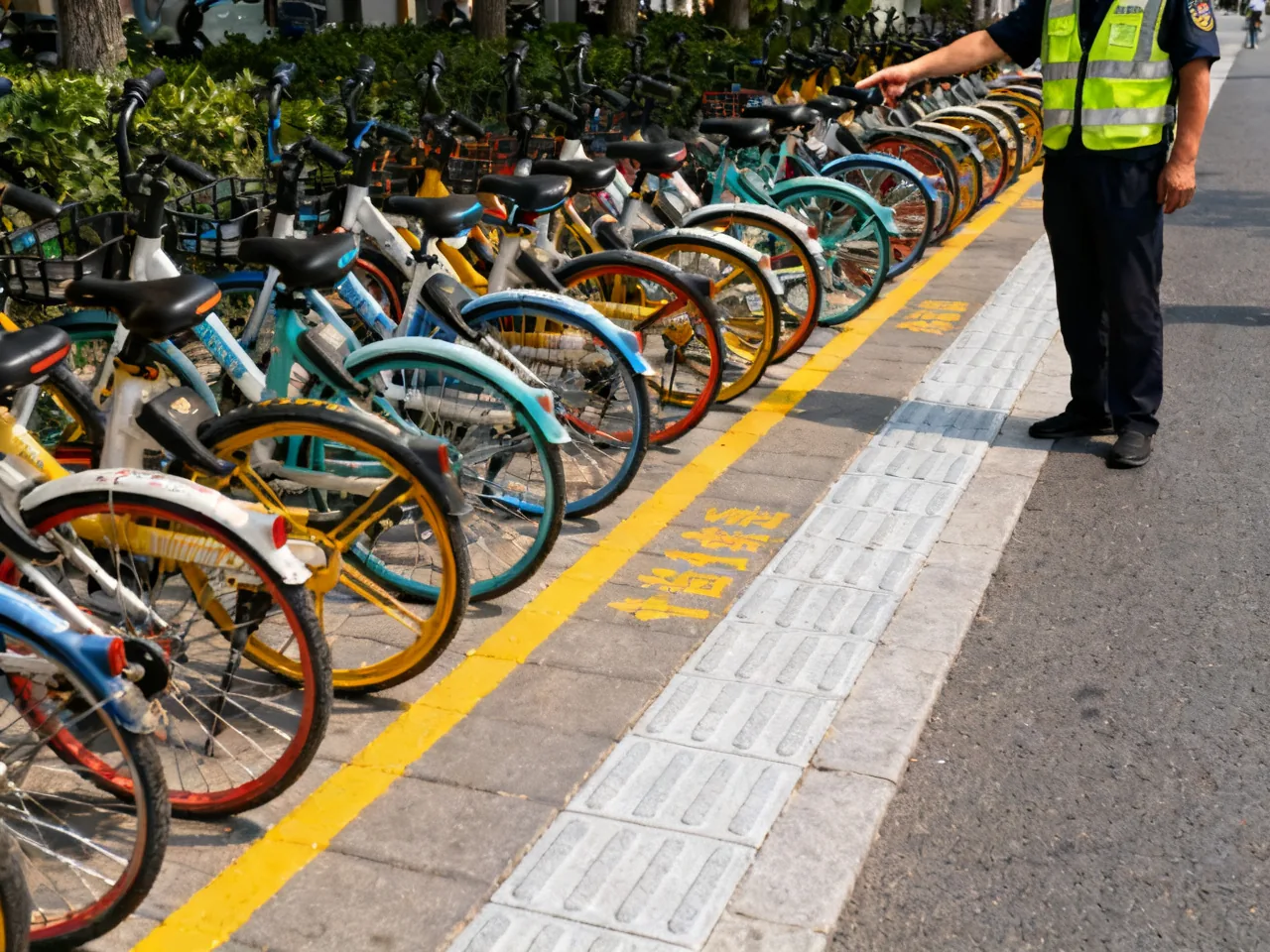
Now, every time I ride a shared bike to a metro entrance, I leave myself a few extra seconds. First I look for the painted parking line, then the tactile path, then whether my own bike will make the next one harder to pull out. If the area already looks messy, I will even straighten one crooked bike nearby, because I know this is not some grand moral act. It is simply finishing my own part properly. If a friend newly arrived in China asks me what rule about shared bikes is easiest to miss, I would say it is not how to scan the code and not how to lock the bike. It is not treating “ending the ride” as something that ends only for yourself. In many high-frequency public spaces in China, the more mature habit is to ask, before leaving, how what you leave behind will affect the next person. For me, learning to leave that little bit of space for the tactile path and for the flow of people was the moment I truly learned how to return a bike here.