How Far Can a Bowl of Noodles Take You: Measuring the Northwest by Wheat
How many kinds of noodles exist in China? There’s no definitive answer, but a rough consensus holds that Shaanxi Province alone has dozens — saozi noodles, oil-splashed noodles, biang biang noodles, fermented water noodles, stick noodles — with every county potentially claiming its own variation. Factor in Gansu, Ningxia, Qinghai, and Xinjiang, and the Northwest’s noodle map becomes staggering in scope. Not because people here lacked imagination for other foods, but because wheat has grown on this land for thousands of years, and flour long ago became the Northwest’s native language of creativity.
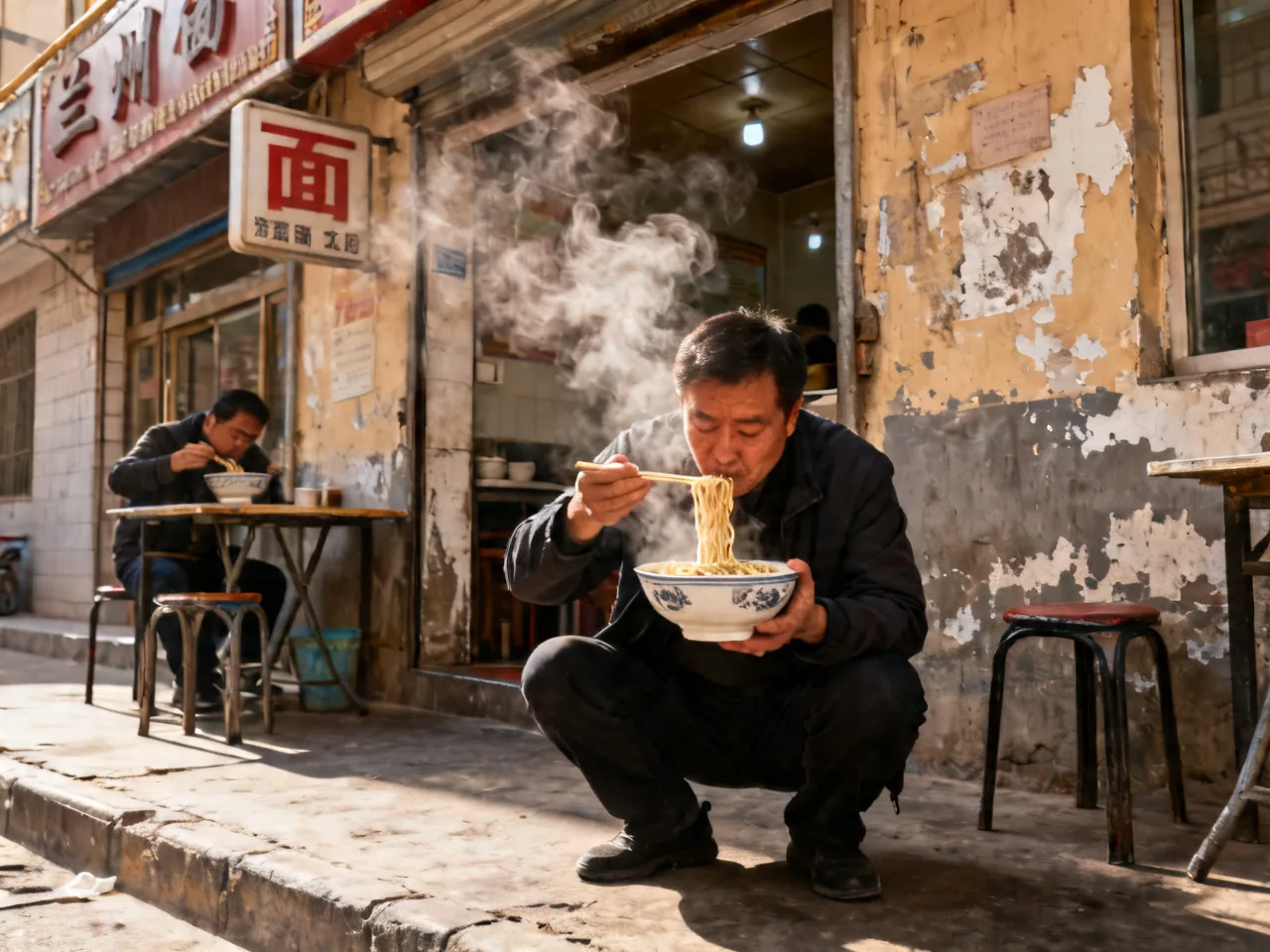
Researchers have noted an interesting phenomenon: Lanzhou locals rarely say “Lanzhou lamian.” They say “beef noodles,” or simply “niu da” — shorthand for a large bowl of beef. “Lanzhou lamian” is largely a label applied by the outside world as the dish spread nationally. In Lanzhou itself, the identity of this bowl is far more modest — it’s breakfast, a ritual that must be completed before 7 AM.
At 6:30 AM outside a beef noodle shop that’s been open for thirty years in central Lanzhou, twenty-odd people are already in line. The cook stands behind the counter, pulling a mass of dough between his hands, stretching it into hair-thin strands in the air — the motion almost too fast to follow. The broth has been simmering since the night before: beef bone stock, clear and golden, a few drops of red oil floating on the surface. A bowl arrives: noodles, broth, white radish slices, beef, one final spoonful of chili oil. Diners eat standing at the door or squatting on the curb. Five minutes, bowl pushed aside, off to work.
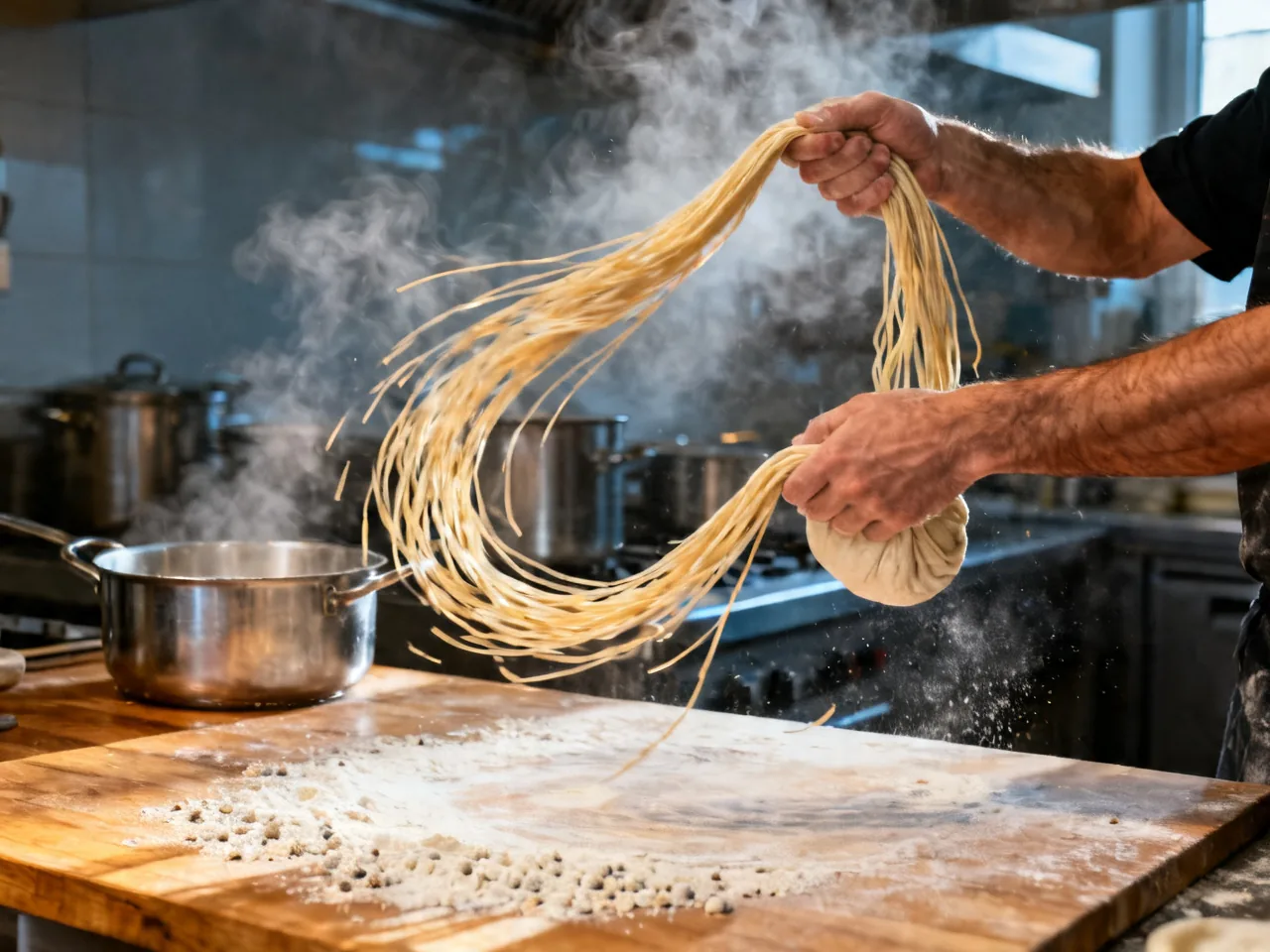
Lanzhou beef noodles have an industry standard known as “one clear, two white, three red, four green, five yellow”: clear broth, white radish, red chili oil, green cilantro and garlic shoots, yellow-bright noodles. These five dimensions form the basic framework for judging whether a bowl meets the mark. Any deviation, and a seasoned local will notice immediately.
If Lanzhou’s beef noodles represent precision and speed, Xi’an’s noodle philosophy moves in the opposite direction: thick, bold, unconcerned with delicacy.
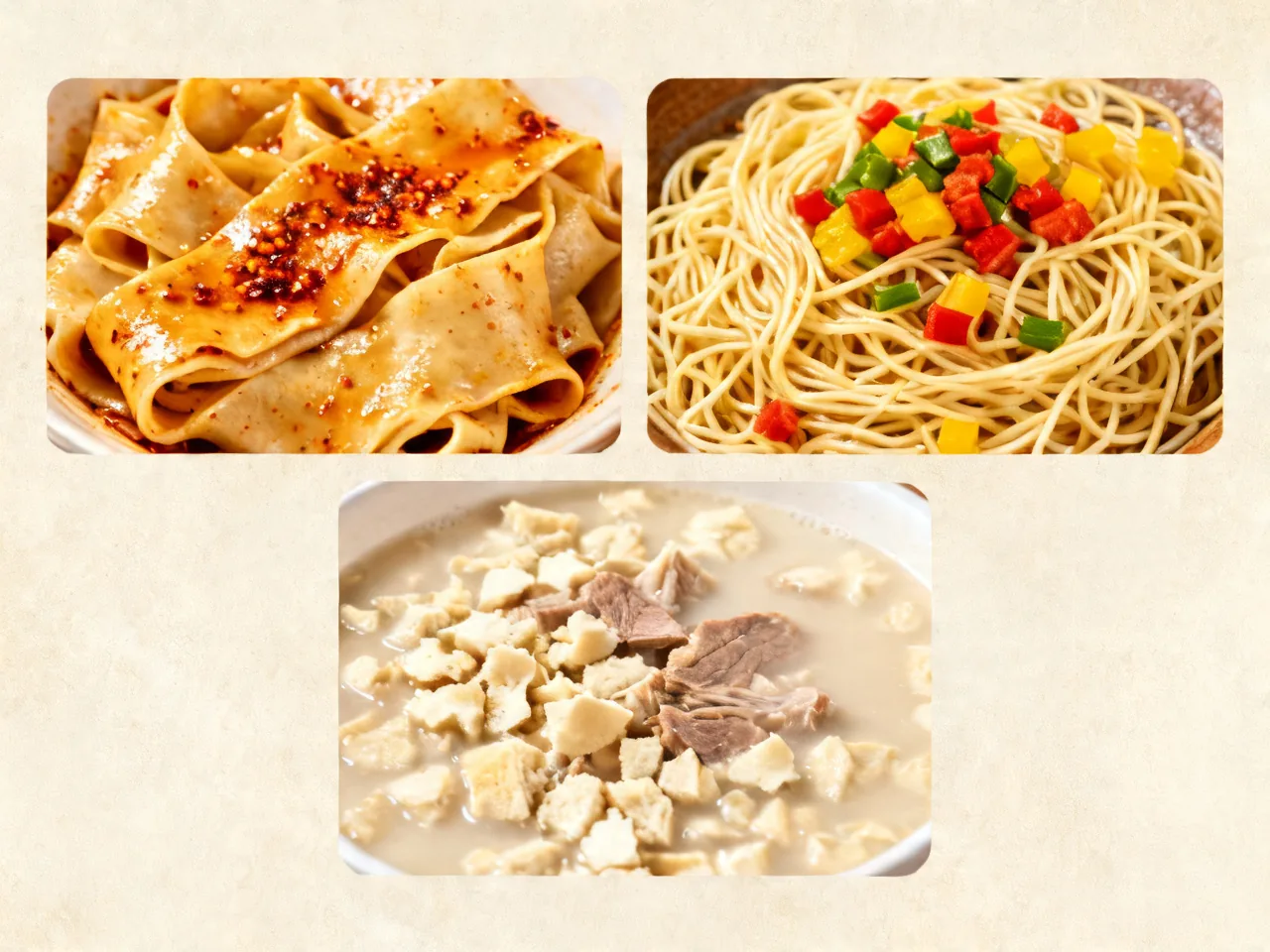
Biang biang noodles are Xi’an’s signature. The noodles are as wide as a belt, long enough to drape over a knee, served in a large bowl with scalding oil-splashed chili poured over the top, then salt, vinegar, and scallions — a sizzling sound, fragrance everywhere. Eating this bowl requires some technique: the noodles are too wide and long to grip cleanly with chopsticks, and many diners use their hands to guide the noodles into their mouths. Chili oil ends up around the lips. Xi’an people don’t mind.
Rou jia mo — meat sandwiched in flatbread — is another unavoidable presence on Xi’an streets. Strictly speaking it isn’t a noodle dish, but its relationship with flour is inseparable: the mo is baked from leavened dough, crisp outside and soft within, split open and stuffed with braised pork — fat and lean interleaved, juices soaking into the bread. Xi’an locals judge a rou jia mo by three simple criteria: the meat must be tender enough, the bread crisp enough, the juices plentiful enough. A good stall can sell several hundred in a day.
Lanzhou beef noodles have traveled the entire country, but Gansu holds many noodle dishes that have never left home. Tianshui’s gua gua is made from buckwheat flour, cut into strips, dressed with chili oil and vinegar — chewy, sour, spicy, a breakfast obsession for locals. Zhangye’s cuo yu mian has dough rolled into small fish shapes, tapered at both ends, cooked in lamb broth — almost no garnish, but the depth of the broth is unforgettable.
These dishes haven’t been franchised or branded. They exist within specific geographic and climatic conditions, tied to local ingredients, water quality, even altitude. Take them away from that land and the taste changes. This isn’t a limitation — it’s the most honest quality of truly local food.
The Northwest’s noodle map grows wider the deeper you go. At the end of one bowl, another begins.
Related Reads
- The 8 Great Cuisines of China
- Spellbound at First Bite: A Stranger’s Descent into Chengdu’s Heat
- Street Steam: The Real Pulse of Chinese Cities
- The Peppercorn Dossier: Sichuan’s Flavor Map Through a Botanist’s Eyes
- 10-Day East China Five-City Loop