Foshan Lion Dance: The Martial World Behind a Lion
Master Huang Said: “You See a Lion. I See a Fist.”
The day I went to Foshan’s Ancestral Temple, I was originally there for the Wong Fei-hung Memorial Museum.
Before I even got through the gate, the drums on the plaza pulled me in. Two lions leaped between steel poles three meters high, a lion head whipped around, eyes blinking twice, mouth opening and closing — the expression alive like a real beast thinking. An old master in a white tank top stood nearby, arms crossed, muttering: “The back leg’s horse stance isn’t low enough.”
I struck up a conversation and learned his surname was Huang — he’d taught lion dance in Nanhai for forty years. What he said stuck with me: “Outsiders watch the spectacle and think it’s dance. Insiders watch the technique — every step is Southern Fist kung fu.”
How a Thousand-Year-Old Evil-Warding Beast Became a Martial Art
Lion dance history goes back further than you’d think.
The earliest records trace back to the Three Kingdoms period, over 1,700 years ago. But lion dance then was more of a court ritual — nothing like what you see on Foshan streets today. The real turning point came in the late Qing Dynasty, when a Foshan man named Wong Fei-hung folded Southern Fist footwork, body mechanics, and power into every lion dance movement.
From then on, lion dance was no longer just “dance” (舞) — it was “martial” (武).
Wong Fei-hung opened his Po Chi Lam clinic in Foshan — treating patients by day, teaching kung fu by night, leading his disciples to dance lions during festivals. His student Lam Sai-wing passed the art down, generation after generation, to the present day. In 2006, Foshan lion dance was inscribed on China’s first National Intangible Cultural Heritage list. One lion, carrying a thousand years of history and a century of martial arts DNA, walked into the twenty-first century.
Southern and Northern Lions: Same Name, Two Species
Someone asked me the difference between Southern and Northern lions. I said it’s like asking the difference between Sichuan and Cantonese cuisine — apart from both being food, nothing’s the same.
Northern lions look like real lions — shaggy fur, usually appearing in male-female pairs, playing with a monk figure holding an embroidered ball. Watching Northern lions is like watching a circus — lighthearted, fun for the whole family.
Southern lions are an entirely different creature. The head is massive and ornate, a mirror embedded in the forehead (said to reflect and repel evil spirits), horn rising high, eyes and mouth fully articulated. Two people inside — the front controls the head, the back supports the body — coordinated like a single being. Southern lions don’t do cute. Southern lions have attitude.
Southern lions come in three “personalities,” named after Three Kingdoms heroes: Liu Bei lion (yellow with white beard — steady and dignified), Guan Gong lion (red with black beard — loyal and fierce), Zhang Fei lion (black with black beard — savage and explosive). The color tells you which character is performing today.
Cai Qing: The “Crime” Triggered by a Head of Lettuce
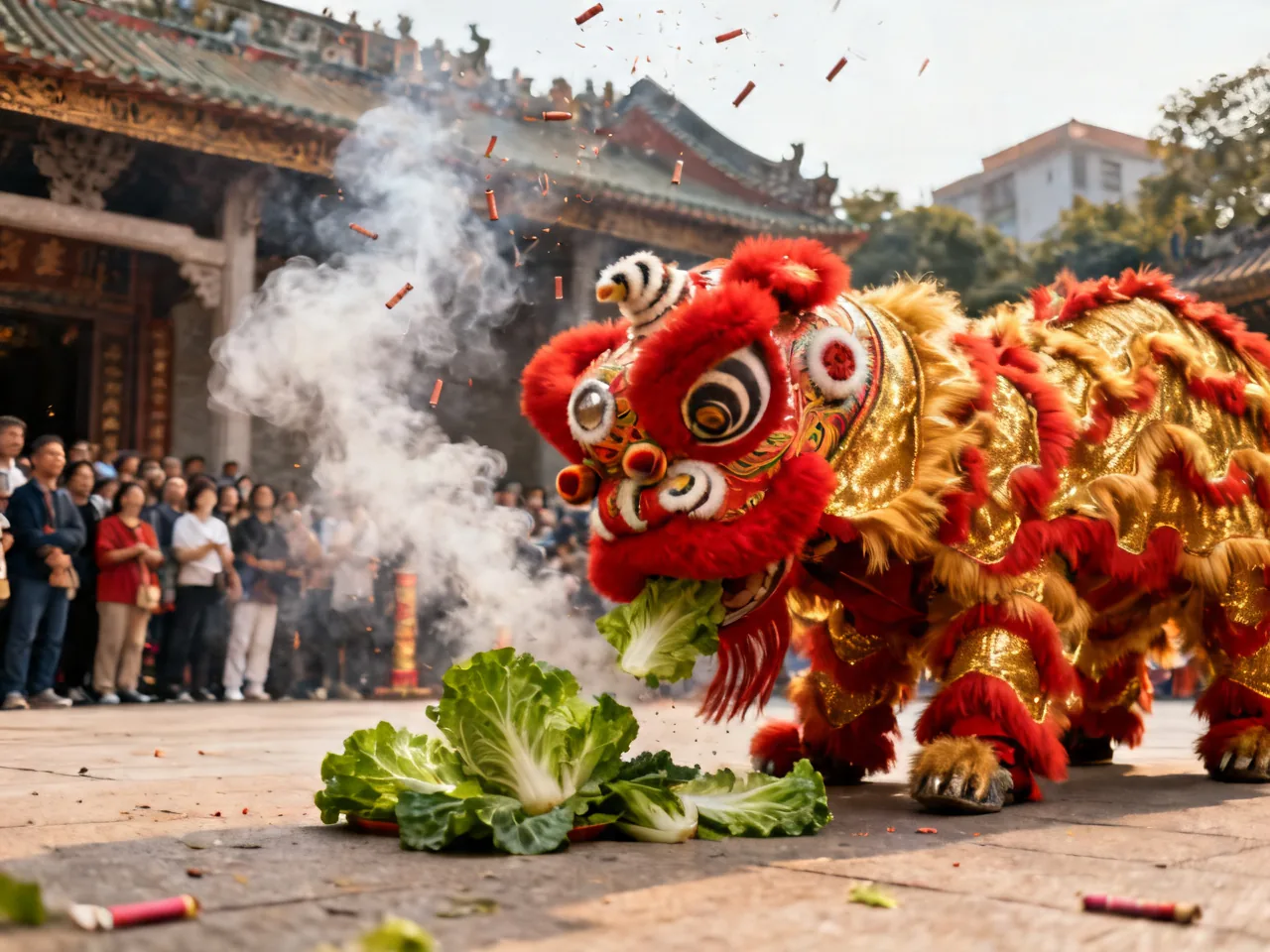
The climax of every lion dance performance is a ritual called “cai qing” — plucking the greens.
A head of lettuce hangs high, stuffed with a red envelope of money. The lion must go through an entire “plot” to reach it: first sleeping, then startled awake by drums, looking around, spotting the prize, hesitating and testing, finally lunging to seize it — then chewing the lettuce and spitting it out, shredded leaves flying everywhere, symbolizing “generating wealth” (生菜 sounds like 生财).
This isn’t just a couple of casual chews. In a good cai qing, the lion’s expressions must have layers — confusion, curiosity, greed, fear, determination — all conveyed by the lead dancer’s hands controlling the eyes and mouth. Master Huang told me: “Whether a cai qing is good doesn’t depend on the moves — it depends on the ‘drama.’ The lion must have drama.”
Gao Zhuang: Flying on Three-Meter Steel Poles
If cai qing is the soul of lion dance, then gao zhuang (high poles) is its adrenaline.
Over twenty steel poles, the tallest three meters, the shortest one meter, spaced unevenly. Two people carrying a lion weighing dozens of jin leap, spin, split, and balance on one foot atop the poles — completing the cai qing on the highest one. One mistake means a three-meter fall.
High-pole lion dance developed in Malaysian Chinese communities in the 1990s, then was brought back and pushed to extremes by Foshan troupes. Today’s international competition pole formations are difficult enough to make your palms sweat just watching. Malaysia’s Kun Seng Keng troupe has won multiple world championships, but Foshan Nanhai teams have been closing the gap in recent years.
2024: Lions Went Viral — and to the Olympics
2024 was the year lion dance “broke out” of its niche.
An all-female lion dance team from Guangzhou Sport University went viral on Douyin — 500 million views. The women in traditional costumes completed high-difficulty pole maneuvers previously attempted only by male teams. The top comment read: “Who said lion dance is a man’s thing?”
That same year, a Foshan lion dance troupe was invited to perform at Paris Olympics cultural events. A Chinese lion, plucking greens against the backdrop of the Eiffel Tower — no matter how you look at it, it feels like the ending of a movie.
And one story that had me laughing for half a day: a young Foshan man hid an engagement ring in the lettuce during a competition’s cai qing. What the lion “spat out” wasn’t shredded leaves — it was a diamond ring. 200 million views on Weibo. She said yes.
Go to Foshan, Watch a Real Lion Dance
Li Bai wrote “I throw back my head laughing and stride out the door.” I think that perfectly describes how you feel after watching a great lion dance performance.
If you can only go to one place, go to Foshan Ancestral Temple. The Wong Fei-hung Memorial Museum is inside, with daily lion dance performances and exhibitions of lion heads through the ages. One ticket covers history, martial arts, and lion dance.
For a deeper experience, Nanhai has a lion dance training center offering half-day immersive courses — teaching basic footwork, letting you try on a lion head (heavier than you’d imagine), and showing you the three-star drum pattern. I tried it. The moment the lion head went on, my vision narrowed to a tiny hole, all I could hear was my own breathing — then the drums hit, and I forgot everything, just wanting to move with the rhythm.
Spring Festival is the best time. During Spring Festival 2025, over a hundred lions paraded simultaneously on Zumiao Road, drums shaking every window on the street. But even outside Spring Festival — Mid-Autumn, National Day, even ordinary weekends — you might catch a lion dance at the Ancestral Temple plaza.
Master Huang left me with one last line: “The lion is fake. The kung fu is real. Remember that and you’re good.”
I remembered.
Related Reads
- Spring Bloom Map: China’s Most Beautiful Flower Fields
- Summer Escapes: Plateaus & Islands
- Huangshan Sea of Clouds & Welcome Pine: Beautiful in All Seasons
- Best Autumn Foliage Spots in China
- 10-Day East China Five-City Loop