Seafood Rice Beside a Ningbo Pier Was Not Something the Menu Taught Me
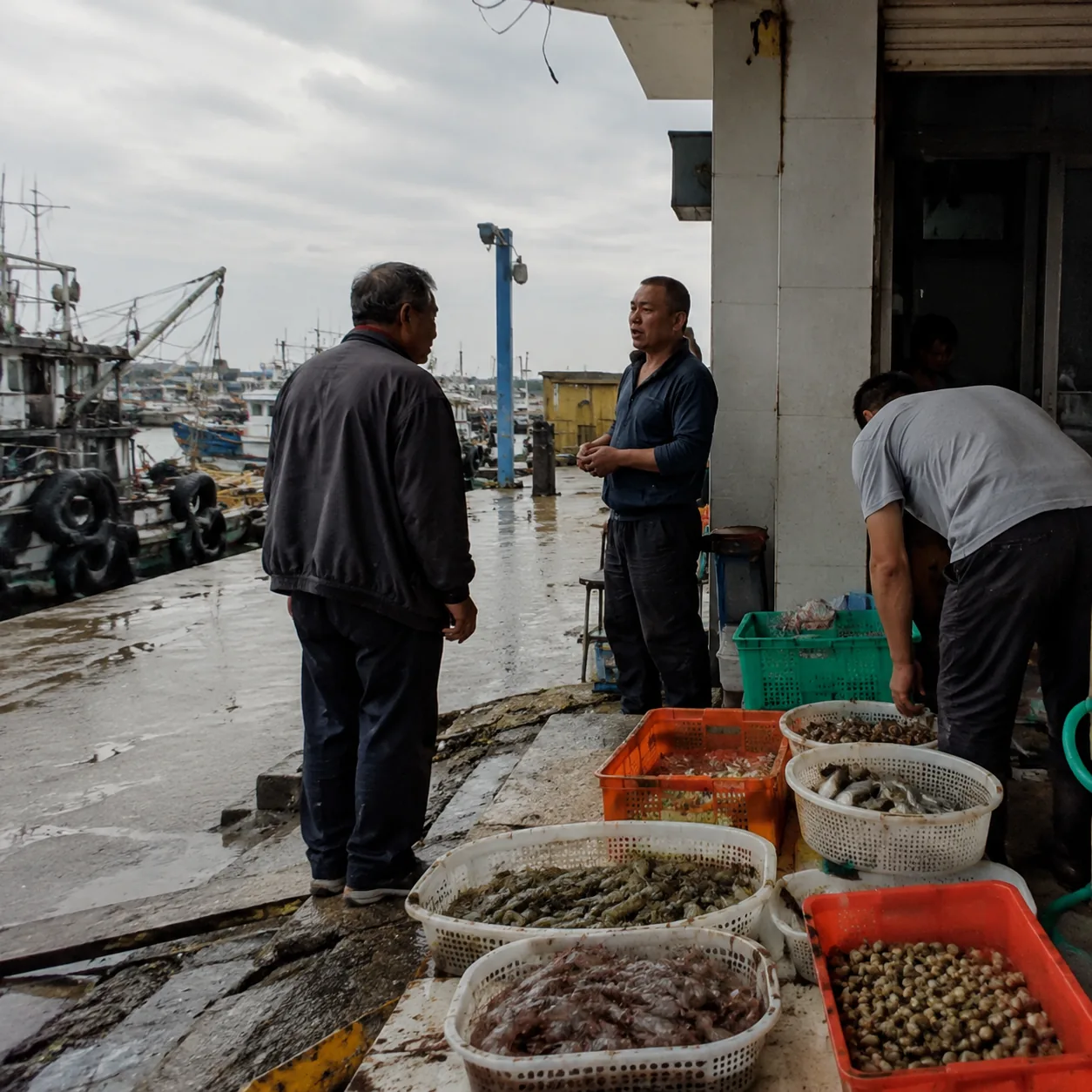
When I arrived in Ningbo that afternoon, the rain had just stopped, and the water beside the pier still carried gray wrinkles. Wind came through the gaps between boats, smelling of salt, diesel, and wet wood. A friend said there was a small place nearby that made seafood rice. The menu was simple, he told me, but it was better not to stare only at it. I did not understand at first and thought he simply meant I should check what was fresh that day. Only when I stood at the doorway, saw shrimp, clams, and small yellow croaker still dripping in plastic baskets, and heard the owner bargaining with people from a fishing boat a few steps away did I realize that the first line of this meal was written outside the menu.
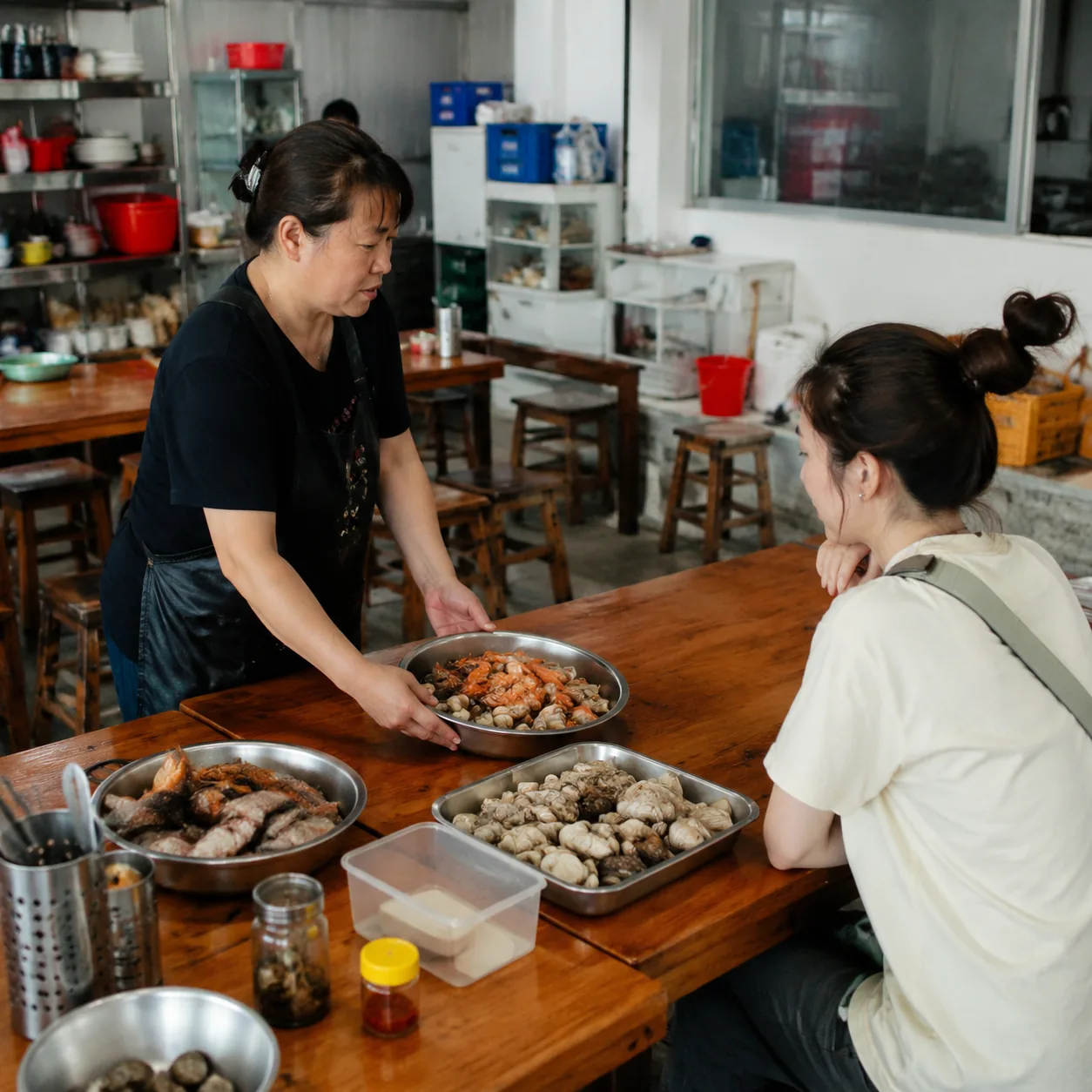
Inside, there were two long tables, a few low stools, and a handwritten price list on the wall. What they called seafood rice was not a dish fixed like a formula. The owner asked how many people were eating, whether I could take scallion and ginger, whether I wanted it soupy or drier, and roughly how much I wanted to spend. I had been ready to say, “give me the signature one,” but those questions stopped the words. The menu listed shrimp rice, crab rice, clam rice, and mixed seafood rice, all seemingly clear. Yet once ordering began, choice became a matter of the scene itself: what was lively today, what was fat, what suited rice, and what was expensive but not necessarily worth it. At that moment I realized that beside a pier, ordering does not begin with dish names. It begins with the day’s seawater.
The owner led me to the baskets by the door, as if showing me a blackboard that kept changing. He lifted a few shrimp whose whiskers were still trembling. He opened a basket of clams and said this batch had cleaned out their sand well, good for making a broth base. The small yellow croaker were not large, but their eyes were bright and the meat would be sweet. Swimming crab had just passed its fattest moment; he could cook it if I wanted, but in rice it might not be as worthwhile as steaming it plain. He did not speak slowly, yet every sentence carried judgment. As I listened, I felt less like a customer choosing ingredients and more like a student attending a lesson on tide, season, and wok heat. The textbook hung on the wall, but the real content lay in the baskets.
In the end I ordered seafood rice with clams, shrimp, and small yellow croaker. The owner suggested a soupy version because the wind after rain was cool and the clams would make a good base. He did not simply mix rice and seafood together. First he put ginger slices and the white parts of scallions into the wok. When the oil began to speak, he added the small fish and seared them briefly, then poured in water to draw out a foundation of flavor. When the clams entered, their shells opened one by one like tiny doors. The shrimp went in last, turning from blue-gray to orange-red so quickly that there was no time to look away. When rice was poured into the broth, the sound in the wok softened, and the seafood’s freshness seemed to be caught by each grain.
I sat near the door and could see people moving goods back and forth on the pier. Some wore rain boots and stacked empty baskets high. Some crouched beside boats to rinse decks. An auntie on an electric scooter stopped to ask whether there were any cheap small mixed fish that day. The shop did not deliberately create a seaside atmosphere, because the atmosphere was already pouring in through the entrance. Wind slapped the plastic door curtain against the frame, steam from the wok ran outward, and damp air from outside moved in. A place like this did not need to be decorated as a “seafood theme.” It was already only a few steps upstream from the seafood, and every sound was still wet from landing.
When the seafood rice arrived, the bowl was deeper than I had expected. Scallions floated on the surface, shrimp backs curved into red arcs, small yellow croaker lay half-buried among the grains, and clam shells opened like breathing spaces left for the bowl. I tasted the broth first. The freshness came quickly, but it did not shove itself forward. There was the clean sweetness of shellfish, the depth drawn from fish bones, and ginger holding down any fishiness without stealing attention. The rice had absorbed the broth, soft at the edges while keeping a little shape at the center. The shrimp was firm and springy; the fish had fine bones that reminded me not to eat as impatiently as fast food. From the first bite, the bowl asked me to slow down.

At the next table sat three local diners who ordered with far more ease than I did. They did not look at the menu on the wall. They simply asked, “What is good today?” The owner named several things, and they decided quickly: one wanted razor clam fried rice, one wanted rice in broth, and one wanted small mixed fish fried separately. It sounded casual, but each choice matched experience. Razor clam fried rice needed fast heat and grains that were not wet. Rice in broth needed a fresh base and suited cooler weather. Small mixed fish were better fried separately because they would break apart too easily in rice and taste better on their own. Listening beside them, I found this more specific than any guide. The menu told me what existed; regulars told me how to judge.
I asked the owner why he did not write all of this in more detail. He laughed and said it could not be fully written, and even if written, it would not stay accurate. Seafood was not the same every day, and customers did not want the same texture every day either. People in a hurry suited a drier stir-fry. Those with elderly family members or children were safer with soupy rice. Those who came for freshness should have more shellfish. Those who wanted a meaty bite could switch to fish chunks or crab. A dish name on paper could only provide an entrance. Real ordering had to consider the person, the catch, the weather, and the wok. That answer helped me understand the rules of pier-side restaurants: they are not refusing standardization; standardization simply cannot keep up with change.
Halfway through, I found that the bowl’s layers did not come from complicated seasoning, but from the order in which ingredients entered the wok. The fish was seared first, so the broth had a faint roasted base. The clams went in midway, opening their freshness without becoming tough. The shrimp entered last, keeping its bounce. The rice finished the process, gathering all previous flavors together again. If that order were reversed, the result would become a different bowl. Many people talk about seafood only in terms of freshness, but freshness is only the starting point. What truly decides whether a bowl of rice is good is how the cook lets different kinds of freshness keep their own edges while finally becoming one whole.
The meal also made me see Ningbo’s flavor again. I had heard people describe Ningbo food as salty-fresh, but in my mind only the word salty remained, like a label too rough to be useful. Sitting beside the pier with seafood rice, I learned that salty-fresh is not about using a heavy hand with salt. It is about giving the taste of the sea support. Salt here is like a line tying shellfish, fish, shrimp, rice, ginger, and scallion together. Without it, freshness scatters; with too much, it covers every detail. The precision of Ningbo taste lies in the tension of that line. It is neither bland nor rough, but a measure gained from living close to the sea for a long time.
A young fisherman came in from outside, his trouser cuffs still wet, and asked whether there was any rice left. The owner served him a bowl of seafood rice without much concern for appearance: fewer shrimp, more broth, and two pieces of fried fish placed on top. He carried it to a corner and ate quickly with almost no words. That scene pulled me out of the posture of “tasting.” For me, the bowl was a discovery during travel. For him, it may have been something that let his stomach settle after work. The same pot of rice could be slowly analyzed by a visitor and urgently needed by someone who labored there. Food beside a pier is like that: it carries flavor on one side and physical strength on the other.
I kept eating and began to understand why my friend had told me not to look only at the menu. A menu is useful for reassuring strangers; it organizes the unknown into selectable items. But the most interesting part of seafood rice beside a pier lies precisely in instability. How long ago the rain stopped, what time the boat came in, how the water temperature had been, which basket was selling quickly, whether the cook was willing to advise you against ordering something expensive, and how regulars combined ingredients could all change the bowl you finally received. If you only ordered from the menu, took a photo, paid, and left, you would miss the most living part of the meal. It was not a hidden menu; it was a living menu.
Near the end, the grains had absorbed a deeper flavor. At the bottom of the bowl were tiny bits of fish and clam juice; when the spoon passed through, the freshness became more concentrated than before. I suddenly thought that seafood rice does not try to make every bite identical. The first bite is the opening of broth, the middle carries the presence of shrimp and fish, and the ending lets rice collect all the small fragments. It resembles a reduced version of a day at the pier: boats arrive, goods come up, people bargain, baskets move away, and a little water and fish scale remain on the ground until wind dries them. The bottom of the bowl is not leftover. It is the echo of the whole meal.
When I paid, the owner asked whether the flavor had been enough. I said it had, and that it was more complicated than it looked on the menu. He waved his hand and said it was not complicated; the ingredients just had to be right. I knew there was both a craftsperson’s modesty and a hard standard inside that sentence. “Right ingredients” does not mean buying some seafood at random. It includes knowing the catch, handling it, controlling heat, pairing textures, and knowing when not to add more seasoning, when to suggest another method to a customer, and when to let rice rather than seafood take the final position. Mature experience often speaks this lightly, as if everything were obvious, while many failures and corrections sit behind it.
When I walked out, the sky over the pier had turned from gray toward blue, and the water had brightened a little. Someone rinsed empty baskets and placed them upside down by the wall. A cat slipped past a coil of rope and stared at fish scales on the ground. In the distance, the engines of boats sounded in broken intervals. A little sweetness from shellfish and warmth from ginger remained in my mouth. That seafood rice did not give me a repeatable ordering template; instead, it made me give up the template. Next time I come, I may eat a completely different bowl: more razor clams, less crab, a whiter broth, drier rice, perhaps a different price. But as long as I am willing to stand beside the baskets and listen, it will still teach me.
Later I thought that the ability to order while traveling is not about memorizing a few famous dishes. It is about admitting that you know nothing about the scene and then letting the scene speak slowly. What that bowl of seafood rice beside a Ningbo pier taught me was not which version I should order, but how I should ask. Ask what came ashore today, what suits rice, whether one person will be ordering too much, and whether a good ingredient might be better cooked another way. A good shop does not fear questions, and good food can withstand that back-and-forth. The menu gives strangers a safety net, while the scene opens that net and lets you see how wind, tide, boats, wok, and human judgment fall together into one bowl of rice.
So what I remembered was not the few lines of dish names on the wall, but the time spent standing at the door before ordering. The owner turned over plastic baskets, shrimp whiskers trembled lightly, clam shells clicked against one another, the eyes of small yellow croaker reflected the post-rain sky, and a regular nearby added, “that one is good today.” During those minutes, the rice had not yet entered the wok, but the flavor had already begun to form. Ningbo’s seafood rice was not something the menu taught me. It was taught by the pier, the weather, regular diners, the owner, and a wok of rising steam together. It made me understand that food truly close to the sea is sometimes in no hurry to be written down; it happens first by the water, and only afterward is it served in a bowl.