At 6:30 a.m. in a Chongqing Noodle Shop, a Bowl of Wanza Mian Explained the City
At 6:30 in the morning, the chili oil in a Chongqing alley woke up before the city did. I had not even reached the shopfront when the smell of Sichuan pepper, pork fat, and fresh noodle broth had already grabbed me by the nose. The air on the slope carried a bit of river dampness. The rolling shutter was only half open, and inside someone was already shouting orders: “Er liang wanza, extra greens! Small vegetarian bowl, mild! One red-oil wonton out first!” I slipped into the queue by scent alone, the soles of my shoes still carrying the moisture of the bluestone pavement below my guesthouse.
The shop had no polished facade—just a sign darkened at the edges by years of oil smoke, a few low tables, a pot of broth that never stopped rolling, and the kind of morning efficiency that says, if you want to eat, decide quickly. I had intended to study the menu with fake composure, but the auntie in front of me turned around, sized me up once, and asked, “First time here?” I nodded. She looked like someone who had seen too many hesitant out-of-towners and made half the decision for me: “Wanza noodles. Start there. Safest choice.”
The line moved fast. Beside the cashier stood plastic baskets filled with raw garlic, cilantro, scallions, and small packets of pickled mustard greens. The red-paper menu on the wall had curled at the edges from steam. In the back, the cook dropped handful after handful of noodles into the boiling water, each flick of his wrist sending down a white rain of strands. At ordering time, the owner gave me exactly two seconds: “How many liang? How spicy?” My brain was not fully awake yet, so I copied the people ahead of me and answered, “Two liang, regular spice.” The young guy behind me laughed. “Good. That’s how breakfast should start.”
A Chongqing breakfast queue explains a lot about the city. Some people come down in slippers for their first bowl of the day. Some wait with laptop bags on their shoulders and one eye on their phones. Construction workers stand there with traces of dust that yesterday never fully washed off their hands. Retired uncles arrive after morning exercise with towels over their necks and such familiarity with the owner that they do not need complete sentences. Everyone is in a hurry, but not a cold kind of hurry. The speed here comes with steam, shouted orders, teasing between regulars, and the solid rhythm of chopsticks tapping bowls.
I did not wait long before my bowl arrived. The bowl itself was sturdy, its rim carrying the fine old marks of years of hot broth. At first glance the surface looked less violently red than I expected. The chili oil sat lower down, restrained on top by the yellow of the stewed peas, the brown of the minced meat topping, and the green of the vegetables. The peas had cooked down into near softness, almost dissolving; the minced topping shone with oil in tiny granules; the noodles hid beneath. The rising steam pushed the fragrance of Sichuan pepper and sauce straight into my face. Before I even lifted my chopsticks, my glasses had already fogged.
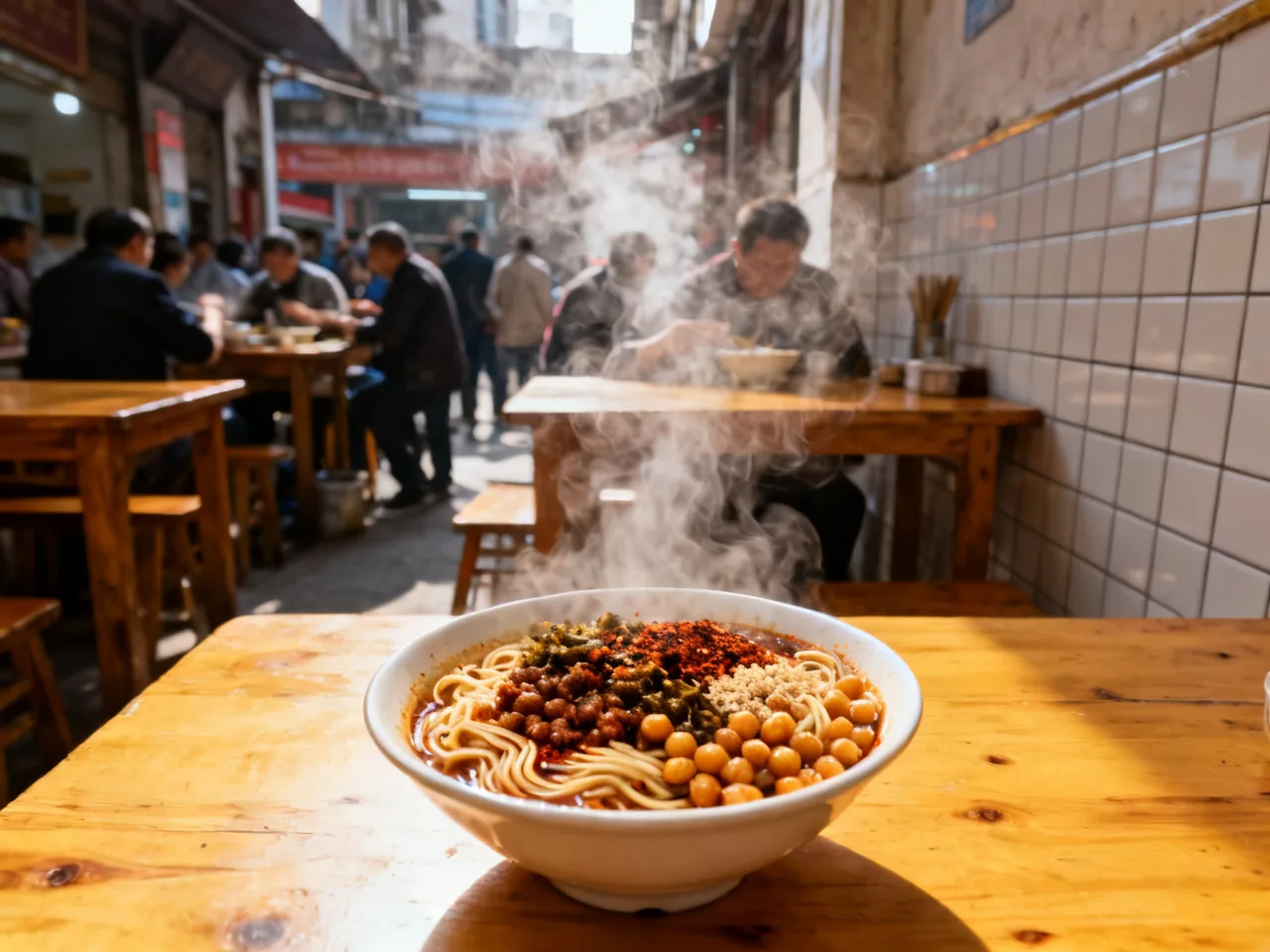
The first bite should not be rushed. As the owner’s wife walked past and saw me preparing to stir everything together, she immediately warned, “Eat the top first, then lift from the bottom.” I pulled back my hand and followed instructions. First came a spoonful of peas, soft as porridge fresh off the morning boil but carrying the deep thickness of beans. Then a bit of minced topping, salty and fragrant with a faint sweetness underneath. Only when my chopsticks finally reached the bottom and brought up noodles coated in chili oil did the flavor turn fully dimensional: the numbing note touched the tip of the tongue first, the heat rose right after it, and finally the taste of flour and meat held the whole mouth together.
I had eaten noodles in other cities before, but the brilliance of Chongqing noodles lies not in a single note of heat. It lies in how the layers push through in quick succession. Just when the Sichuan pepper seems to dominate, the warmth of the peas presses it back down. Just when the minced topping feels as if it may become too oily, a bite of greens restores freshness. Stainless steel spoons crack lightly against the bottoms of bowls, people around me slurp with astonishing speed, engines from motorbikes climbing the slope outside give off a muffled growl, and somewhere near the doorway I can still smell sweet potatoes heating over a gas flame. The whole shop feels like a many-voiced ensemble playing at once.
Halfway through the bowl, the auntie who had recommended wanza noodles to me earlier came and sat nearby with her own breakfast. She asked whether I could handle it. I told her it went down even better than I had imagined. She gave a satisfied smile and said she came every single day; if she missed one morning, it felt as though she had failed to complete a proper task. She taught me that if the heat begins creeping upward too strongly, I should not rush for iced soy milk. Instead I should sip a little broth first, then eat a bite of peas, and the mouth would balance itself again. As she spoke, she casually pushed the extra cilantro in her bowl to one side with the practiced motion of someone arranging a daily order.
Much food in Chongqing carries this same character of “fierce first, steady afterward.” At first encounter, the aroma and heat startle you. But once you sit down, you realize they are not attacking; they are telling you quickly how this city speaks: many hills, heavy fog, hurried people, yet not narrow-hearted. Later I thought about how different that felt from breakfasts elsewhere. Cantonese morning tea asks you to settle in slowly, while Xi’an roujiamo belongs to a life of biting as you walk. This bowl of wanza noodles belongs to the morning of a city built on slopes, a life that needs the body lit up immediately.
If you want to place this meal into a wider travel understanding, the nighttime logic of food in Chongqing and other cities can be compared with Late-night food map. And if you want a completely different breakfast or midday food rhythm to compare against, the Guangzhou piece Cantonese dim sum for two is useful to hold in mind alongside it. To understand how food and commuting intertwine in Chinese cities more broadly, Chinese city commuting choices also helps you see “where to eat” and “how to get there” as one travel decision.
The people in the shop changed wave after wave, yet the rhythm slowly shifted from fast to slow. The earliest office-bound crowd finished in five or six minutes and left; later arrivals began to linger and talk. Some added a fried egg. Some ordered another bowl of wontons. Behind the steam the owner kept calling tickets without losing his voice. I, too, stopped eating like someone in a race. I lifted the noodles and watched the chili oil slide back toward the bottom of the bowl, watched the peas loosen gently across the back of the spoon. The feeling that had first pushed me inward by sheer aroma gradually turned into a quieter one: sitting inside the city and listening to it speak.
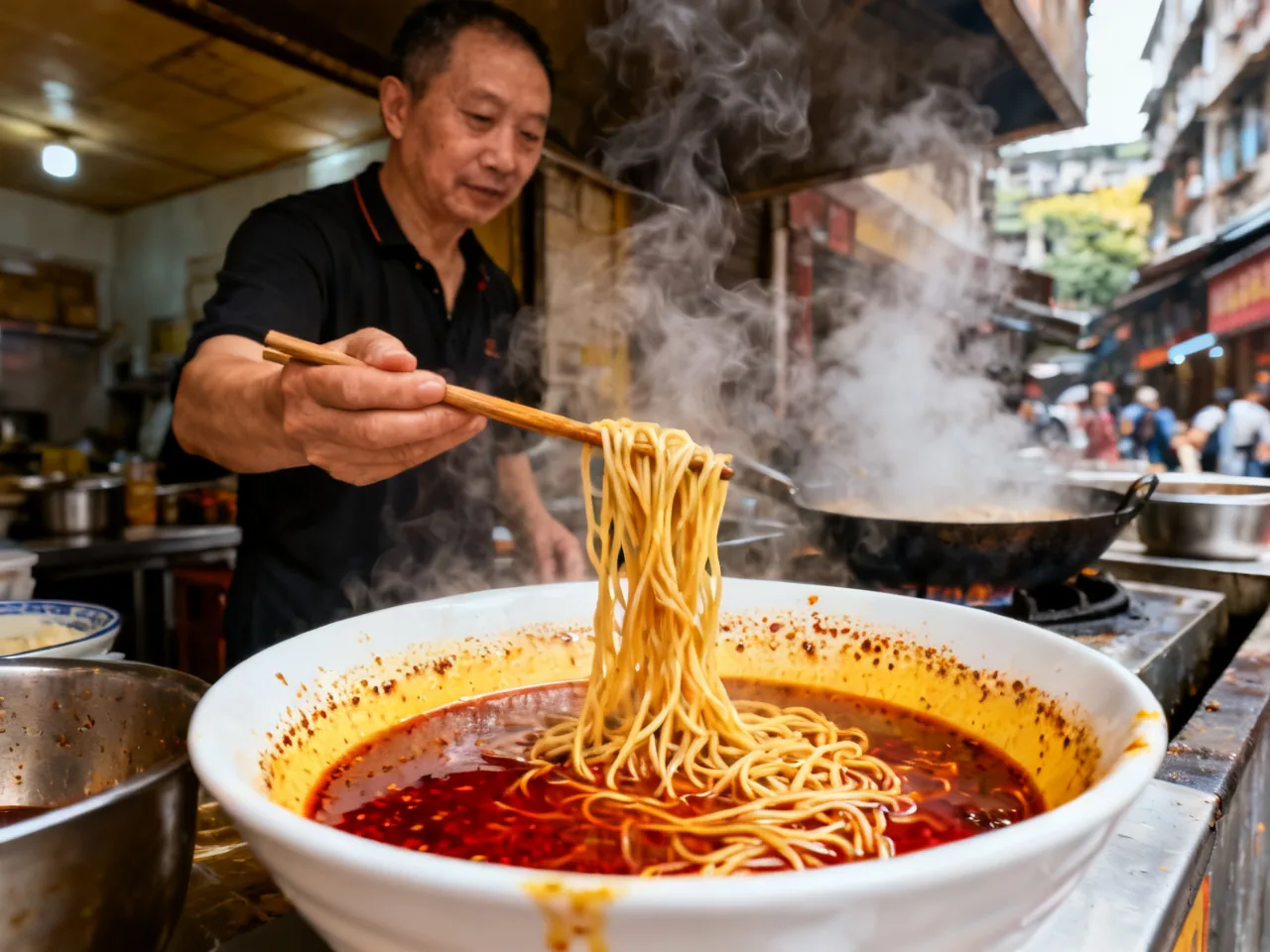
By the time I finished the last bite, the sky outside had fully brightened. Down the slope came the hiss of a bus pulling into a stop, and several schoolchildren ran past with backpacks bouncing, their shoes making quick slapping sounds on the damp ground. I pushed the empty bowl forward. At the bottom remained only a little red oil and chopped scallion. As the owner’s wife passed by, she glanced at it and smiled. “All right?” she asked. “More than all right,” I said. “I want to come back tomorrow.” She wiped the table briskly and set down the next pair of chopsticks. The warm smell of pepper and noodle broth was still drifting into the street, and when I stood up and walked out, my tongue still tingled, a light sweat sat on my forehead, and the whole city of Chongqing felt as if it had just introduced itself through a single bowl.